

Ukraine’s Fortress Belt: The Strategic Backbone of a Defensible Eastern Frontline
By Samir Singh 'Bharat': Editor In Chief
 war-times.com
Send an email
18 April 2026
war-times.com
Send an email
18 April 2026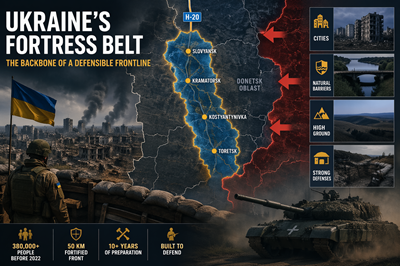
WAR-REPORT : The war between Ukraine and Russia has made clear that geography remains one of the most decisive factors in modern warfare. In eastern Ukraine, a highly fortified defensive zone known as the Fortress Belt has emerged as a central element in maintaining a stable and defensible frontline. Located in Donetsk Oblast, this belt represents years of preparation, strategic planning, and adaptation to evolving military threats.
The Fortress Belt is not a simple defensive line. It is a deeply layered system built around major urban centers, supported by natural terrain features and reinforced by extensive fortifications. Over more than a decade, Ukraine has transformed this area into a strong defensive network capable of resisting sustained attacks. Its importance extends beyond immediate battlefield concerns and plays a critical role in shaping long term strategic outcomes.
The Geography and Structure of the Fortress Belt
The Fortress Belt extends approximately fifty kilometers along a north to south axis, following the H-20 highway that connects important cities such as Kostyantynivka and Slovyansk. This corridor includes four major cities and several surrounding settlements, forming a continuous defensive zone. Before the large scale invasion in 2022, this region had a population of more than three hundred eighty thousand people.
The strategic value of this area lies in its combination of urban density and favorable terrain. The cities provide strong defensive positions, while the surrounding geography enhances their effectiveness. Together, these elements create a system that is difficult for attacking forces to overcome.
Long Term Preparation and Development
Since 2014, Ukraine has invested significant effort in strengthening this defensive belt. The experience gained from earlier phases of the conflict allowed for careful planning and gradual improvement of defensive positions. Over time, trenches, bunkers, and anti tank obstacles were constructed and integrated into the landscape.

These defenses are connected by a network of roads and railways that allow for rapid movement of troops and supplies. This ensures that the defensive system is not static but can respond to changing battlefield conditions. The result is a layered defense that can absorb pressure and slow down enemy advances.
Key Elements of Terrain Advantage
The strength of the Fortress Belt can be understood through four main factors: urban development, water features, elevation, and prepared defenses.
Urban Development
Urban areas provide natural protection for defending forces. Buildings offer cover from enemy fire, while narrow streets and complex layouts limit the movement of attacking units. Industrial zones can be converted into strong defensive positions that are difficult to capture.

This environment favors defenders by reducing the effectiveness of heavy weapons and making it harder for attackers to coordinate large scale operations.
Water Features
Rivers, canals, and reservoirs act as natural barriers that restrict movement and channel advancing forces into predictable paths. These features can be used to slow down attacks and create opportunities for defensive actions.
Bridges and crossing points become critical locations that can be heavily defended or destroyed to prevent enemy access.
Elevation and Slope
Even small changes in elevation can provide significant advantages in combat. Higher ground offers better visibility and more effective firing positions. Defensive positions placed on slopes or elevated areas can control surrounding terrain and limit enemy movement.
Prepared Fortifications
The Fortress Belt includes a wide range of defensive structures such as trenches, bunkers, and anti tank barriers. These fortifications have been built over many years and are designed to withstand heavy attacks.
Their integration with natural terrain features creates a strong and resilient defensive system that is difficult to break.
Strategic Importance
The Fortress Belt is essential for maintaining a stable frontline in eastern Ukraine. By holding this line, Ukraine can prevent enemy forces from advancing into areas that are less suitable for defense. This helps protect key cities and infrastructure while maintaining supply lines.
If the Fortress Belt were lost, the frontline would shift into open terrain with fewer natural advantages. This would make it much harder to defend and could lead to further territorial losses.
International Significance
The importance of the Fortress Belt is also recognized by international partners, including the United States. Efforts to reach a peaceful resolution to the conflict depend in part on the existence of a stable and defensible frontline.
A strong defensive position reduces the risk of renewed attacks and supports the possibility of a lasting agreement. Without such a position, any peace arrangement could remain unstable.
Risks and Challenges
Despite its strengths, the Fortress Belt faces ongoing challenges. Continuous attacks, resource limitations, and changing military tactics can put pressure on the defensive system. A breakthrough in any part of the belt could weaken the entire line and force a withdrawal.
Maintaining this defense requires sustained support, including equipment, supplies, and coordination. Without these, even well prepared defenses can become vulnerable.
Our Media Opinion
Ukraine’s Fortress Belt is one of the most important defensive systems in the current conflict. Built over many years, it combines urban environments, natural terrain, and strong fortifications into an effective defensive network.
Its role in maintaining a stable frontline makes it a key factor in the outcome of the war. As the situation continues to evolve, the ability to hold this belt will remain critical for Ukraine’s defense and for the broader stability of the region.
war-times.com
Send an email
18 April 2026