

Journalism in Crisis: More Media Outlets, Less Journalism; More Reporters, Less Credibility
Newspapers, digital channels and self-proclaimed reporters are multiplying, but independent reporting, professional accountability and public trust are increasingly under pressure. Unpaid journalists, attacks on reporters, political influence and growing hostility between media professionals and officials expose deeper structural weaknesses.

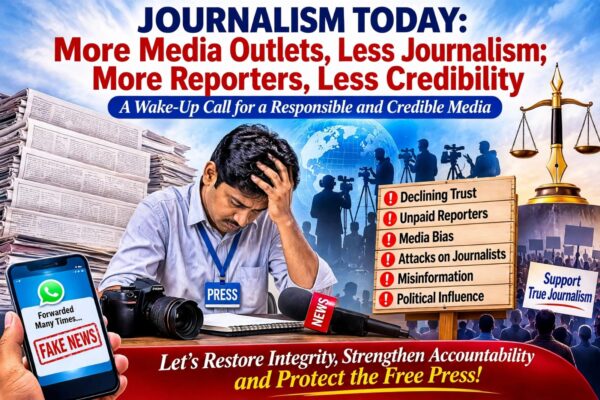
SPECIAL ANALYSIS: Doruvu Paul Jagan Babu – Assistant Chief Editor: Journalism today presents a striking contradiction. Newspapers, television channels, YouTube platforms and social media news outlets are multiplying, yet credible, independent and investigative reporting appears to be struggling to maintain its place.
Andhra Pradesh and Telangana offer a revealing example. Thousands of registered Telugu publications coexist with numerous digital platforms and local news channels. However, the increasing number of media outlets does not necessarily translate into more meaningful journalism.
The fundamental distinction is between establishing a media outlet and practising journalism. Starting a newspaper, YouTube channel or social media news page has become relatively easy. Sustaining a professional newsroom, employing trained reporters and investing in independent verification remain considerably more difficult.
This contradiction is not confined to Telugu states. Across the world, traditional media organisations are confronting declining advertising revenues, shrinking newsrooms and growing competition from digital platforms.
The global crisis: More news consumption, fewer reporting resources

The digital revolution has expanded access to information, but it has disrupted the economic foundations that traditionally supported journalism.
Advertising revenue has increasingly shifted towards technology platforms such as Google and Meta. Many newspapers have consequently reduced their workforce, closed local editions or discontinued publications.
The disappearance of local newsrooms has serious implications. Coverage of municipal administration, public expenditure, schools, hospitals, courts and grassroots governance often suffers when experienced reporters are no longer available.

Digital newsletters, independent journalists and nonprofit news organisations are attempting to fill some of these gaps. Nevertheless, their financial sustainability and reporting capacity remain challenges.
The crisis, therefore, is not necessarily a shortage of information. It is a shortage of resources and institutional commitment to gather, verify and publish reliable information.
Telugu journalism: Political perceptions and WhatsApp newsroom
In Andhra Pradesh and Telangana, political affiliations and ownership interests have become important subjects of public debate concerning media credibility.
Major publications and television channels are frequently perceived as favouring particular political or business interests. While media owners have editorial freedom, readers increasingly question whether political considerations influence news selection, presentation and interpretation.
Consequently, the same incident may receive sharply different treatment across competing media organisations.
Meanwhile, WhatsApp groups, forwarded videos, screenshots and voice messages have become informal newsrooms, particularly in towns and villages.
Their advantages include speed and grassroots participation. Their weaknesses include the absence of systematic verification, editorial scrutiny and correction mechanisms.
A message does not become factual merely because hundreds of people forward it. Yet the pressure to publish first often overshadows the responsibility to establish what actually happened.
The unpaid reporter: Journalism without financial security
One of the most neglected dimensions of the crisis is the condition of local reporters, particularly stringers and freelance journalists.
Many district- and mandal-level reporters work without regular salaries, written appointment orders, insurance, travel allowances or other basic professional support.
Some receive payments according to the number or size of published stories, while others depend on occasional payments that may be delayed. This creates a serious contradiction: reporters are expected to investigate public issues, question powerful institutions and expose wrongdoing, but many lack the financial security required to perform those responsibilities independently.
Three consequences are particularly damaging:
Dependence: Reporters seek alternative income through advertising collection, public relations or other activities.
Vulnerability: Financial dependence can expose them to pressure from politicians, business interests and local authorities.
Compromised verification: Investigative reporting requires time, travel, documents and resources. Reproducing a press release or forwarding a WhatsApp message is considerably easier.
This is not simply an individual ethical failure. It is also an institutional problem. A profession expected to protect public accountability must provide its practitioners with reasonable professional security.
Attacks on journalists: Protests must lead to accountability
Physical attacks, intimidation and obstruction of journalists remain serious concerns, particularly when they report on politically sensitive or locally influential subjects.
Coverage of illegal mining, land disputes, public contracts, corruption and electoral irregularities can expose reporters to confrontation and threats.
However, every alleged attack must be investigated objectively, and its motive must be established through evidence rather than assumption.
Another troubling pattern is the response following attacks.
Condemnations, black badges, demonstrations, press conferences and memoranda often dominate the immediate aftermath. But what happens afterwards?
Were cases registered? Were the accused arrested? Did the victim receive medical assistance, legal support or compensation where appropriate? Was the investigation followed through to its logical conclusion?
Journalist organisations deserve recognition for mobilising support and raising their voices. At the same time, their effectiveness should be measured not merely by the number of protests conducted but by the tangible protection and justice secured for affected journalists.
Solidarity must extend beyond photographs and statements.
Journalism’s credibility crisis: When everyone claims to represent the truth
Almost every media organisation claims to stand for truth, justice and public interest. But these expressions have little meaning without a demonstrable commitment to verification.
Truth in journalism must be understood as a process involving:
Authentic documents and identifiable sources.
Verification of facts before publication.
An opportunity for concerned individuals to respond.
Clear separation of factual reporting from opinion.
Corrections when published information is found to be inaccurate.
A reporter’s responsibility is not to confirm an individual’s allegation or promote a particular political narrative. It is to establish what can reasonably be supported by evidence.
Readers, too, have a responsibility. Sharing information that reinforces personal or political preferences without checking its authenticity contributes to misinformation.
At the same time, it would be unfair to dismiss all journalists as irresponsible. Many continue to undertake difficult reporting despite financial insecurity, institutional pressures and personal risks.
The challenge is to create an environment in which professional journalism is rewarded rather than discouraged.
The officer–reporter conflict: Mutual distrust is damaging both institutions
An increasingly visible problem in local administration is the strained relationship between government officials and journalists.
Some officials reportedly complain that several individuals approach their offices carrying microphones, cameras and press identity cards without adequate preparation or knowledge of the subjects they wish to discuss.
They question whether everyone claiming to be a reporter has the professional background, institutional affiliation or journalistic responsibility expected of the profession.
There is another side to the issue.
Genuine reporters often complain that officials refuse to provide information, avoid answering legitimate questions, selectively interact with established media representatives or treat smaller publications with indifference.
In some instances, reporters are allegedly subjected to humiliating remarks such as ‘illiterates’ or ‘useless fellows’.
Such language is unacceptable. Even when a reporter is mistaken or inadequately informed, an official should respond with facts, clarification and appropriate documentary evidence rather than personal insults.
Equally, journalists must recognise that an identity card or microphone does not automatically establish the credibility of a report.
The relationship should be governed by mutual respect, professional preparation and institutional accountability.
The vicious cycle: Unprepared reporting and administrative contempt
The conflict can develop into a damaging cycle:
A reporter approaches an official without sufficient background information.
The official dismisses the questions or responds disrespectfully.
The reporter feels humiliated and becomes increasingly distrustful of the administration.
Unverified information or allegations may subsequently find their way into publication.
The official uses such instances to question the credibility of the entire media fraternity.
Eventually, genuine journalists, irresponsible content creators and individuals misusing press credentials are treated as though they belong to the same category.
This is harmful to both sides.
Officials must understand that journalists have a legitimate role in seeking information about public administration. Journalists, in turn, must understand that asking questions is not a substitute for investigating their subject.
A document, government order, official record or verified response is more valuable than an argument conducted in front of a camera.
Why are more newspapers and channels emerging despite the crisis?
The increasing number of media outlets raises an important question: If journalism is becoming economically difficult, why are new newspapers, channels and digital platforms continuing to emerge?
Several factors help explain this trend.
Low entry barriers: A smartphone, internet connection and basic recording equipment are sufficient to start a digital news platform.
Influence and visibility: Some individuals view media ownership as a means of gaining social recognition, political access or influence over local affairs.
Political and commercial interests: In certain instances, media platforms may serve interests beyond independent news reporting.
Employment difficulties: Young people unable to secure regular media employment increasingly attempt independent reporting and content creation.
Audience preferences: Sensational headlines, confrontational videos and politically charged content often attract immediate attention, while painstaking investigative reporting may receive comparatively little engagement.
Thus, the expansion of media platforms should not automatically be interpreted as the expansion of journalism.
Who is responsible? reporters, managements, governments and readers
The crisis cannot be attributed to one section alone.
Some reporters compromise professional ethics. Some managements fail to provide salaries, appointment orders and adequate working conditions. Some political and administrative institutions attempt to influence media coverage or restrict legitimate scrutiny.
Professional associations, too, must introspect about the standards they maintain while granting membership and representing journalists.
At the same time, readers must learn to distinguish verified journalism from propaganda, personal attacks and unsubstantiated social media content.
However, generalisations must be avoided. Not every reporter is irresponsible, not every media owner is exploitative and not every government official is hostile to the press.
The real concern is the absence of sufficiently strong institutional safeguards that consistently encourage ethical journalism and discourage its misuse.
The way forward: Restore professionalism before demanding public respect
Rebuilding journalism requires more than slogans about press freedom, democracy and the Fourth Estate.
Some practical measures deserve immediate attention:
Written appointments, reasonable remuneration and basic insurance for regular reporters.
Transparent editorial policies and clear responsibility for published content.
Separation of advertising collection from news reporting.
Professional training in reporting, fact-checking, legal awareness and public records.
Legal assistance and medical support for journalists facing attacks.
Sustained follow-up of cases involving threats and violence against media professionals.
Responsible verification and timely responses from government departments.
Credible professional identification and transparent membership standards.
Public awareness programmes encouraging readers to verify information before sharing it.
Media organisations should also distinguish between professional journalists and independent digital content creators. Both may have legitimate roles, but their responsibilities, institutional affiliations and accountability mechanisms should not be confused.
More voices must mean more truth, not more noise
Journalism remains indispensable to democracy. Its responsibility is not to please governments, political parties, business establishments or individual interests. It is to serve the public through accuracy, fairness, independence and accountability.
But these principles cannot survive on slogans alone.
A reporter who is unpaid, unprotected and professionally unsupported cannot be expected to withstand every form of pressure. A media organisation that prioritises influence over independent reporting cannot command lasting public confidence. An official who treats legitimate questions as an inconvenience undermines transparency. And an audience that rewards unverified sensationalism contributes to the deterioration of public discourse.
The central question is no longer how many newspapers are published, how many channels operate or how many people carry press identity cards.
It is whether the information reaching the public has been independently verified, whether journalists can work without fear or financial coercion, and whether institutions are prepared to respect legitimate scrutiny.
More newspapers, more channels, more microphones and more press identity cards cannot compensate for the absence of responsible journalism.
Journalism does not need more people merely claiming to speak for the truth. It needs more professionals prepared to establish the truth, defend it with evidence and accept accountability for what they publish.
Until that transformation takes place, the media may continue to expand in numbers, while journalism itself struggles to retain its credibility.