

“Who Ordered It, Sir?” Congress Seeks Supreme Court Approval to Ask CEC Gyanesh Kumar 48 Questions on ‘Vote Chori’
INDIA Bloc Questions Election Commission’s Decision-Making Process in Nationwide SIR, Seeks Personal Responses from Chief Election Commissioner and Two Election Commissioners Over Alleged Electoral Roll Irregularities

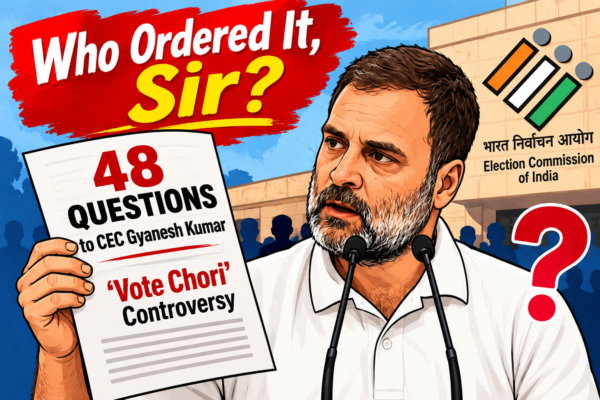
Opinion I New Delhi : The Congress has intensified its challenge against the Election Commission of India (ECI) over alleged irregularities in the Special Intensive Revision (SIR) of electoral rolls, popularly described by the opposition as the ‘Vote Chori’ controversy. The party has disclosed that the INDIA bloc has submitted an affidavit before the Supreme Court seeking permission to put 48 questions to the Election Commission, including Chief Election Commissioner (CEC) Gyanesh Kumar.
The development comes after the Election Commission submitted its affidavit before the Supreme Court in connection with the allegations surrounding the SIR exercise. The Congress has maintained that the ECI’s response has failed to address the fundamental questions raised by opposition parties regarding the revision of electoral rolls and the decision-making process behind it.
In a statement shared on social media platform X, the Congress said that the Election Commission’s affidavit had not answered any of the questions concerning alleged ‘Vote Chori’. According to the party, INDIA Alliance leaders have now approached the Supreme Court seeking permission to submit interrogatories to the Election Commission.
The proposed questions are reportedly directed not only at CEC Gyanesh Kumar but also at the two other Election Commissioners and the Director General of Information Technology. The opposition wants clarity on the decisions, administrative procedures and technological arrangements associated with the nationwide SIR exercise.
Who Took the Major Decisions?
Among the 48 questions highlighted by the Congress, one particularly significant issue concerns the role of the three Election Commissioners in the decision-making process.

The opposition has asked how many decisions were taken despite disagreement from the other two Election Commissioners with the Chief Election Commissioner. This question seeks to establish whether important decisions were taken collectively or whether disagreements existed within the Election Commission.
Another major question concerns who authorised the nationwide implementation of the Special Intensive Revision. The Congress wants to know which authority initiated the exercise and what institutional process was followed before extending it across the country.
The party has also questioned who decided to modify Form 6, which is used for applying for inclusion of names in electoral rolls. Any changes to voter registration procedures can have significant consequences for citizens seeking to exercise their democratic rights.

Questions Over Centralised Electoral Data
The proposed interrogatories also focus on the centralisation of ERONET and ECINET, the digital platforms associated with electoral roll management and election-related services.
The Congress has sought clarification about who authorised the centralisation of these systems and who controls access to electoral rolls and related information.
The opposition believes that transparency regarding digital infrastructure, administrative control and access to voter data is essential to maintaining public confidence in the electoral process.
Supreme Court’s Role Becomes Crucial
By seeking the Supreme Court’s permission to put 48 questions directly to senior Election Commission officials, the INDIA bloc is attempting to bring greater accountability to the controversy.
However, the allegations raised by the opposition remain allegations and will require examination through the appropriate judicial process. The Election Commission’s position and the Supreme Court’s eventual observations will be important in determining how these concerns are addressed.
At the centre of the dispute is a fundamental democratic question: how are electoral roll decisions made, who authorises them, and what mechanisms ensure accountability?
For Congress and the INDIA bloc, the demand is straightforward: the Election Commission must provide clear answers about the decisions taken during the SIR exercise.
The larger issue extends beyond political confrontation. The credibility of elections depends not only on conducting polls but also on ensuring that every eligible voter has a fair opportunity to participate. Transparency in electoral roll preparation is therefore essential to preserving public trust in India’s democratic institutions.