

Saudi Arabia Prepares for Possible Yemen Offensive as Red Sea Tensions Escalate
Riyadh is reportedly weighing a limited coastal operation against the Houthis, while Yemeni government forces could lead the ground campaign and Pakistan and Türkiye deepen military cooperation with Saudi Arabia

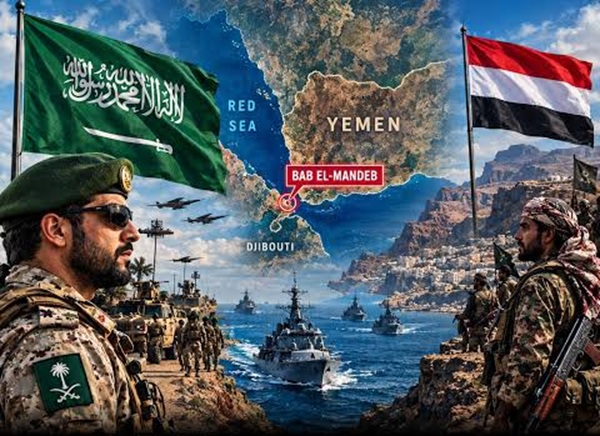
WAR-REPORT I RIYADH : Saudi Arabia is reportedly preparing for a new military offensive against Yemen’s Houthi movement, with Riyadh considering operations aimed at reversing recent Houthi territorial gains along the southern Red Sea coast and restoring control around the strategically important Bab el-Mandeb Strait.
According to a Reuters report published on October 2, Saudi officials and regional and Western sources familiar with the preparations said the options under consideration include a focused coastal operation or a broader offensive involving multiple fronts inside Yemen. The ground campaign would be led primarily by Yemeni government-aligned forces, with Saudi Arabia providing air support.
The potential operation would represent a significant escalation in a conflict that had been relatively contained for several years after a 2022 truce. It would also place the Red Sea shipping corridor, Saudi security concerns and the newly established defence relationship among Saudi Arabia, Pakistan and Türkiye at the centre of a rapidly changing regional security environment.
At the same time, diplomatic options have not completely disappeared. Pakistan’s Foreign Minister Ishaq Dar said on October 2 that Iran had suggested political engagement with the Houthis, and that the three members of the recently established Makkah Joint Defence Agreement—Saudi Arabia, Türkiye and Pakistan—would discuss the proposal at an emergency meeting in Riyadh.
The result is an increasingly complicated situation in which military preparations and diplomatic efforts are developing simultaneously.

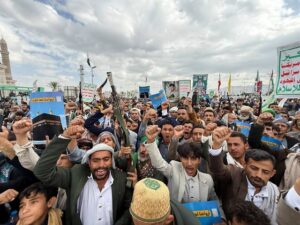
A Possible Coastal Offensive
Reuters reported that Saudi Arabia is considering an operation designed primarily to reverse Houthi advances made along Yemen’s Red Sea coast in September.
The immediate strategic focus is the Bab el-Mandeb Strait, the narrow maritime passage connecting the Red Sea with the Gulf of Aden. The waterway is one of the world’s important shipping routes, linking trade between the Mediterranean and Asia.

According to officials cited by Reuters, the Houthis recently advanced down the coast and seized control of territory around Bab el-Mandeb. Riyadh reportedly considers Houthi control of the area a major obstacle to any new peace negotiations.
Two broad military options are reportedly under consideration.
The first would be a relatively limited operation focused on the coastal area surrounding Bab el-Mandeb.
The second would involve a wider campaign, potentially combining the coastal offensive with attacks on several other fronts, including areas around Al-Bayda, Marib, Taiz and Al-Jawf.
Reuters reported that more than 100,000 Yemeni troops could potentially be mobilized depending on the scale of the operation, although the precise size, timing and scope remain uncertain.
That uncertainty is important.
A military plan being considered is not the same thing as a military operation already being launched. The sources cited by Reuters gave different estimates for the possible timing, ranging from within weeks to a period after the U.S. midterm elections in November.
Why Bab el-Mandeb Matters
The importance of Bab el-Mandeb extends far beyond Yemen.
The strait is the southern entrance and exit of the Red Sea and forms part of a major international maritime route. Ships moving between Europe and Asia have historically used the Red Sea and Suez Canal corridor to avoid longer routes around Africa.
Any prolonged disruption in the area can therefore affect shipping costs, insurance premiums, delivery times and global trade.
The strategic significance of the waterway has increased further because of wider regional disruptions, including tensions surrounding the Strait of Hormuz.
Reuters reported that the Bab el-Mandeb route has assumed greater importance this year as an alternative maritime corridor amid disruptions involving Hormuz.
This explains why Saudi Arabia is not viewing the coastal territory simply as another piece of Yemeni territory.
Control of the coastline and the approaches to Bab el-Mandeb has direct implications for regional security and international commerce.
In geopolitical language, geography has once again become a military argument.
Why Riyadh May Prefer a Limited Operation
Saudi Arabia has direct experience of the difficulties involved in a large-scale Yemen campaign.
Riyadh entered Yemen’s civil war in 2015 at the head of an Arab coalition supporting the internationally recognized government after the Houthis took control of Sana’a.
The subsequent conflict became a prolonged and costly confrontation involving air strikes, ground fighting, missile attacks and attacks on Saudi territory.
A truce agreed in 2022 significantly reduced the level of fighting for several years. However, the situation has deteriorated again during 2026.
Reuters reported that the Saudi objective now under consideration may be considerably narrower than the campaign launched in 2015. Former U.S. ambassador to Saudi Arabia Michael Ratney told Reuters that he expected any new offensive to be more limited and focused on reversing Houthi territorial gains around Bab el-Mandeb rather than attempting to eliminate the movement entirely.
That distinction could be crucial.
There is a major difference between trying to defeat an armed movement across an entire country and trying to recover a specific coastal corridor.
The first could become an open-ended war.
The second could theoretically be designed as a limited military objective.
But the distinction on paper does not automatically guarantee a limited war in practice.
Yemeni Forces Would Carry the Ground Burden
According to Reuters, Saudi Arabia intends Yemeni government-aligned forces to lead the ground component of the operation while Saudi aircraft provide air support.
This approach would allow Riyadh to provide substantial military power without necessarily placing large numbers of Saudi ground troops directly into Yemen.
The strategy also reflects the fragmented nature of Yemen’s anti-Houthi forces.
The internationally recognized Yemeni government does not operate through a single, unified military structure. Various Yemeni factions have been supported at different times by Saudi Arabia and the United Arab Emirates, while southern forces have pursued their own political objectives.
Reuters quoted Yemen analyst Mohammed Albasha as warning that many anti-Houthi forces remain insufficiently organized for a sustained offensive against a disciplined Houthi military force.
That could become one of the biggest challenges for Riyadh.
Saudi airpower can provide a significant advantage, but territory ultimately has to be controlled by ground forces.
An air campaign can destroy targets.

The Houthi Factor
The Houthis are not simply an irregular force waiting for an attack.
Over the years, the movement has developed missile and drone capabilities and has demonstrated an ability to strike targets well beyond the immediate battlefield.
Saudi Arabia therefore has to consider not only whether Yemeni forces can retake territory, but also how the Houthis might respond.
A new offensive could potentially trigger attacks against Saudi military facilities, oil infrastructure, ports and other strategic assets.
Reuters reported that one of Riyadh’s major concerns is protecting its oil facilities and other infrastructure from possible Houthi missile and drone attacks.
This creates a familiar Middle Eastern strategic dilemma:
A military operation designed to secure one area can create vulnerabilities somewhere else.
The longer the campaign continues, the greater the possibility that the conflict expands beyond the original battlefield.
Pakistan’s New Role
Pakistan occupies a particularly sensitive position in the developing crisis.
Islamabad has historically maintained relations with Saudi Arabia while also preserving diplomatic channels with Iran.
That balancing act has become more complicated following the signing of the Makkah Joint Defence Agreement between Saudi Arabia, Türkiye and Pakistan on August 7.
The agreement states that an armed attack against one of the three countries would be regarded as an attack against all three and provides for broader defence cooperation. Official statements from Saudi Arabia and Pakistan describe the agreement as a framework for strengthening collective security and defence cooperation.
Reuters reported that Pakistan has already supplied military equipment to Saudi Arabia and the Saudi-backed Yemeni government.
According to Pakistani officials cited by Reuters, four cargo aircraft transported equipment to Aden in September, including air-defence systems, light artillery, drones and anti-drone systems. Pakistani military advisers are also reportedly working alongside Saudi counterparts.
Pakistan has also deployed between 30,000 and 40,000 troops to Saudi Arabia, according to a Pakistani official cited by Reuters. However, the official said those troops were intended to defend Saudi territory and assist with drone and missile interception, and Islamabad had not decided to send them into Yemen for combat operations.
This distinction matters.
Pakistan’s military involvement should not automatically be described as direct participation in a Yemen ground offensive.
The current reporting points instead to equipment supplies, advisers and defensive deployments around Saudi territory.
Türkiye’s Military Connection
Türkiye is also becoming part of the security equation.
Reuters reported that Turkish drones previously purchased by Saudi Arabia have been deployed over Yemen. Turkish and Saudi defence cooperation has expanded within the broader framework established by the Makkah defence agreement.
The agreement itself was signed in Makkah on August 7 by Saudi Crown Prince and Prime Minister Mohammed bin Salman, Turkish President Recep Tayyip Erdoğan and Pakistani Prime Minister Shehbaz Sharif.
The official joint statement said the agreement is intended to strengthen collective deterrence and deepen defence cooperation among the three countries.
The pact therefore provides a political and security framework, but it should not be interpreted automatically as a commitment by all three countries to send combat forces into Yemen.
Current Reuters reporting specifically says Saudi allies are not expected to play a direct combat role in the planned offensive.
The Diplomatic Door Is Still Open
While military preparations are being reported, diplomacy has not disappeared.
Pakistan’s Foreign Minister Ishaq Dar said Iran had suggested engaging the Houthis politically.
Dar described the idea as a good-faith suggestion rather than a formal written offer. He said it would be considered as an alternative to military action at an emergency meeting of the Makkah pact members in Riyadh.
This is particularly significant because Pakistan occupies a position that is unusual in the current regional environment.
Islamabad is closely linked to Riyadh through defence cooperation, but it also maintains relations with Tehran.
Reuters reported earlier in September that Pakistan had sought to prevent escalation and had communicated with Iranian officials regarding the Houthi-Saudi conflict. At that time, Pakistan’s foreign ministry said no military response to Houthi attacks was under discussion and emphasized restraint, dialogue and diplomacy.
The new developments suggest that Islamabad is now facing a difficult balancing act.
The Makkah Pact Faces Its First Major Test
The August defence agreement was announced as a framework for collective security.
Now, barely two months later, the Houthi-Saudi confrontation is providing an early test of what that agreement actually means in practice.
The treaty says an armed attack against one member is regarded as an attack against all three.
But collective defence does not necessarily mean identical military participation.
A country can provide intelligence.
Another can provide air defence.
Another can provide equipment.
Another can deploy troops for border protection.
And diplomatic engagement can continue at the same time.
That appears to be the situation emerging around Saudi Arabia, Pakistan and Türkiye.
The alliance is therefore moving from diplomatic language into operational reality, even as its exact military boundaries remain under development.
Saudi Arabia’s Strategic Calculation
For Riyadh, the central question is not simply whether the Houthis can be pushed back.
It is whether the strategic gains would justify the risks of renewed war.
A successful limited operation could potentially restore government control over parts of the Red Sea coast and reduce the Houthis’ leverage over Bab el-Mandeb.
But an unsuccessful or prolonged operation could create another cycle of missile attacks, economic disruption and regional escalation.
Saudi Arabia must also consider its domestic infrastructure.
The kingdom has invested heavily in economic diversification, tourism, logistics, energy and infrastructure.
A sustained missile or drone campaign against major facilities could create economic and political costs far beyond the immediate battlefield.
That is why air defence and border security are central to Riyadh’s preparations.
The United States Keeps a Careful Distance
The United States remains an important factor.
Reuters reported that Washington is providing intelligence, military advisers and targeting information to support Saudi air operations, but that U.S. President Donald Trump had previously rejected requests for direct American military support such as air strikes.
This suggests that Washington is seeking to support Saudi security without necessarily becoming a direct combat participant in a renewed Yemen war.
That distinction could change if the conflict expands, but current reporting does not establish that the United States intends to participate directly in the planned offensive.
For Riyadh, therefore, regional partners are becoming increasingly important.
A New War or a Limited Operation?
This is perhaps the biggest unanswered question.
Saudi officials appear to be considering a limited coastal operation.
But Yemen’s previous experience shows how quickly limited military objectives can become complicated.
The Houthis have demonstrated resilience.
Anti-Houthi forces remain divided.
The geography is difficult.
The coastline is strategically important.
And the conflict is connected to wider tensions involving Saudi Arabia, Iran and the international maritime system.
A 50-mile advance on a map may look relatively straightforward.
On the ground, it can become a completely different proposition.
Military planners can draw arrows.
Soldiers have to move through the territory represented by those arrows.
Red Sea Shipping Adds a Global Dimension
The international community will be watching the situation closely because Bab el-Mandeb is not simply a Yemeni battlefield.
It is part of the global maritime economy.
Any prolonged threat to shipping through the Red Sea could affect transport costs and supply chains.
Energy markets could also react to a wider regional escalation, particularly if attacks extend to Saudi oil infrastructure or other strategic facilities.
This means the consequences of a Yemen offensive could reach far beyond Riyadh, Sana’a or the Red Sea coast.
The conflict has the potential to become another pressure point in an already fragile international trading environment.
What Happens Next?
Several developments are likely to determine the direction of the crisis.
First, Saudi Arabia must decide whether to proceed with the coastal operation and, if so, how limited its objectives will be.
Second, Yemeni government-aligned forces must demonstrate whether they can operate as a sufficiently coordinated military force.
Third, the Houthis will have to decide how to respond to any Saudi-backed offensive.
Fourth, Pakistan and Türkiye will have to define how far their defence commitments extend without becoming direct combat participants.
Fifth, diplomatic efforts involving Pakistan and Iran could determine whether there remains a realistic alternative to military escalation.
And finally, international shipping companies will closely monitor developments around Bab el-Mandeb.
Conclusion: The Red Sea Is Becoming the Next Strategic Test
Saudi Arabia’s reported preparations for a new Yemen offensive mark a potentially important turning point in the conflict.
The immediate objective appears narrower than the Saudi-led intervention that began in 2015: recover territory along the Red Sea coast, restore control around Bab el-Mandeb and improve Riyadh’s strategic position before any future negotiations.
But limited objectives do not guarantee limited consequences.
The military balance will depend heavily on the performance of Yemeni ground forces, Saudi airpower and the Houthis’ ability to respond.
At the same time, the involvement of Pakistan and Türkiye introduces a new regional dimension. Their military cooperation with Saudi Arabia has expanded under the Makkah Joint Defence Agreement, but current reporting indicates that their role remains focused on equipment, advisers, air defence and Saudi territorial protection rather than direct combat inside Yemen.
The diplomatic channel also remains open. Pakistan says an Iranian suggestion for political engagement with the Houthis will be discussed by the Makkah pact members in Riyadh.
The central question, therefore, is no longer simply whether Saudi Arabia can launch an offensive.
It is whether Riyadh can achieve its limited strategic objectives without turning the Red Sea coast into the starting point of another prolonged regional war.
For the moment, the answer remains uncertain.
What is clear is that Bab el-Mandeb has once again become a focal point where Yemen’s internal conflict, Saudi security concerns, international shipping, Iranian influence and a new Saudi-Pakistan-Türkiye defence relationship are converging.
And when all those interests meet in one narrow stretch of coastline, even a supposedly limited military operation can carry consequences far beyond its original battlefield