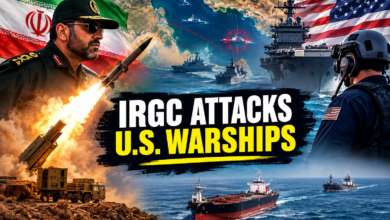



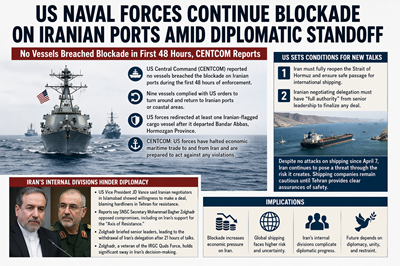
WAR-REPORT : The United States has strengthened its pressure campaign against Iran by enforcing a strict naval blockade on major Iranian ports, marking a serious rise in tensions across the Middle East. According to official statements from United States Central Command on April 15, the blockade has been effective so far, with no vessels breaking through the restrictions during the first forty-eight hours of enforcement. This development shows that Washington is committed to limiting Iran’s maritime trade while pushing Tehran toward renewed negotiations under firm conditions.
United States Central Command reported that at least nine vessels followed orders to turn back and return to Iranian waters or nearby coastal areas. These early results suggest that the blockade is already influencing commercial shipping behavior without direct military confrontation. The United States also stated that its naval forces are ready to act against any ships that attempt to ignore the blockade, showing a clear willingness to enforce the operation with strength if required.

In addition to redirecting foreign vessels, United States forces also stopped and redirected at least one Iranian cargo ship after it left Bandar Abbas in Hormozgan Province. This action shows that the blockade is not only aimed at foreign trade partners but also at limiting Iran’s own shipping activities. By stopping economic maritime trade to and from Iran, Washington is trying to isolate the country economically while maintaining controlled military pressure.
Strategic Importance of the Blockade
The blockade is a planned effort to apply economic and psychological pressure on Iran without starting a direct war. Maritime trade is very important for Iran’s economy, especially because the country depends on oil exports and imported goods. By interrupting these trade routes, the United States aims to weaken Iran’s economy and force its leadership to rethink its strategy.

The impact of this situation goes beyond Iran. The Strait of Hormuz remains one of the most important waterways in the world, as a large share of global oil passes through it. Although Iran has not attacked international shipping since April 7, the risk is still present. Shipping companies and global markets are very sensitive to any instability in this region, and even the possibility of danger can affect their decisions.
The United States appears to be using this situation carefully. Instead of relying only on military action, it is also using uncertainty as a tool. By keeping a strong naval presence and enforcing the blockade, the United States is shaping the situation in a way that discourages shipping linked to Iran.
Conditions for New Negotiations
Along with military pressure, the United States has set two main conditions for restarting negotiations with Iran. First, Iran must fully reopen the Strait of Hormuz and ensure safe passage for international ships. Second, the Iranian negotiation team must have full authority from the country’s senior leadership to finalize any agreement.

These conditions show a change in the United States approach. It is not only focusing on the outcome of talks but also on how the talks are conducted. By asking for a fully authorized Iranian team, Washington wants to make sure that any agreement reached will be final and not affected by internal disagreements within Iran.
The demand to reopen the Strait of Hormuz also highlights the importance of maritime security in the current crisis. Even without direct attacks, the fear of danger is enough to stop normal shipping activity. This puts pressure on Iran to provide clear guarantees that it will not threaten international trade routes.
Iran’s Careful Strategy
Iran appears to be following a careful and balanced approach. It has avoided direct attacks on ships in recent days, but it has also not given strong guarantees about maritime safety. This allows Iran to keep some level of influence without causing a direct military conflict.
This strategy has both benefits and risks. On one hand, Iran can still affect global shipping decisions without using force. On the other hand, the continued uncertainty may increase the economic impact of the blockade.
Shipping companies are likely to remain cautious until the situation becomes clearer. Factors such as insurance costs, safety risks, and political tension all influence their decisions. As a result, even a small disruption can create large economic effects.
Internal Divisions in Iran
Another major issue is the presence of internal divisions within Iran’s leadership. Reports suggest that the United States is not dealing with a single unified authority but with a divided system that includes both hardline and moderate groups.
This division became clear during recent talks in Islamabad. United States Vice President JD Vance stated that Iranian negotiators seemed willing to reach an agreement. However, he also suggested that hardline groups in Tehran were preventing progress.
Reports indicate that tensions increased when Iran’s foreign minister appeared open to possible compromises, including reducing support for regional groups. This position caused strong opposition from more conservative elements within Iran’s political and military system.
Role of Hardline Leadership
A key figure in this situation is Mohammad Bagher Zolghadr, a senior official in Iran’s security structure. He is known for his strong views and long involvement in Iran’s regional policies.
According to reports, Zolghadr strongly opposed any compromise during the negotiations. He informed senior leaders about what he saw as a departure from official policy. This included communication with military officials and individuals close to the country’s top leadership.
As a result, the Iranian delegation was ordered to leave the talks after about twenty-one hours. This event shows how much influence hardline leaders still have, especially on issues related to national security and foreign relations.
Difficulties in Reaching an Agreement
The lack of unity within Iran creates serious problems for diplomacy. For any agreement to succeed, both sides must trust that it will be followed. If Iranian negotiators do not have full authority, any deal may fail.
This problem is made worse by differences in views between hardline and moderate groups. Some believe that negotiations are necessary to reduce economic pressure, while others see compromise as a threat to national strength.
The United States demand for a fully authorized delegation is meant to solve this issue. It aims to ensure that any agreement reached will be stable and respected by all parts of Iran’s leadership.
Wider Regional Situation
The current conflict is part of a larger and complex regional situation. The Middle East remains unstable, with many countries and groups having different and often competing interests.
Iran’s support for regional groups has been a major issue for the United States and its allies. Any discussion about reducing this support is very sensitive, especially for hardline leaders who see it as essential to national strategy.
At the same time, the United States must avoid a larger war while still trying to limit Iran’s influence. The naval blockade represents a balanced approach, applying pressure without direct large-scale conflict.
Economic Effects on the World
The blockade is not only affecting Iran but also the global economy. Energy markets are closely connected to the Strait of Hormuz, and any disruption can lead to changes in oil prices and supply concerns.
Even without physical attacks, the fear of risk can affect trade. Shipping delays, higher insurance costs, and longer routes all increase expenses and reduce efficiency.
For Iran, the situation is especially serious. The blockade limits access to global markets and adds to existing economic pressure. This may eventually influence Iran’s decisions, especially if it leads to internal economic problems.

Our Media Opinion
The United States naval blockade of Iranian ports represents an important moment in the ongoing tension between the two countries. While the early stage of the blockade has been effective, its long-term impact will depend on military actions, economic pressure, and political decisions.
The United States has set clear conditions for renewed talks, focusing on maritime safety and a unified Iranian negotiation team. However, internal divisions within Iran make progress difficult.
The situation remains uncertain, and the risk of further escalation is still present. The coming period will be important in deciding whether the crisis moves toward peaceful negotiation or increased confrontation.
In the end, this situation highlights the importance of clear strategy, strong communication, and continued diplomatic efforts in managing one of the most serious international challenges today.