

Iran’s Push for Control of the Strait of Hormuz Raises Global Alarm 2026
Over Energy Security and Regional Stability
 Samir Singh 'Bharat'-Editor-in-Chief
Send an email
24 May 2026
Samir Singh 'Bharat'-Editor-in-Chief
Send an email
24 May 2026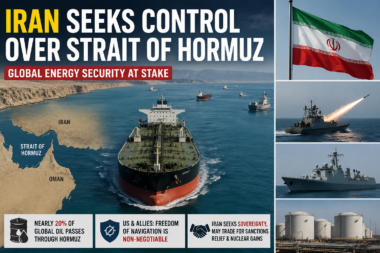
WAR-REPORT : The Strait of Hormuz has once again emerged at the center of global geopolitical tensions as Iran intensifies efforts to secure greater control and recognition of its sovereignty over one of the world’s most strategically vital waterways. While international attention often focuses on Iran’s nuclear ambitions and sanctions negotiations, analysts increasingly believe that Tehran’s long-term strategic objective extends far beyond economic concessions or transit revenues. At the heart of current negotiations lies a far more consequential goal: establishing effective Iranian dominance over the Strait of Hormuz.
This narrow maritime corridor, located between Iran and Oman, remains one of the most critical chokepoints in global trade and energy supply. Nearly one-fifth of the world’s oil and a major portion of liquefied natural gas shipments pass through the strait every day. Any disruption to navigation in the region can send shockwaves across global energy markets, disrupt supply chains, and intensify military tensions across the Middle East.
According to strategic assessments, Iran views control over the Strait of Hormuz not merely as a military or economic objective but as a matter of sovereignty, national prestige, and geopolitical leverage. Iranian leaders have repeatedly emphasized that Tehran seeks recognition of its authority over navigation and security in the area. This demand has become increasingly prominent during negotiations surrounding the broader Iran conflict and discussions involving sanctions, regional security arrangements, and nuclear diplomacy.
Why the Strait of Hormuz Matters So Much
The Strait of Hormuz is only about 33 kilometers wide at its narrowest point, yet it serves as the gateway connecting the Persian Gulf to the Arabian Sea and the wider global economy. Oil exports from countries including Saudi Arabia, Iraq, Kuwait, the United Arab Emirates, and Qatar depend heavily on uninterrupted passage through the strait.
Because of its strategic location, the waterway has long been a focal point of rivalry between Iran and the United States. Washington considers freedom of navigation through the strait essential to global economic stability and international maritime law. The US Navy has maintained a significant presence in the region for decades to ensure safe transit for commercial shipping and deter Iranian interference.

Iran, however, has consistently argued that its geographic position gives it special rights and security responsibilities in the strait. Tehran frequently criticizes the presence of foreign military forces in the Gulf and portrays itself as the natural guardian of regional waterways.
Iran’s Broader Strategic Objective
Analysts believe Iran’s current strategy involves leveraging ongoing negotiations to secure either formal or informal recognition of its dominant role in the Strait of Hormuz. For Tehran, achieving such recognition would represent a major geopolitical victory that could permanently reshape the balance of power in the Middle East.
Iranian officials have repeatedly signaled that sovereignty over the strait is a more important objective than simply collecting fees from merchant vessels. Although Tehran has occasionally floated ideas involving transit payments or “security fees,” the core objective appears to be strategic control and political recognition.

Iran may ultimately be willing to compromise on some aspects of its nuclear program or regional posture if it can secure significant concessions related to the strait. Such concessions could include:
- large-scale sanctions relief,
- access to frozen financial assets,
- reduction of US military presence in the Gulf,
- or implicit acceptance of Iranian maritime authority.
From the perspective of the United States and many regional allies, however, these potential trade-offs remain deeply problematic because they would strengthen Iran’s regional influence while undermining the principle of free navigation.
Two Possible Paths to Iranian Control
Strategic observers believe Iran currently sees two primary pathways toward consolidating control over the Strait of Hormuz.
1. Formal Recognition Through Negotiation
The first and most ambitious scenario involves achieving official recognition from the United States or other major powers regarding Iran’s special authority over the strait.
Such recognition could emerge indirectly through diplomatic agreements, security arrangements, or negotiated frameworks that effectively acknowledge Tehran’s role in regulating maritime activity. Even if other countries opposed the arrangement, reversing such a geopolitical shift afterward would be extremely difficult.
Iran likely understands that any form of tacit acceptance from Washington would fundamentally alter the regional balance. Once a new status quo becomes established, many countries and shipping firms may adapt to it out of economic necessity rather than political approval.
This possibility alarms many Western and Gulf policymakers who fear it would legitimize Iranian coercion and weaken international maritime norms.
2. De Facto Control Through Coercion
The second path involves maintaining and expanding Iran’s current strategy of coercive pressure through military threats.
Iran has already demonstrated the ability to disrupt shipping in the Gulf using:
- ballistic missiles,
- drones,
- naval mines,
- fast attack boats,
- and proxy forces.
Under this strategy, Tehran may not need formal international recognition to effectively control maritime traffic. Instead, it could rely on credible threats against vessels that refuse to comply with Iranian demands.
Even occasional missile launches, drone incidents, or ship seizures can create enough uncertainty to alter shipping behavior. Insurance costs rise dramatically, shipping companies reroute cargo, and global energy prices fluctuate sharply whenever tensions increase.
In practice, Iran may only need to convince shipping companies that defying its warnings carries unacceptable risks.
Sanctions and Shipping Companies
Iran’s attempts to impose transit-related fees or “protection payments” face major practical challenges because of international sanctions. Many global shipping firms remain extremely cautious about any financial dealings involving Iranian authorities.
Companies operating internationally must comply with complex US and European sanctions regimes. Paying Iran directly for passage could expose shipping firms to:
- financial penalties,
- legal liability,
- restricted market access,
- or secondary sanctions.
As a result, analysts believe Iran’s direct fee-collection strategy may ultimately fail in economic terms.
However, the failure of the fee model does not necessarily mean Iran’s broader strategy will collapse. Tehran’s objective may not require widespread financial compliance if it can still establish effective control through intimidation and selective enforcement.
In other words, even ships that refuse to pay Iran may still hesitate to transit the strait without military protection or diplomatic assurances.
Impact on Global Energy Markets
Any serious escalation in the Strait of Hormuz immediately affects global oil markets. Energy traders monitor developments in the region closely because disruptions can quickly drive up crude oil prices worldwide.
The strait handles enormous daily energy flows, including exports from some of the world’s largest oil producers. A sustained disruption could:
- trigger inflation globally,
- increase transportation costs,
- disrupt industrial production,
- and weaken economic growth.
Asian economies such as China, India, Japan, and South Korea are particularly vulnerable because they rely heavily on Gulf energy supplies.
Europe also remains exposed despite efforts to diversify energy imports following recent geopolitical crises. Any instability in Hormuz could place additional strain on global supply chains already facing multiple pressures.
US Military Presence and Strategic Calculations
The United States has long maintained that freedom of navigation through the Strait of Hormuz represents a core national interest. American naval forces regularly patrol the region alongside allied fleets from Britain, France, and Gulf Arab states.
Washington fears that allowing Iran to dominate the strait would:
- undermine international maritime law,
- embolden Iranian regional ambitions,
- weaken American credibility,
- and threaten allied security.
US policymakers also worry that concessions regarding Hormuz could encourage similar coercive strategies elsewhere in the world.
At the same time, some analysts argue that prolonged military deployments in the Gulf impose major financial and political burdens on the United States. This debate has intensified amid broader discussions about reducing American military involvement in the Middle East.
Iran may view these debates as an opportunity to pressure Washington into accepting a reduced US presence in exchange for temporary regional stability.
Gulf States and Regional Reactions
Arab Gulf countries remain deeply concerned about Iran’s ambitions in the Strait of Hormuz. Nations such as Saudi Arabia and the United Arab Emirates depend heavily on secure maritime trade routes for economic survival.
These states fear that increased Iranian influence over the strait would give Tehran enormous leverage over regional economies and political decisions.
As a result:
- Gulf states continue investing heavily in naval modernization,
- strengthening security cooperation with Western allies,
- and developing alternative export routes that bypass Hormuz where possible.
However, completely bypassing the strait remains extremely difficult due to geography and existing infrastructure limitations.
Nuclear Negotiations and Strategic Bargaining
The issue of Hormuz increasingly intersects with broader negotiations involving Iran’s nuclear program.
Tehran may attempt to use maritime stability as leverage during discussions about:
- uranium enrichment,
- sanctions relief,
- prisoner exchanges,
- and regional security arrangements.
Some experts believe Iran views the nuclear issue and Hormuz issue as interconnected bargaining tools rather than separate diplomatic tracks.
This creates a complex challenge for negotiators because concessions in one area may strengthen Iranian leverage in another.
A Defining Strategic Challenge
The growing dispute over the Strait of Hormuz represents far more than a regional maritime disagreement. It has become a defining strategic challenge involving energy security, military deterrence, global trade, and the future balance of power in the Middle East.
Iran appears determined to expand its influence over one of the world’s most important waterways, whether through formal agreements or sustained coercive pressure. The United States and its allies, meanwhile, view unrestricted navigation through the strait as a non-negotiable principle essential to global stability.
As negotiations continue, the central question remains whether diplomacy can prevent escalation without granting Iran effective control over the strait. The answer could shape not only the future of the Gulf region but also the broader global economic and security landscape for years to come.