

Russia Launches Massive Missile and Drone Assault on Ukraine as
By Samir Singh 'Bharat': Editor In Chief

WAR-REPORT : Russian forces carried out one of their largest coordinated air attacks against Ukraine in recent months, launching a wide range of missiles and drones overnight between April 14 and April 15. The assault targeted multiple regions across the country, combining ballistic missile strikes with hundreds of unmanned aerial vehicles in an effort to overwhelm Ukrainian air defenses and inflict damage on both military and civilian infrastructure.
Russia Drone Attack Ukraine 2026: Massive Overnight Assault
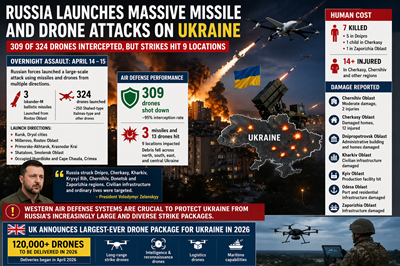
According to the Ukrainian Air Force, Russian forces launched three Iskander M ballistic missiles from areas within Rostov Oblast. In addition to the missiles, Russia deployed a total of 324 drones of various types. These included Shahed type drones, Italmas type drones, and other unmanned systems. Ukrainian officials noted that approximately 250 of the drones used in the attack were Shahed type drones, which have been widely used by Russian forces throughout the conflict.

The drones were launched from multiple directions, including the regions of Kursk and Oryol, as well as Millerovo in Rostov Oblast, Primorsko Akhtarsk in Krasnodar Krai, and Shatalovo in Smolensk Oblast. Additional launch points included areas in occupied Crimea, specifically Hvardiiske and Cape Chauda. This wide geographic spread of launch sites highlights the scale and coordination of the operation, designed to stretch Ukrainian defenses across a broad front.
Despite the intensity of the attack, Ukrainian air defense systems achieved a high interception rate. The Ukrainian Air Force reported that 309 of the drones were successfully shot down, representing an interception rate of roughly ninety five percent. This performance reflects the increasing effectiveness of Ukraine’s layered air defense network, which includes a combination of radar systems, surface to air missiles, and electronic warfare measures.

However, not all incoming threats were neutralized. Ukrainian officials confirmed that the ballistic missiles, along with thirteen drones, were able to reach their targets. These strikes impacted nine different locations across the country. In addition, falling debris from intercepted drones caused damage in several regions, affecting areas in the north, south, east, and central parts of Ukraine.
Ukrainian President Volodymyr Zelensky provided further details about the impact of the attack, stating that Russian strikes hit several major cities, including Dnipro, Cherkasy, Kharkiv, Kryvyi Rih, and Chernihiv. He also reported that the attacks extended to the regions of Donetsk and Zaporizhia, demonstrating the widespread nature of the assault.
The human cost of the strikes was significant. According to official reports, five people were killed in the city of Dnipro. In Cherkasy, a child lost their life as a result of the attack, highlighting the tragic impact on civilians. Another fatality was reported in Zaporizhia Oblast. These deaths underscore the continued danger faced by civilians living in areas targeted by Russian strikes.

In addition to the fatalities, several people were injured in different parts of the country. Ukrainian officials reported that two individuals were injured in Chernihiv Oblast, where the strikes also caused moderate damage to infrastructure. In Cherkasy Oblast, twelve people were reported injured, and residential areas suffered notable damage.
The attacks also caused destruction to infrastructure in multiple regions. In Dnipropetrovsk Oblast, an administrative building and residential properties were damaged. Kharkiv Oblast experienced damage to civilian infrastructure, while a production facility was struck in Kyiv Oblast. In Odesa Oblast, port facilities and residential areas were affected, raising concerns about the impact on Ukraine’s economic and trade activities. Infrastructure in Zaporizhia Oblast was also damaged, adding to the overall toll of the assault.
The widespread damage caused by the attack highlights the ongoing challenges faced by Ukraine in defending against large scale aerial operations. While the high interception rate demonstrates the strength of Ukrainian air defenses, the ability of some missiles and drones to penetrate these defenses shows the limits of current capabilities, especially against ballistic threats.
Military analysts continue to emphasize the importance of advanced air defense systems in protecting Ukraine from such attacks. Western supplied systems have played a key role in improving Ukraine’s defensive capabilities. Among these, high end systems such as the Patriot air defense system have been particularly effective in countering ballistic missiles and other high speed threats.
The need for continued support from Western allies remains critical. As Russian forces increase the scale and complexity of their attacks, Ukraine requires more advanced technology and resources to maintain its defensive advantage. This includes not only air defense systems but also radar, intelligence support, and coordination capabilities.
In response to these needs, Ukraine’s allies have continued to expand their military assistance programs. The United Kingdom announced on April 15 that it plans to deliver its largest ever drone package to Ukraine in the year 2026. This package will include at least one hundred twenty thousand drones, representing a major increase in support for Ukraine’s unmanned capabilities.
The drone package will consist of a wide range of systems designed for different roles. These include long range strike drones capable of targeting enemy positions deep behind the front lines, as well as intelligence and reconnaissance drones used for surveillance and battlefield awareness. Logistics drones will also be included, helping to transport supplies and equipment to frontline units.
In addition, the package will feature maritime capabilities, indicating a focus on strengthening Ukraine’s ability to operate in coastal and naval environments. This aspect of the support is particularly important given the strategic importance of the Black Sea region and the need to protect shipping routes and port infrastructure.
The United Kingdom also confirmed that deliveries of these new drones began in April 2026, signaling that support is already being implemented. This ongoing assistance reflects a broader commitment among Western countries to help Ukraine defend itself against continued Russian aggression.
The increasing use of drones by both sides has become a defining feature of the conflict. Drones are used for a wide range of purposes, including surveillance, targeting, and direct attacks. Their relatively low cost and flexibility make them an effective tool in modern warfare, especially in situations where traditional assets may be limited or at risk.
Russia’s use of large numbers of drones in the April 14 to 15 attack demonstrates its reliance on this technology to supplement missile strikes and overwhelm defenses. By launching hundreds of drones at once, Russian forces aim to saturate Ukrainian air defense systems, increasing the likelihood that some threats will get through.
Ukraine, in turn, has adapted its defense strategy to counter this approach. The high interception rate reported by the Ukrainian Air Force suggests that these efforts are having a significant impact. However, the continued success of some strikes indicates that further improvements are needed.
The situation remains highly dynamic, with both sides constantly adjusting their tactics and capabilities. As the conflict continues, the role of technology and international support will remain central to the outcome.
The latest wave of attacks also serves as a reminder of the ongoing humanitarian impact of the war. Civilians continue to bear the brunt of the violence, with homes, infrastructure, and lives affected by each new strike. Efforts to strengthen air defenses are not only a military priority but also a crucial step in protecting civilian populations.
Our Media Opinion, the large scale missile and drone attack carried out by Russian forces on April 14 and 15 represents a significant escalation in the use of combined aerial tactics. While Ukrainian defenses successfully intercepted the majority of incoming drones, the strikes that did reach their targets caused loss of life and widespread damage.

The incident highlights the importance of continued international support for Ukraine, particularly in the area of air defense and advanced military technology. With further assistance from allies such as the United Kingdom, Ukraine aims to strengthen its ability to defend against increasingly complex and large scale attacks.
As the conflict continues, the balance between offense and defense will remain a key factor in shaping the course of events. The ability to adapt, innovate, and sustain support will determine how effectively Ukraine can respond to future challenges and protect its people and territory.