

Ukraine Attempts to Break Stalemate as Battlefield Dynamics Begin to Shift
Ukraine Regains Tactical Drone Advantage
 Samir Singh 'Bharat'-Editor-in-Chief
Send an email
28 May 2026
Samir Singh 'Bharat'-Editor-in-Chief
Send an email
28 May 2026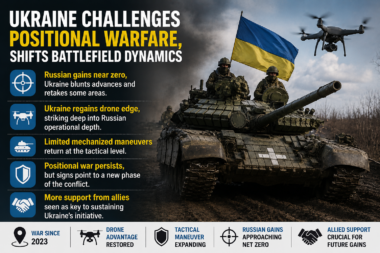
WAR-REPORT : The nature of the ongoing war between Ukraine and Russia may be entering a new phase as Ukrainian forces increasingly challenge the positional warfare that has dominated the battlefield since late 2023. Military analysts believe recent developments suggest that Ukrainian troops are gradually creating conditions for limited tactical maneuver operations while slowing Russian advances across several sectors of the frontline.
According to assessments from defense observers and battlefield analysts, Russian territorial gains have approached near zero in multiple areas, while Ukrainian forces have managed not only to halt several Russian assaults but also to reverse some localized Russian gains.
Experts say these battlefield shifts could indicate the beginning of a transition away from static trench-style warfare toward a more fluid and maneuver-oriented phase of conflict, although large-scale operational breakthroughs remain unlikely in the immediate future.
Positional Warfare Dominated the Battlefield Since 2023
Since late 2023, the war has largely evolved into a highly defensive and positional conflict in which neither side has been capable of conducting large-scale operational maneuvers.
The battlefield has become heavily influenced by drones, surveillance systems, artillery and layered defensive positions, making it extremely difficult for either army to mass forces or launch traditional armored breakthroughs.

Military analysts describe the current battlefield as partially transparent due to the extensive use of:
- reconnaissance drones,
- thermal imaging,
- satellite intelligence,
- electronic surveillance,
- and tactical strike UAVs.
This environment has significantly reduced the survivability of concentrated troop formations and armored columns near the frontline.
Expanding “Kill Zone” Reshaping Combat
One of the defining features of the current conflict is the creation of a massive “kill zone” extending roughly 15 to 25 kilometers from the frontline.

Within this zone, both Russian and Ukrainian forces face constant threats from:
- FPV drones,
- loitering munitions,
- artillery fire,
- and aerial reconnaissance systems.
Military experts state that any large concentration of troops, armored vehicles or logistics convoys inside this area becomes highly vulnerable to immediate detection and destruction.
As a result, both sides have been forced to disperse their forces into smaller units operating from concealed or fortified positions.
Russian Advances Slow Dramatically
Recent battlefield reports suggest Russian offensive momentum has weakened significantly in several sectors.
Although Russian forces continue to launch attacks, analysts say their advances are increasingly limited, costly and unsustainable.
Russian military operations since 2025 have relied heavily on small-scale infiltration tactics rather than conventional mechanized assaults.
Instead of mass armored pushes, Russian forces frequently deploy:
- small infantry groups,
- covert infiltration teams,
- and dispersed assault units
to penetrate Ukrainian defensive lines.
These infiltration units typically consist of one to three soldiers attempting to exploit:
- terrain cover,
- destroyed infrastructure,
- forest belts,
- underground tunnels,
- and abandoned structures
to move undetected through contested areas.
Complex Intermixed Frontlines Emerging
Military observers describe the current frontline as highly fragmented and “pointillist” in nature.
Rather than a clearly defined continuous frontline, Ukrainian and Russian strongpoints are now often intermixed within contested territory.
Russian infiltration teams attempt to bypass Ukrainian defensive positions and establish temporary rally points in tactical rear areas before launching localized assaults.
This has created a battlefield where:
- isolated strongpoints,
- trenches,
- tree lines,
- and field fortifications
are scattered across contested zones occupied by both sides simultaneously.
The result is an extremely fluid tactical environment despite the broader strategic stalemate.
Ukraine Regaining Drone Advantage
One of the most important developments highlighted by analysts is Ukraine’s apparent restoration of a drone advantage on parts of the battlefield.
Ukrainian forces have increasingly deployed advanced drone systems capable of:
- reconnaissance,
- electronic warfare,
- precision strikes,
- and deep operational disruption.
Analysts say Ukrainian drone operations are now targeting Russian:
- logistics hubs,
- ammunition depots,
- command posts,
- air defense systems,
- and supply routes
well beyond the frontline.
These deep-strike capabilities are believed to be weakening Russian operational flexibility and disrupting troop coordination.
Tactical Mechanized Maneuver Reappearing
While full operational maneuver warfare remains impossible under current conditions, Ukrainian forces are reportedly reintroducing limited tactical mechanized operations in selected sectors.
Defense experts say Ukrainian troops have begun cautiously integrating:
- armored vehicles,
- mechanized infantry,
- mobile assault teams,
- and rapid tactical repositioning
into localized combat operations.
These operations remain limited in scale but may signal a gradual evolution in battlefield tactics.
Analysts believe Ukraine is attempting to exploit temporary vulnerabilities in Russian defensive systems before Russian forces fully adapt to Ukraine’s new operational concepts.
Tactical Reconnaissance Strike Complex Dominates Battlefield
Military observers describe the battlefield system shaping the war as a “Tactical Reconnaissance Strike Complex” or TSRC.
This system combines:
- drones,
- artillery,
- electronic warfare,
- precision-guided munitions,
- surveillance systems,
- and fortified defenses
into an integrated network capable of rapidly identifying and destroying targets.
The TSRC has made traditional maneuver warfare extremely difficult because troop movements can often be detected almost instantly.
Both sides are engaged in constant drone warfare where unmanned systems hunt enemy troops, vehicles and artillery around the clock.
Neither Side Capable of Major Operational Breakthrough
Despite recent Ukrainian tactical improvements, analysts caution that neither Russia nor Ukraine currently possesses the ability to conduct large-scale operational maneuvers similar to those seen during earlier phases of the war.
The persistent drone threat and dense defensive networks continue to prevent either side from concentrating sufficient combat power for major breakthroughs.
However, experts say Ukraine’s recent ability to blunt Russian advances while regaining tactical flexibility could represent the early stages of a broader shift in the conflict.
Ukraine’s Window of Opportunity May Be Limited
Defense analysts believe Ukraine currently has a narrow but potentially significant opportunity to capitalize on Russian vulnerabilities.
Russia continues facing pressure from:
- heavy battlefield losses,
- logistics strain,
- equipment shortages,
- and Ukrainian deep-strike operations targeting rear infrastructure.
At the same time, Ukrainian forces are attempting to innovate faster than Russian military adaptations.
Analysts warn, however, that Russia’s military-industrial capacity and battlefield adaptation cycle could eventually neutralize Ukraine’s current tactical advantages if Ukraine fails to act quickly.
International Support Seen as Critical
Military experts argue that continued international military assistance will remain crucial for Ukraine’s ability to sustain momentum.
Analysts say Ukraine’s evolving battlefield strategy depends heavily on:
- advanced drone systems,
- electronic warfare capabilities,
- precision weapons,
- armored vehicles,
- intelligence sharing,
- and logistical support from allies.
Supporters of Ukraine believe increasing military aid at this stage could place additional pressure on Vladimir Putin and potentially force Moscow to reassess its long-term military strategy.
War Entering New Tactical Phase
Although the conflict remains far from resolution, analysts increasingly believe the war may be transitioning into a new tactical phase characterized by:
- dispersed maneuver warfare,
- intensified drone combat,
- localized mechanized operations,
- and continuous deep-strike campaigns.
The coming months are expected to determine whether Ukraine can successfully exploit its current battlefield initiative or whether Russia will once again adapt and stabilize the frontlines.
Military observers caution that the conflict remains highly unpredictable, with both sides continuing to innovate rapidly under the pressures of modern high-intensity warfare.