

2026 Dangerous U.S.-Israeli War With Iran Pushes Egypt Into Mounting Economic and Security Risks
“Strategic Balance” Under Severe Pressure:
 Samir Singh 'Bharat'-Editor-in-Chief
Send an email
16 May 2026
Samir Singh 'Bharat'-Editor-in-Chief
Send an email
16 May 2026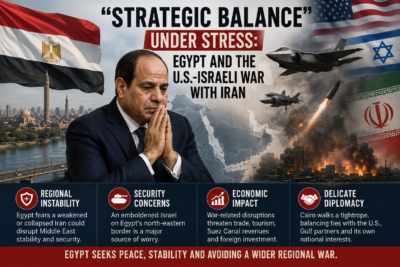
WAR-REPORT : The escalating confrontation involving the United States, Israel, and Iran has placed Egypt in one of the most delicate geopolitical positions it has faced in years. As tensions across the Middle East intensify, Cairo is attempting to maintain a careful strategic balance between regional stability, national security concerns, diplomatic relationships, and economic survival.
Egyptian authorities are increasingly worried that a prolonged war involving Iran could dramatically reshape the balance of power across the Middle East. While Cairo has traditionally maintained close ties with Washington and carefully managed its relationship with Israel since the Camp David Accords, it is also deeply aware that a weakened or destabilized Iran could trigger wider instability throughout the region.
For Egypt, the stakes are not only political or military. The country’s fragile economy, already under severe strain from debt, inflation, and currency challenges, depends heavily on Gulf Arab investment, tourism revenues, shipping income, and regional stability. Any major escalation in the conflict threatens to worsen Egypt’s economic difficulties and increase domestic pressure on the government.
Officials in Cairo are therefore walking a diplomatic tightrope — trying to avoid direct involvement while simultaneously preventing the region from descending into a wider war.
Egypt’s Fear of Regional Destabilization
Egyptian policymakers are deeply concerned that a collapse or severe weakening of Iran could create a dangerous power vacuum across the Middle East.

Although Egypt and Iran have historically had tense relations, Cairo does not necessarily view complete Iranian destabilization as beneficial. Egyptian strategic analysts fear that the sudden collapse of a major regional power could unleash unpredictable consequences, including proxy wars, militant expansion, refugee flows, sectarian violence, and intensified regional rivalries.
Many Egyptian officials believe that maintaining a balance among regional powers has historically helped prevent total domination by any single state.
The possibility of an emboldened Israel emerging from a successful military campaign against Iran is another major concern for Cairo. Egyptian strategists worry that Israeli military superiority, combined with weakened regional rivals, could significantly alter the regional security equation in ways that might eventually affect Egyptian national interests.

Security experts in Cairo are particularly cautious about growing instability near Egypt’s northeastern border and across the broader Eastern Mediterranean region.

Economic Fragility Intensifies Egypt’s Anxiety
The economic dimension of the crisis may be even more critical for Egypt than the military one.
Over the past several years, Egypt has struggled with:
- Rising external debt
- Currency devaluation
- Inflationary pressures
- High unemployment
- Declining purchasing power
- Import dependency
- Energy cost fluctuations
To stabilize its economy, Egypt has increasingly relied on financial support and investment from Gulf Arab states, particularly Saudi Arabia, the United Arab Emirates, and Qatar.
These Gulf investments have become essential for keeping Egypt’s economy functioning amid mounting fiscal pressures.
However, any large-scale regional war involving Iran threatens Gulf economic stability itself. Oil market disruptions, investor uncertainty, shipping insecurity, and rising geopolitical tensions could reduce the flow of capital into Egypt at a time when Cairo desperately needs external financial support.
Egyptian officials understand that even indirect economic shocks from the conflict could trigger serious domestic consequences.
Suez Canal Revenues Under Threat
One of Egypt’s biggest concerns centers around the security of maritime trade routes and the future of Suez Canal revenues.
The Suez Canal remains one of the most important sources of foreign currency income for Egypt. Millions of barrels of oil and enormous volumes of international trade pass through the canal every day.
If the conflict between the U.S., Israel, and Iran expands into maritime confrontations across the Red Sea, the Strait of Hormuz, or nearby shipping corridors, global shipping companies may begin rerouting vessels away from conflict zones.
Any significant decline in Suez Canal traffic would directly affect Egypt’s foreign currency reserves and state revenues.
Egyptian economic experts warn that disruptions to shipping routes could have devastating consequences for the national economy, especially when combined with inflation and debt pressures already affecting the country.
The situation becomes even more dangerous if regional militant groups begin targeting commercial vessels or energy infrastructure.
Tourism Industry Faces New Risks
Egypt’s tourism sector is another area vulnerable to regional instability.
Tourism is one of the country’s most important economic pillars, generating billions of dollars annually and supporting millions of jobs.
However, the Middle East conflict has already begun affecting traveler confidence across the region. International tourists often avoid destinations perceived as geographically close to war zones, even when those countries are not directly involved in the fighting.
Egyptian tourism operators fear that continued escalation could reduce visitor numbers to:
- Cairo
- Luxor
- Aswan
- Sharm El-Sheikh
- Hurghada
- The Red Sea coast
Any major decline in tourism revenues would further intensify Egypt’s economic strain.
Balancing Relations With Washington
Egypt has maintained a long-standing strategic partnership with the United States for decades.
Washington remains one of Egypt’s most important military and diplomatic partners. The Egyptian military receives substantial U.S. assistance, training, and defense cooperation.
At the same time, Cairo is attempting to avoid appearing fully aligned with any military campaign against Iran.
Egyptian diplomacy has therefore focused heavily on calls for de-escalation, ceasefire negotiations, and regional dialogue.
Cairo understands that openly opposing Washington could damage critical strategic ties, while openly supporting military escalation could inflame domestic public opinion and increase regional tensions.
This balancing act has become increasingly difficult as regional alliances shift rapidly.
Public Opinion Inside Egypt
Domestic sentiment inside Egypt adds another layer of complexity for the government.
Many Egyptians remain deeply sympathetic to broader Arab and Palestinian causes and are highly critical of Israeli military operations across the region.
Public opinion in Egypt is often suspicious of expanding Israeli military influence and skeptical of Western intervention in Middle Eastern conflicts.
If the war with Iran intensifies dramatically, the Egyptian government may face growing domestic pressure to adopt stronger political positions.
Analysts believe Cairo is carefully monitoring public sentiment to prevent internal instability while maintaining strategic diplomatic relationships abroad.
Managing this internal-external balance has become one of the government’s most difficult political challenges.
Iran’s Regional Influence and Egypt’s Calculations
Although Egypt and Iran have not maintained strong relations for decades, Cairo still recognizes Iran’s influence across the Middle East.
Iran’s regional network includes influence in:
- Lebanon
- Iraq
- Syria
- Yemen
- The Persian Gulf
- Various militant and political movements
Egyptian strategists fear that attempts to completely dismantle Iran’s regional position could produce widespread instability rather than stability.
Some experts in Cairo believe that weakening Iran too aggressively could intensify sectarian tensions and create space for extremist organizations to expand again across fragile regions.
The memory of previous Middle East conflicts — including Iraq, Libya, and Syria — continues shaping Egyptian thinking about the dangers of state collapse and prolonged war.
Israel’s Expanding Regional Role
The war has also intensified discussions within Egypt regarding Israel’s growing military and political influence across the region.
Egypt remains committed to maintaining its peace treaty with Israel, which has been a cornerstone of regional diplomacy for decades.
However, Egyptian officials are closely watching how the conflict could reshape regional power dynamics.
Some analysts worry that if Iran’s influence declines significantly, Israel could emerge as the overwhelmingly dominant regional military power.
This possibility creates strategic discomfort for several Arab states, including Egypt, even among governments maintaining diplomatic ties with Israel.
Cairo’s security establishment prefers a regional order where power remains relatively balanced among multiple states rather than concentrated heavily in one actor.
Energy Markets and Inflation Risks
The conflict has also created serious concerns regarding global energy prices.
Any disruption involving Iran, the Strait of Hormuz, or Gulf energy infrastructure could trigger major spikes in oil and gas prices worldwide.
For Egypt, rising energy costs would increase:
- Import expenses
- Inflation
- Transportation costs
- Food prices
- Industrial production costs
Higher inflation would place additional pressure on ordinary Egyptians already struggling with economic hardship.
Economic experts warn that food security could also become a serious issue if global shipping disruptions affect grain imports and supply chains.
Egypt is one of the world’s largest wheat importers, making it highly vulnerable to global commodity price shocks.
Regional Diplomacy Intensifies
As tensions rise, Egypt has increased diplomatic engagement with regional and international powers.
Cairo is reportedly seeking to:
- Prevent broader regional escalation
- Encourage ceasefire negotiations
- Protect maritime trade routes
- Maintain economic stability
- Preserve regional security balances
Egyptian diplomacy has historically positioned itself as a mediator in Middle Eastern conflicts, and Cairo may attempt to revive that role during the current crisis.
Officials believe that diplomatic solutions remain the only sustainable path to avoiding catastrophic regional consequences.
Gulf States Also Watching Closely
Egypt is not alone in its concerns.
Several Gulf Arab governments are also cautiously monitoring the conflict while attempting to protect economic and security interests.
Although some Gulf states have improved relations with Israel in recent years, many remain wary of uncontrolled regional escalation.
The Gulf economies are deeply interconnected with global energy markets, maritime trade, and international investment flows.
A prolonged regional war could damage not only oil infrastructure but also long-term investor confidence throughout the Middle East.
Because Egypt’s economic survival increasingly depends on Gulf partnerships, Cairo’s concerns are closely tied to broader Gulf stability.
Fear of a Wider Regional War
Perhaps Egypt’s greatest fear is that the conflict could evolve into a prolonged multi-front regional war.
Such a scenario could involve:
- Proxy militias
- Maritime attacks
- Missile exchanges
- Cyber warfare
- Energy infrastructure strikes
- Refugee crises
- Economic collapse in vulnerable states
Egyptian military planners understand that regional wars rarely remain geographically contained.
Even countries attempting neutrality can eventually suffer severe economic, political, or security consequences.
This reality explains why Cairo has repeatedly emphasized diplomacy, restraint, and de-escalation.
Egypt’s Strategic Tightrope Continues
For now, Egypt continues trying to maintain a difficult strategic equilibrium.
The government wants:
- Strong relations with the United States
- Stability in ties with Israel
- Continued Gulf financial support
- Avoidance of regional collapse
- Protection of domestic stability
- Economic survival
Achieving all these goals simultaneously is becoming increasingly complicated as the conflict intensifies.
Egypt’s position reflects the broader dilemma facing many Middle Eastern states today — balancing geopolitical alliances against domestic pressures, economic fragility, and fears of uncontrollable regional instability.
As the U.S.-Israeli confrontation with Iran continues to evolve, Egypt may find its carefully maintained strategic balance tested more severely than at any point in recent years.