


“People across the country are troubled by the rising cybercrime and the dysfunctional helpline system.”
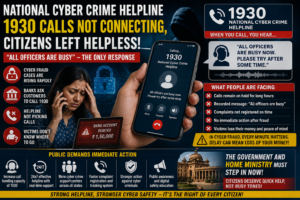
“When calling 1930, people continuously hear a recorded message saying, ‘All officers are busy.’”

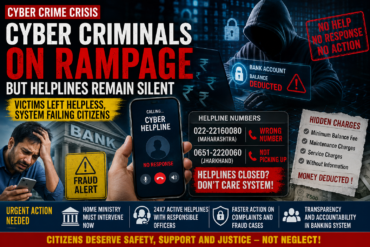
Mumbai – Ranchi – New Delhi: India is rapidly moving toward a digital economy. Online banking, UPI payments, mobile wallets, and internet-based financial services have undoubtedly made life easier for millions of people. However, alongside this digital transformation, the threat of cybercrime is growing at an alarming rate. Every day, thousands of people across the country are falling victim to online fraud, fake calls, digital arrest scams, banking fraud, OTP theft, fake investment schemes, and social media hacking. The biggest concern is that when victims approach cyber helplines or government agencies for assistance, timely support is often unavailable.
In several states, cyber helpline numbers are reportedly either constantly busy, not answering calls, or even found to be incorrect. This situation has created deep public dissatisfaction and growing anger among citizens.
People argue that in the era of Digital India, if victims of cybercrime do not receive immediate support, public trust in online banking and digital payment systems may gradually weaken.
Banks Shifting Responsibility to Cyber Departments
In many cyber fraud cases, victims claim that when they approach banks after unauthorized transactions, bank officials simply advise them to contact cyber cells or the National Cyber Crime Helpline, thereby limiting their own responsibility. Several victims allege that despite money being withdrawn from their accounts, they are not provided adequate information or immediate support.
Many customers complain that even hours after fraudulent withdrawals, they receive no proper alert or assistance from banks. At the same time, frustration is also increasing over minimum balance penalties, service charges, and other deductions. Customers allege that banks deduct various hidden charges without providing clear prior information, adding to the financial stress of ordinary citizens.

No Response from Helpline Numbers
Serious questions are now being raised regarding the functioning of cyber helpline services in multiple states. Complainants claim that helpline numbers such as Maharashtra’s 022-22160080 and Jharkhand’s 0651-2220060 either do not connect, remain unanswered for long periods, or are reportedly incorrect or inactive.
Victims say that when banks direct them to cyber departments and no assistance is available there either, ordinary citizens feel completely helpless. Several people have alleged that some cyber department officials and staff appear to avoid responding to complainants, leading to growing public anger.
Public Anger Growing Over Constantly Busy 1930 Cyber Helpline
Amid rising cybercrime across the country, the National Cyber Crime Helpline 1930 is considered one of the primary support systems for victims. However, a large number of people are now complaining that whenever they call 1930, they repeatedly hear recorded messages stating that “all officers are busy.”

Several victims claim that despite trying for hours, they are unable to register complaints, severely affecting timely action in cyber fraud cases.
Experts point out that the first few minutes after an online fraud are extremely critical. If a complaint is registered immediately, there is a higher chance that bank accounts involved in the fraud can be frozen and money recovered. But when victims cannot even reach the helpline, their difficulties increase significantly.
Victims Left Helpless After Cyber Fraud
Cases of digital arrest scams, fake investment schemes, OTP fraud, UPI scams, social media hacking, and banking fraud are continuously increasing. Victims are often instructed by banks to call the 1930 helpline. But when no response is received there either, citizens feel abandoned by the system.
Rising Threat of Digital Arrest and Online Scams
In recent years, “digital arrest” scams have emerged as one of the fastest-growing forms of cybercrime. Criminals impersonate officials from agencies such as the CBI, ED, police departments, income tax authorities, or banks to intimidate people and force them to transfer money from their bank accounts.
Senior citizens, women, and people with limited technical knowledge are among the most targeted victims.
Cyber criminals are now increasingly using artificial intelligence, fake websites, deepfake videos, and social media platforms to trap people. In many cases, victims lose their life savings within minutes.
Public Confidence in Digital Systems Weakening
Experts warn that unless strong mechanisms are created for controlling cybercrime and ensuring rapid complaint resolution, people may begin distancing themselves from online payments and digital banking. This could negatively impact India’s digital economy.
People living in rural areas and smaller towns are already not fully comfortable with digital systems. Continued cyber fraud and poor support infrastructure could push many citizens back toward cash transactions.
Demand for Home Ministry Intervention
Various social organizations and consumer rights groups are now demanding serious intervention from the Central Government and the Ministry of Home Affairs. Citizens argue that merely issuing helpline numbers is not enough; authorities must also ensure immediate response and effective assistance.
Experts have suggested establishing 24×7 cyber response centers in every state where trained officials can instantly freeze suspicious bank accounts, stop fraudulent transactions, and register complaints without delay. There is also growing demand for real-time coordination between banks and cybercrime departments.
Questions Raised Over Banking Transparency
Customers also claim that lack of transparency in the banking system is becoming a major issue. Many consumers allege that banks impose various penalties and service charges for not maintaining minimum balances without clearly informing customers in advance.
Consumer rights activists argue that every citizen has the right to know why money has been deducted from their account. If banks deduct any charge, customers must receive clear and transparent notifications.
Demand for Accountability from State Authorities
Citizens say that if helpline numbers listed on official government websites are not functioning or if officials do not answer calls, accountability must be fixed. Many people are demanding regular monitoring of cyber helplines and public disclosure of call response times.
Administrative experts believe that if government systems fail to respond in time, public trust in governance itself could weaken. In a democratic system, listening to public grievances and providing quick solutions is considered a fundamental responsibility of the government.
Need to Make Cyber Security a National Priority
Technology experts argue that cybercrime is no longer merely a financial issue; it has become a matter of national security and public confidence. Therefore, India’s cyber security framework needs major strengthening.
Experts have recommended that:
- All state cyber helplines should be integrated into a unified system.
- Responses to complaints should become mandatory within 15 minutes.
- Temporary transaction blocking systems should be introduced immediately in banking fraud cases.
- Large-scale public awareness campaigns on cybercrime should be conducted.
- Special cyber safety training programs should be launched for senior citizens and rural populations.
Government Faces a Major Challenge Ahead
The rapid expansion of digital payments is considered one of the government’s biggest achievements. However, strengthening cyber security and grievance redressal systems is now emerging as one of the country’s biggest challenges.
If strong corrective measures are not implemented in time, public trust in the digital ecosystem may suffer. Citizens today are demanding not only technology and convenience, but also security, accountability, and timely support. The growing issue of cybercrime and weak helpline systems could become a major test for the government, the banking sector, and the administrative machinery in the coming years.