

China–Taiwan Political Tensions Deepen as Opposition Engagement Signals Strategic Shifts
By Samir Singh 'Bharat': Editor In Chief
 war-times.com
Send an email
18 April 2026
war-times.com
Send an email
18 April 2026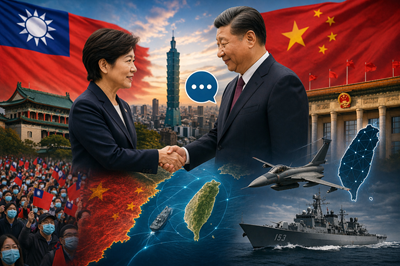
Special-Report : A recent high level meeting between Cheng Li-wun and Xi Jinping has drawn renewed attention to the evolving dynamics of cross strait relations between Taiwan and the People’s Republic of China. The meeting, held on April 10, reflects a broader pattern of engagement between China and Taiwan’s opposition party, the Kuomintang, and highlights Beijing’s ongoing efforts to shape political and economic conditions that favor closer integration.
This development comes at a time of heightened geopolitical tension, with Beijing continuing to assert its long standing claim over Taiwan while simultaneously promoting what it describes as peaceful reunification. The interaction between Cheng and Xi has raised questions about the role of Taiwan’s opposition in facilitating dialogue with China and the potential implications for Taiwan’s domestic politics and international positioning.

A Meeting Framed by Strategic Messaging
The official statement released by Beijing following the meeting emphasized themes that have long been central to Chinese policy toward Taiwan. These included the importance of cross strait integration, opposition to Taiwan independence, and the shared responsibility of both sides to promote closer relations.
Cheng’s remarks during the meeting echoed several elements of this messaging. She referred to the achievements of both Taiwan and mainland China as part of a broader national story, a phrase that aligns with Beijing’s narrative of a unified Chinese identity. This language is commonly used by Chinese officials to reinforce the idea of national rejuvenation, which includes the eventual unification of Taiwan with the mainland.

At the same time, Cheng avoided explicitly endorsing Beijing’s vision of reunification. Reports indicate that she did not directly respond to questions about whether she supports the specific framework proposed by China. This cautious approach reflects the delicate balance that Taiwan’s opposition must maintain between engaging with Beijing and addressing domestic concerns about sovereignty and autonomy.
The Significance of the 1992 Consensus
A central topic of discussion during the meeting was the so called 1992 Consensus. This informal understanding between the Kuomintang and the Chinese Communist Party asserts that both sides recognize the existence of one China, while maintaining different interpretations of what that China represents.
For Beijing, the 1992 Consensus serves as a foundational principle for cross strait dialogue. It provides a framework within which discussions can take place without requiring immediate agreement on the issue of sovereignty. For the Kuomintang, the consensus offers a way to engage with China while preserving its own political stance.

The reaffirmation of this principle by both Cheng and Xi underscores its continued relevance in cross strait relations. However, it remains a contentious issue within Taiwan, where many citizens view it as outdated or insufficient to address current realities.
Historical Context of Cross Strait Engagement
Cheng’s meeting with Xi marks the first time since 2016 that a sitting Kuomintang chairperson has held direct talks with the Chinese leader. The last such meeting involved Hung Hsiu-chu, who similarly emphasized themes of national unity and cross strait cooperation.
Following the election of Tsai Ing-wen in 2016, Beijing suspended official communication channels with Taiwan’s government. Tsai, a member of the Democratic Progressive Party, did not endorse the 1992 Consensus, leading to a breakdown in formal dialogue.
In the absence of official government to government communication, the Kuomintang and other opposition figures have played a key role in maintaining informal channels of engagement with Beijing. This has allowed the party to position itself as a bridge between Taiwan and China, advocating for dialogue and cooperation.
China’s Multi Domain Strategy
The meeting between Cheng and Xi is part of a broader strategy by China to influence Taiwan through multiple channels. While military pressure remains a visible component of this approach, Beijing is also employing economic, political, and social tools to advance its objectives.
One notable development is the release of a ten point plan aimed at increasing integration between China and Taiwan. This plan includes proposals to strengthen infrastructure connections, expand transportation links, and promote economic cooperation.
Particular attention has been given to Taiwan’s offshore islands, including Kinmen and Matsu. These islands are geographically closer to mainland China than to Taiwan’s main island, making them a focal point for integration efforts.
The proposed measures include building infrastructure links between these islands and China’s Fujian Province, as well as allowing direct flights between Taiwan and selected Chinese cities. These initiatives are designed to deepen economic ties and create incentives for closer cooperation.
Economic Integration and Its Implications
China’s emphasis on economic integration reflects a belief that increased interdependence can shape public opinion in Taiwan. By demonstrating the potential benefits of cooperation, Beijing hopes to build support for its broader political objectives.
The focus on Kinmen and Matsu is particularly strategic. These islands already have relatively strong economic and social connections with mainland China. Their proximity and existing ties make them more receptive to integration initiatives compared to other parts of Taiwan.
However, this approach has also raised concerns among analysts and policymakers. Critics argue that increased economic dependence on China could limit Taiwan’s ability to make independent decisions. There are also fears that such initiatives could create divisions within Taiwanese society, particularly if different regions experience varying levels of benefit.
Coercion and Pressure Tactics
In addition to economic measures, China has continued to apply pressure through military and security related activities. These include air and naval operations near Taiwan, as well as actions targeting its offshore islands.
Kinmen, in particular, has been the focus of repeated incursions and demonstrations of force. These activities are intended to signal China’s capabilities and resolve, while also testing Taiwan’s response mechanisms.
Such actions contribute to a climate of uncertainty and tension. They also serve as a reminder that Beijing’s strategy combines both incentives and pressure in pursuit of its goals.
Domestic Reactions in Taiwan
The meeting between Cheng and Xi has sparked a range of reactions within Taiwan. Supporters of the Kuomintang view engagement with China as a pragmatic approach to managing relations and reducing the risk of conflict. They argue that dialogue is essential for maintaining stability and exploring opportunities for cooperation.
Opponents, however, express concern that such interactions may align too closely with Beijing’s agenda. They warn that adopting language and positions associated with Chinese policy could undermine Taiwan’s sovereignty and democratic values.
The broader public remains divided on these issues. While there is strong support for maintaining peace and stability, there is also widespread skepticism about China’s intentions. This creates a complex environment in which political leaders must navigate competing priorities and expectations.
The Role of Identity and National Narrative
Underlying the political and strategic dynamics of cross strait relations is a deeper question of identity. The concept of a shared Chinese nation, emphasized in the meeting between Cheng and Xi, is not universally accepted within Taiwan.
Many Taiwanese identify primarily with their own distinct cultural and political identity, separate from that of mainland China. This perspective has been reinforced by Taiwan’s democratic system and its unique historical experience.
Efforts to promote a unified national narrative therefore face significant challenges. While some individuals and groups may embrace the idea of shared heritage, others view it as incompatible with their sense of identity and political aspirations.
International Dimensions
The situation between China and Taiwan has significant implications for the broader international community. The United States and other countries have a strong interest in maintaining peace and stability in the region.
Taiwan plays a critical role in global supply chains, particularly in the technology sector. Any disruption to cross strait relations could have far reaching economic consequences.
At the same time, the issue is closely tied to questions of international law, sovereignty, and the balance of power in the region. As a result, developments in cross strait relations are closely monitored by governments around the world.

Challenges Ahead
The path forward for Taiwan is shaped by a complex interplay of domestic and external factors. The engagement between the Kuomintang and China highlights the potential for dialogue, but also underscores the challenges involved in balancing competing interests.
China’s strategy of combining economic incentives with political pressure is likely to continue. This approach seeks to create conditions that favor integration while avoiding direct conflict.
For Taiwan, the challenge lies in maintaining its autonomy and democratic system while managing relations with a powerful neighbor. This requires careful policy decisions, strong institutions, and broad public support.
Our Media Opinion
The meeting between Cheng Li wun and Xi Jinping represents a significant moment in the evolving relationship between Taiwan and China. It reflects both the opportunities and the risks associated with cross strait engagement.
While dialogue offers a potential path toward stability, it also raises important questions about sovereignty, identity, and the future of Taiwan. The broader strategy pursued by China, which combines economic integration with political and military pressure, adds further complexity to the situation.
As Taiwan continues to navigate these challenges, the choices made by its leaders and citizens will play a critical role in shaping the future of the region. The balance between cooperation and independence, engagement and caution, will remain at the center of this ongoing and highly consequential issue.
war-times.com
Send an email
18 April 2026