


Person Struck and Killed by Frontier Airlines Plane on Denver Airport
Editorial
 war-times.com
Send an email
9 May 2026
war-times.com
Send an email
9 May 2026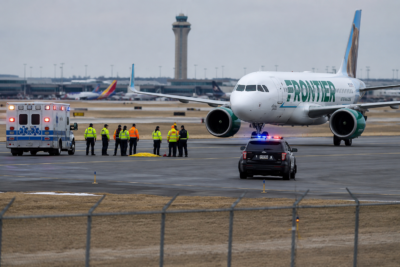
World-Report : A tragic and shocking incident unfolded at Denver International Airport after a man reportedly breached airport security, entered a restricted runway area, and was fatally struck by a moving Frontier Airlines aircraft. The incident has raised serious questions regarding airport perimeter security, mental health concerns, emergency response protocols, and aviation safety in one of America’s busiest airports.
According to preliminary reports from airport authorities and local law enforcement agencies, the unidentified individual managed to jump over the airport’s perimeter fence during the early hours of the morning before entering an active runway zone. Moments later, the individual was struck by a Frontier Airlines aircraft that was either taxiing for departure or preparing for runway movement. Officials confirmed that the victim died instantly due to the severe impact.
Authorities at Denver International Airport immediately suspended portions of airport ground operations following the accident. Emergency crews, airport police, and federal aviation officials rushed to the scene shortly after the collision was reported by the flight crew. The runway area was sealed off as investigators began examining how the person managed to bypass one of the country’s most heavily monitored airport security systems.
Eyewitnesses near the terminal area described seeing multiple emergency vehicles racing toward the runway moments after the aircraft came to a sudden stop. Passengers onboard the Frontier Airlines plane reportedly remained seated for an extended period while law enforcement and airport personnel secured the scene and initiated emergency procedures.
Airport officials later issued a public statement expressing condolences to the family of the deceased and emphasizing that passenger safety remained the top priority. The airport authority confirmed that an investigation involving the Federal Aviation Administration and local police departments was underway.

Sources close to the investigation indicated that surveillance footage captured the individual approaching the restricted area before scaling the perimeter fencing. Investigators are now reviewing whether there were any security lapses, damaged fencing sections, or delayed response times that contributed to the breach.
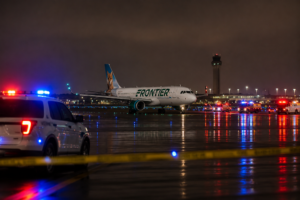
The aircraft involved reportedly sustained limited damage, though operations involving the plane were immediately halted pending technical inspection and investigative clearance. Airline officials stated that the flight crew followed all operational protocols and had little or no opportunity to avoid the collision due to limited visibility and the sudden appearance of the individual on the runway.

The tragic event has once again drawn attention to the immense challenge airports face in securing vast perimeter zones. Denver International Airport covers more than 33,000 acres, making it one of the largest airports in the world by land area. Maintaining constant surveillance across such a massive property presents significant logistical and technological challenges despite advanced monitoring systems, motion sensors, patrol units, and high-security fencing.
Aviation experts noted that runway intrusion incidents involving civilians are extremely rare but can have catastrophic consequences. Airports across the United States operate under strict federal security regulations established after the September 11 terrorist attacks. However, experts argue that perimeter breaches continue to occur occasionally, particularly in isolated sections where human monitoring is limited.
Security analysts believe the incident may trigger renewed debate over whether airports should increase investments in artificial intelligence surveillance systems, automated intrusion detection technology, thermal imaging cameras, and drone-assisted monitoring to prevent unauthorized access.
Several aviation specialists pointed out that airport runways are among the most dangerous operational zones in civil aviation. Aircraft moving on taxiways or runways often have limited maneuverability and cannot stop quickly, especially large commercial jets carrying hundreds of passengers and fuel loads. Even when pilots detect an obstacle, avoiding a collision may become physically impossible within seconds.
Psychological and mental health experts also weighed in on the tragedy, noting that incidents involving deliberate trespassing onto active runways sometimes involve individuals experiencing severe emotional distress, psychological crises, or suicidal intentions. Authorities, however, have not officially confirmed the motive behind the perimeter breach, and investigators continue to examine the background and circumstances surrounding the victim.
Passengers aboard the affected Frontier Airlines flight later described scenes of confusion and fear after the aircraft abruptly stopped. Some travelers reported hearing emergency announcements from the crew while others noticed flashing lights from emergency vehicles surrounding the aircraft outside the windows. Counseling assistance was reportedly offered to crew members and passengers affected by the traumatic event.
Frontier Airlines released a statement expressing deep sorrow over the incident and praising the professionalism of the pilots, cabin crew, and emergency responders. The airline confirmed that it was cooperating fully with federal investigators and airport authorities.
Flight disruptions at the airport continued for several hours following the accident as officials temporarily closed portions of the runway network. Multiple departures and arrivals experienced delays while investigators documented evidence and conducted forensic examinations at the scene.
The incident quickly became national news across the United States, with aviation safety becoming a major topic of discussion on television networks and social media platforms. Many observers questioned how an individual could gain access to such a highly restricted operational zone despite extensive federal aviation security systems.
Transportation safety experts emphasized that while terminal security screening receives significant public attention, airport perimeter protection remains an equally critical component of aviation safety. Airports often rely on extensive fencing, patrol routes, surveillance cameras, and intrusion alarms, but the sheer size of airport properties can create vulnerabilities.
Some former aviation officials suggested that airports may need to implement more aggressive perimeter patrol operations, including robotic surveillance vehicles and AI-powered threat detection systems capable of identifying suspicious movement in real time.
Legal experts noted that airport intrusions can also expose airlines and airport authorities to complicated liability questions, although early indications suggest that the flight crew followed all required safety procedures. Investigators will likely examine cockpit communication records, aircraft movement data, air traffic control instructions, and surveillance footage to reconstruct the sequence of events.
Community leaders in Denver expressed condolences to the victim’s family while urging patience until authorities release verified details. Several officials warned against speculation regarding the individual’s intentions or identity until the investigation is completed.
The tragedy has also reignited broader conversations about mental health support systems across the United States. Advocacy groups highlighted the importance of early intervention programs, emergency counseling resources, and crisis prevention services for vulnerable individuals experiencing emotional distress.
Aviation unions representing pilots and flight crews noted that such incidents can have lasting psychological effects on aviation personnel involved in traumatic runway accidents. Mental health counseling and professional support services are commonly provided to crew members following fatal operational incidents.
Experts explained that pilots operating large commercial aircraft often have only seconds to react during ground movement situations. Because jet aircraft require significant stopping distance and have restricted visibility from cockpit angles, sudden intrusions onto runways can become unavoidable tragedies despite immediate emergency braking attempts.
Investigators from the Federal Aviation Administration are expected to review all security camera footage, emergency response timelines, pilot statements, and airport access systems. Authorities may also evaluate whether existing perimeter infrastructure met federal compliance standards at the time of the incident.
The event has once again demonstrated the delicate balance airports must maintain between operational efficiency, passenger convenience, and high-level security enforcement. Major international airports process thousands of daily movements involving aircraft, vehicles, employees, cargo operations, and passengers, making comprehensive security management a constant challenge.
Transportation analysts believe the Denver incident could influence future airport security policy discussions nationwide. Federal agencies may examine whether additional funding or updated security guidelines are necessary for large-scale airport perimeter protection systems.
Meanwhile, airline passengers across the country continue to express concern over runway safety and airport security procedures. Social media platforms were flooded with reactions ranging from sympathy for the victim to demands for stronger airport security infrastructure.
Law enforcement officials have not yet publicly released the victim’s identity pending notification of family members. Investigators are also reportedly examining whether the individual acted alone and whether any suspicious circumstances preceded the perimeter breach.
Airport operations at Denver International Airport gradually returned to normal later in the day, though the emotional impact of the tragedy remained significant among passengers, airline staff, and emergency responders involved in the incident.
Aviation historians noted that while runway intrusion accidents involving civilians are uncommon, past incidents have prompted airports worldwide to modernize perimeter security technologies. Some international airports now deploy intelligent sensor systems capable of detecting fence climbing, unauthorized movement, or heat signatures across large operational zones.
Experts say future aviation security may increasingly rely on integrated technologies combining artificial intelligence, automated patrol drones, biometric tracking, radar systems, and predictive threat analysis. However, even the most advanced systems cannot entirely eliminate unpredictable human actions.
As federal investigators continue their work, authorities are expected to release additional findings regarding the exact sequence of events, security response measures, and recommendations aimed at preventing similar incidents in the future.
For now, the tragic death on the runway serves as a sobering reminder of both the dangers of restricted airport environments and the ongoing challenges facing aviation security systems in an era of increasingly complex operational demands.
war-times.com
Send an email
9 May 2026