


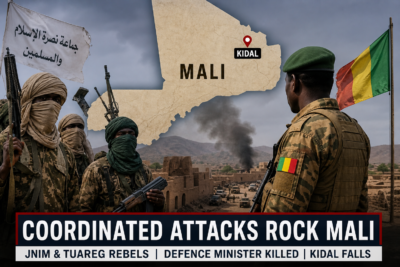
New Delhi : A sweeping wave of coordinated attacks across northern and central Mali has pushed the Sahel into a new phase of instability, raising urgent concerns about governance, security, and regional cooperation. Analysts, including Sahel specialist Ibrahim Yahaya Ibrahim, warn that the evolving alignment between jihadist groups and Tuareg separatists marks a critical turning point in the conflict.
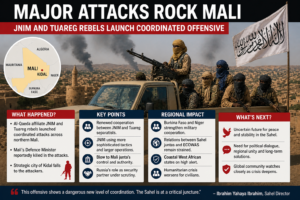
The offensive—linked to the al-Qaeda–affiliated Jama’at Nusrat al-Islam wal-Muslimin (JNIM) and Tuareg rebel factions—demonstrates a level of coordination and operational depth rarely seen in recent years. Reports of the killing of Mali’s defence minister and the fall of the strategic northern city of Kidal have intensified fears about the resilience of the Malian state.
A Coordinated Offensive Across Key Regions
The recent attacks appear to be the result of deliberate planning and synchronized execution. Militants targeted military outposts, administrative centers, and supply routes across multiple regions, overwhelming local defenses.
The capture of Kidal is particularly significant. Historically contested, Kidal has long been a symbol of control over northern Mali. Its fall represents both a strategic and psychological blow to the ruling authorities in Mali.
Equally troubling was the reported killing of a senior defence official during the attacks. Such a high-level casualty highlights the precision and boldness of the operation, suggesting that the attackers had access to detailed intelligence and operational coordination.

JNIM and Tuareg Rebels: A Strategic Convergence
The renewed cooperation between Jama’at Nusrat al-Islam wal-Muslimin and Tuareg separatist groups represents a notable shift in the conflict landscape.
Traditionally, Tuareg rebels have sought autonomy or independence for northern Mali, while JNIM has pursued a broader ideological goal rooted in establishing governance based on its interpretation of Islamic law. Despite these differences, the two appear to have found common ground in opposing the Malian state.
This convergence is driven by pragmatic considerations:

- A shared adversary in the Malian military and its allies
- Mutual benefits from combining resources and local knowledge
- The opportunity to exploit political and military vulnerabilities
The alliance enhances both groups’ capabilities, allowing for more effective and operations.
Evolving Tactics and Military Sophistication
The latest offensive illustrates how Jama’at Nusrat al-Islam wal-Muslimin has evolved beyond traditional insurgent tactics.
Instead of relying solely on hit-and-run attacks, the group is now engaging in:
- Coordinated, multi-location assaults
- Attempts to seize and hold territory
- Targeted strikes against high-ranking officials
This shift suggests an ambition to move from disruption to control, aiming to establish influence over key areas.
Tuareg fighters, with their deep familiarity with the terrain and local dynamics, play a crucial supporting role, enabling more effective of complex operations.
Implications for Mali’s Military Junta
The ruling military leadership in Mali faces mounting pressure as a result of these developments.
The loss of territory and the assassination of senior officials have:
- Undermined public confidence in the government
- Exposed weaknesses in military readiness
- Raised questions about the effectiveness of current strategies
The junta, which came to power promising improved security, now finds itself confronting a more organized and determined adversary.
If the situation continues to deteriorate, analysts warn that internal divisions and political instability could further weaken the government’s position.
Russia’s Role as a Security Partner
In recent years, Mali has strengthened ties with Russia as part of its security strategy.
This partnership includes:
- Military training and advisory support
- Deployment of security personnel
- Provision of equipment and logistical assistance
However, the effectiveness of this collaboration is now under scrutiny. Despite increased support, militant groups appear to be expanding their influence, raising doubts about the long-term viability of the current approach.
Regional Responses: Burkina Faso and Niger
The crisis in Mali is closely linked to broader instability in neighboring countries such as Burkina Faso and Niger.
Both nations, governed by military authorities, face similar threats from extremist groups. In response, they have:
- Intensified military operations
- Strengthened border security
- Increased cooperation with Mali
However, limited resources and ongoing political challenges complicate their efforts to contain the threat.
Strained Relations with ECOWAS
Tensions between Sahelian military governments and ECOWAS have further complicated the situation.
ECOWAS has imposed sanctions and called for a return to civilian rule, while military-led governments have resisted external pressure. This friction has weakened regional coordination at a time when unified action is crucial.
Coastal West Africa on Alert
Countries along the West African coast are increasingly concerned about the potential spread of instability.
Nations such as Ghana, Ivory Coast, and Benin have taken precautionary measures, including:
- Increasing military patrols
- Enhancing intelligence-sharing mechanisms
- Strengthening border defenses
The possibility of extremist groups expanding into coastal regions represents a significant strategic concern.
Humanitarian Consequences
The impact of the conflict extends far beyond military considerations. Civilians in affected areas are facing severe hardships, including:
- Displacement from their homes
- Limited access to food and healthcare
- Increased exposure to violence
Humanitarian agencies warn that conditions could worsen if the conflict continues unchecked.
Future Outlook: Uncertainty and Risk
The situation in Mali remains highly volatile. Key questions remain unanswered:
- Can the government regain control of lost territory?
- Will the alliance between JNIM and Tuareg rebels endure?
- How will regional and international actors respond?
Experts like Ibrahim Yahaya Ibrahim emphasize that military solutions alone are unlikely to resolve the crisis. Long-term stability will require:
- Political dialogue and reconciliation
- Economic development initiatives
- Strengthened governance and institutions
Our Media Opinion: A Region at a Critical Juncture
The coordinated offensive in Mali highlights the evolving nature of conflict in the Sahel. The alignment between extremist groups and separatist movements, combined with weak state institutions and regional tensions, creates a complex and challenging environment.
As the crisis unfolds, the need for comprehensive and coordinated responses becomes increasingly urgent. The coming months will play a decisive role in determining whether the region moves toward further instability or finds a path toward sustainable peace.