


Social Media Revolt: Gen Z Questions Raghav Chadha’s Credibility
By Doruvu Paul Jagan Babu: Assistant Chief Editor

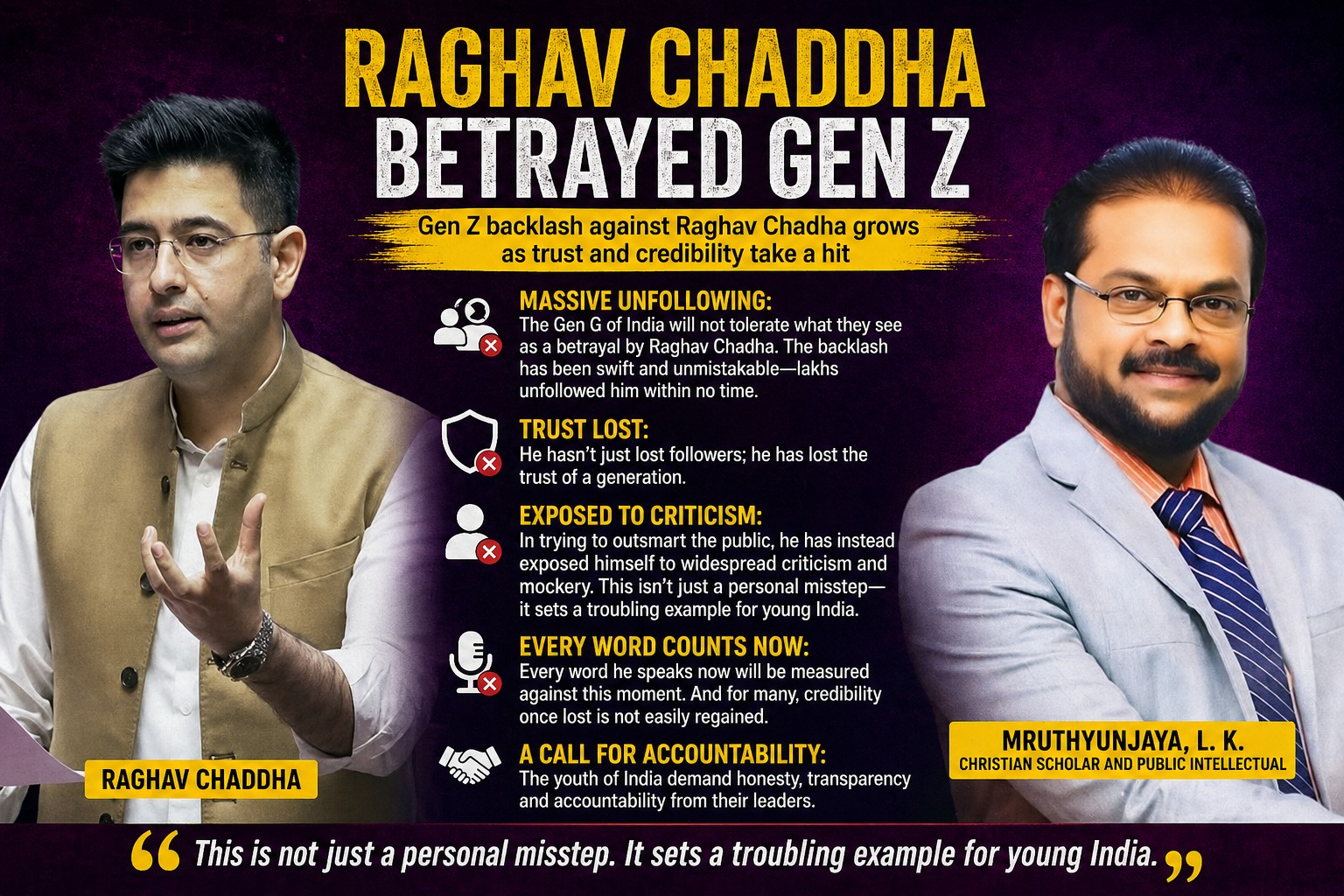
A sharp wave of criticism from young Indians has engulfed Raghav Chadha, with large-scale social media unfollows and public disapproval reflecting what some observers describe as a growing trust deficit between political figures and the Gen Z electorate.
A sudden digital backlash
The response from Gen Z has been swift and visible, marked by a significant drop in online support. Social media platforms witnessed lakhs of users distancing themselves, signaling not just disagreement but a deeper sense of disillusionment.
This reaction underscores the increasing influence of digital sentiment in shaping political narratives, especially among younger audiences.
Trust deficit among young voters

According to Christian Scholar and public intellectual Dr. Mruthyunjaya, L K, the issue extends beyond a single controversy. He argues that the episode has eroded trust among Gen Z, a demographic known for its heightened sensitivity to authenticity and accountability.
For many young citizens, the perceived misstep is not merely political—it is seen as a breach of credibility.
A wider message for political leadership

The incident highlights a broader challenge for contemporary leaders: engaging a generation that demands transparency and consistency. Attempts to navigate public perception without clarity, critics suggest, can quickly backfire in an era of instant digital scrutiny, he added.
Long-term impact on credibility
Analysts note that reputational damage in the digital age can be difficult to reverse. Every future statement or action is likely to be evaluated through the lens of this controversy, making recovery a gradual and uncertain process.
A generational shift in accountability
The episode reflects a larger shift in Indian politics, where younger voters are increasingly assertive and less forgiving. Their expectations go beyond rhetoric, focusing instead on integrity and alignment between words and actions.
The backlash serves as a reminder that in today’s political landscape, credibility is both fragile and critical—especially among Gen Z, whose collective voice is rapidly becoming a decisive force.