


Malaika Arora’s Salad Confession: Does Healthy Eating Really Have to Look Like a Diet?
But Malaika Arora has now offered a rather different perspective.

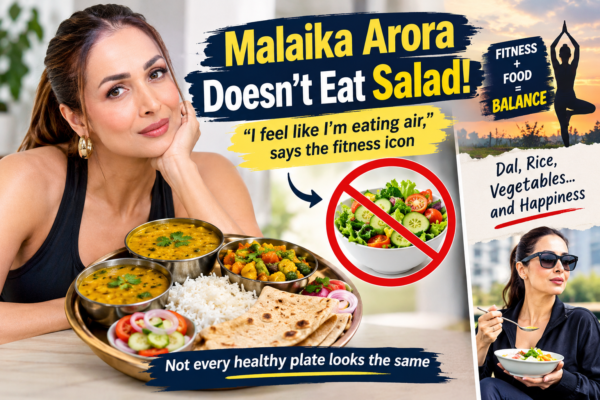
Opinion : At 52, Malaika Arora says she does not enjoy salads and prefers satisfying home-cooked meals such as dal, rice and vegetables, offering a refreshing perspective on celebrity fitness and the pressure to eat like a “fitness influencer”
For years, celebrity fitness culture has quietly created an image of what a “healthy” plate is supposed to look like.
A bowl filled with lettuce, cucumber, tomatoes and a few carefully arranged vegetables is often presented as the ultimate symbol of discipline. Add a green juice, a workout photograph and a yoga session, and the picture seems complete.
But Malaika Arora has now offered a rather different perspective.
At 52, the actor and fitness personality has openly admitted that she does not enjoy eating salads. Speaking to Sophie Choudry on Famously Fit with Sophie on Amazon MX Player, Malaika explained that a bowl of salad does not feel like a satisfying meal to her.

Her description was remarkably simple: if someone gives her salad, she feels as though she is “eating air.”
The comment may sound humorous, but it touches upon a much larger conversation about food, fitness and celebrity culture.
Malaika has spent decades being associated with fitness, yoga, movement and a disciplined lifestyle. Her physical appearance has frequently attracted public attention, making her comments about food particularly interesting.

Yet her latest revelation does not suggest that she has rejected healthy eating.
Instead, it highlights something that is often forgotten in the increasingly commercial world of diet culture: healthy eating does not necessarily have to look the same for everyone.
Malaika Arora Is a Fitness Icon Who Says She Is Also a Foodie
Perhaps the most interesting part of Malaika’s comments is not that she dislikes salads.
It is that she describes herself as a foodie.
During her conversation with Sophie Choudry, she spoke about her love for food and made it clear that eating is an important part of her life.
That is an interesting contrast to the stereotype surrounding celebrity fitness.
When people think about a celebrity known for maintaining a fit physique, they often imagine extremely restrictive meals, tiny portions and endless bowls of green vegetables.
Malaika’s comments challenge that image.
Her approach appears to be based less on eliminating food and more on maintaining a relationship with food that she can actually enjoy.
That distinction matters.
Because a diet that looks perfect on social media may not necessarily be sustainable in real life.
A person may be able to eat salads for a few days because they have decided to follow a strict diet. But if every meal leaves them unsatisfied, hungry or unhappy, maintaining that routine for months or years can become difficult.
Malaika’s philosophy appears to be different.
She wants food to be nutritious, but she also wants it to be enjoyable.
And perhaps that is one of the more realistic lessons emerging from her comments.
The Great Bollywood Salad Myth
The entertainment industry has often promoted a particular image of fitness.
Actors train for hours.
Actresses post yoga photographs.
Celebrities share carefully designed meal plans.
Nutrition becomes part of the public image.
Over time, certain foods become associated with celebrity fitness.
Salad is one of them.
The humble salad has somehow become a symbol of discipline.
If someone is eating a bowl of vegetables, people assume that person must be serious about health.
If someone is eating rice, roti or dessert, the judgment can be very different.
But nutrition is not quite that simple.
A healthy diet is not determined by whether a meal looks fashionable or whether it can be photographed attractively for social media.
It is about the overall nutritional balance, portion sizes, individual requirements and long-term eating habits.
Malaika’s point is not that salads are unhealthy.
She has acknowledged that many people enjoy them.
Her point is simply that salad does not work for her as a satisfying meal.
That is an important distinction.
There is a difference between saying, “I don’t like this food,” and saying, “This food is bad for everyone.”
Malaika appears to be making the first argument, not the second.
So What Does Malaika Actually Like to Eat?
Malaika’s food preferences are much closer to familiar Indian home cooking than the stereotypical celebrity diet might suggest.
She has previously spoken about eating a balanced, home-cooked diet and has discussed foods such as dal, sabzi, roti and rice.
Lunch has been described as an important meal for her, with combinations including rice, vegetables and lentils.
She has also spoken about choosing organic produce where possible.
Dinner can sometimes be lighter, with soup among the foods she has mentioned, while khichdi has also featured among her preferred meals.
There is something particularly interesting about this.
The food on Malaika’s plate does not necessarily look dramatically different from what millions of Indian families eat every day.
Dal.
Vegetables.
Rice.
Roti.
Khichdi.
These are not exotic celebrity foods.
They are staples of Indian kitchens.
The difference is perhaps not what she eats, but how consistently she approaches food, exercise and overall lifestyle.
That is an important point because celebrity culture often creates the impression that fitness requires expensive ingredients, imported superfoods or highly specialised meals.
Malaika’s comments suggest that a person can maintain a fitness-oriented lifestyle while continuing to eat familiar food.
Rice Is Not Automatically the Enemy
One of the most interesting aspects of Malaika’s food philosophy is her attitude towards rice.
For years, rice has been treated almost like a forbidden food in certain sections of diet culture.
The word “carbohydrate” is sometimes enough to make people nervous.
Rice is often the first food removed from a weight-loss plan, even though it remains a staple in large parts of India and across Asia.
Malaika, however, has spoken about having rice as part of lunch, particularly in combination with dal and vegetables.
That combination itself is worth examining.
A plate containing rice, dal and vegetables is fundamentally different from eating a large quantity of rice alone.
The meal brings together carbohydrates, plant-based protein and vegetables, creating a broader nutritional combination.
A dietitian quoted by The Indian Express has similarly explained that rice can form part of a balanced meal when paired with protein-rich foods such as dal or pulses and vegetables, while appropriate portions and preparation methods remain important.
The lesson is not that rice is a “fitness food.”
Nor is it that everyone should eat rice every day.
The lesson is simpler:
One food does not determine whether an entire diet is healthy.
The overall pattern matters.
Why the “Perfect Diet” Does Not Exist
The modern fitness industry sometimes creates the illusion that there is one perfect diet.
One person avoids carbohydrates.
Another avoids dairy.
Someone else avoids gluten.
Another follows intermittent fasting.
Someone drinks green juice.
Someone eats only high-protein meals.
Another person insists that dinner should be finished before sunset.
And social media turns all of these individual choices into universal advice.
But human beings are different.
Their nutritional needs are different.
Their activity levels are different.
Their cultural food habits are different.
Their work schedules are different.
Their health circumstances are different.
Even their relationship with hunger and satisfaction can be different.
Therefore, a diet that works well for one person may not necessarily be appropriate for another.
Malaika’s salad confession becomes interesting precisely because she is not presenting herself as someone who has discovered a universal formula.
She is simply explaining what works for her.
That is considerably more realistic than the idea that everyone needs to copy a celebrity’s breakfast, lunch or dinner.
The Real Issue Is Satisfaction
Perhaps the most important word in Malaika’s comments is not “salad.”
It is satisfaction.
If a person eats a meal and still feels hungry shortly afterwards, that meal may not be appropriate for that individual as a complete meal.
That does not make the food unhealthy.
It simply means the meal may need to be changed, expanded or combined with other foods.
This is where the difference between dieting and sustainable eating becomes important.
A diet based entirely on restriction may produce short-term changes for some people.
But long-term health requires habits that a person can realistically maintain.
If someone loves Indian home cooking, telling them that fitness requires abandoning rice, dal and roti completely may not be realistic.
If someone loves salads, there is obviously no reason to discourage them from eating salads.
The goal should not be to create anxiety around food.
The goal should be to develop a sustainable relationship with it.
Malaika’s comments fit comfortably into that broader idea.
Fitness Does Not Have to Mean Punishment
There is a growing tendency in popular culture to treat fitness almost like punishment.
Eat less.
Work harder.
Sleep less.
Cut carbohydrates.
Avoid sugar.
Skip dinner.
Train every day.
And then repeat.
But a healthy lifestyle cannot simply be a permanent battle against food.
Exercise is important, but so are recovery and adequate nutrition.
Food provides energy.
It is also part of social life, culture and emotional experience.
Malaika’s statement that she loves food offers a refreshing contrast to the idea that being fit requires being permanently dissatisfied with what is on the plate.
Her philosophy appears to be closer to balance than deprivation.
That does not mean indulgence without limits.
It means recognising that healthy living has to fit into real life.
The Indian Home-Cooked Meal Gets a Celebrity Endorsement
There is also a cultural dimension to Malaika’s comments.
For decades, Indian home cooking has sometimes been portrayed as incompatible with modern fitness.
The assumption is that if someone wants to stay fit, they need to replace traditional meals with imported ingredients and expensive health products.
But Malaika’s food choices challenge that assumption.
Dal and vegetables are not new.
Rice is not new.
Roti is not new.
Khichdi is certainly not new.
These foods have existed in Indian households for generations.
The modern conversation is not about discovering them.
It is about understanding how they fit into a balanced diet.
That is why the celebrity dimension of Malaika’s comments is significant.
When a well-known fitness personality says that she enjoys ordinary home-cooked food, it potentially pushes back against the idea that fitness requires abandoning familiar cuisine.
But Celebrity Diets Should Not Become Personal Prescriptions
There is one important caution.
Malaika Arora’s diet should not automatically become a template for everyone else.
Celebrity lifestyles are often very different from ordinary routines.
Actors may have access to trainers, chefs, nutrition professionals and structured exercise schedules.
Their working hours can also be unusual.
Their dietary requirements may differ.
Their bodies, metabolism, age, activity levels and personal circumstances are different.
Therefore, copying a celebrity’s exact meal plan is not necessarily sensible.
The useful part of Malaika’s comments is not the specific menu.
It is the principle behind it.
Find a sustainable way of eating that provides adequate nutrition and that you can actually enjoy.
That is a much more practical message than “eat exactly what this celebrity eats.”
The Bigger Problem With Celebrity Food Culture
Celebrity food culture has become a business of its own.
There are detox drinks.
Protein powders.
Diet plans.
Fitness apps.
Meal subscriptions.
Supplements.
Cookbooks.
Social-media programmes.
And countless influencers selling a particular version of health.
The consumer is constantly being told that the next product, ingredient or diet will transform their body.
Malaika’s comments offer an unexpectedly simple counterpoint.
Maybe healthy eating does not need to be complicated.
Maybe it does not need to be expensive.
Maybe it does not require abandoning every food you enjoy.
Maybe the real challenge is not discovering the “perfect” diet, but finding a balanced routine that can be followed consistently.
That message is not as glamorous as a celebrity detox programme.
But it may be considerably more practical.
What Malaika’s Comments Really Say About Modern Fitness
There is another important element here.
Malaika is 52.
Her continued association with fitness makes her comments about food particularly relevant to conversations about ageing.
The popular culture surrounding women often places extraordinary pressure on appearance.
Women are expected to remain youthful.
They are expected to remain slim.
They are expected to maintain a particular body shape.
And celebrities face even greater scrutiny.
Against that background, Malaika’s willingness to say that she simply does not enjoy salad is surprisingly ordinary.
She is essentially saying:
I exercise, I care about my health, but I also like eating food that satisfies me.
That is a far more human message than the carefully controlled image of a celebrity who supposedly survives entirely on green vegetables and air.
From “Diet Culture” to “Lifestyle Culture”
Perhaps the broader shift happening in health conversations is from dieting to lifestyle.
A diet is often understood as something temporary.
A lifestyle is something sustainable.
A temporary diet asks:
How quickly can I change my body?
A sustainable lifestyle asks:
How can I remain healthy for years?
Those are two very different questions.
Malaika’s comments appear more compatible with the second approach.
Her fitness routine includes yoga and physical activity, while her food choices include familiar home-cooked meals.
That combination suggests that health is not necessarily created by eliminating every food that has been labelled “bad.”
It can also come from consistency.
The Salad May Be Innocent After All
Perhaps the funniest conclusion from this entire discussion is that the salad itself has done nothing wrong.
Malaika does not like it.
Millions of other people do.
Some people may find a salad completely satisfying.
Others may need dal, rice, vegetables or another combination.
There is no reason for the salad to become the villain.
The real villain may be the idea that everyone must eat the same way to be healthy.
That is the myth worth questioning.
Opinion: Fitness Should Fit Into Life, Not Replace It
Malaika Arora’s latest comments may appear at first to be a light-hearted celebrity confession.
“I don’t eat salad.”
But behind that statement is a much larger conversation about how society defines health.
For years, fitness culture has sometimes suggested that healthy people must eat tiny portions, eliminate carbohydrates and survive on salads.
Malaika’s comments present a different picture.
She describes herself as a foodie.
She enjoys eating.
She prefers familiar home-cooked meals.
She has spoken about dal, vegetables, roti, rice and khichdi.
And she continues to maintain a fitness-oriented lifestyle.
The important point is not that everyone should copy Malaika.
It is that nobody needs to copy someone else’s plate simply because that person is famous.
Salads can be healthy.
Rice can be part of a balanced meal.
Dal can provide protein.
Vegetables can add fibre and micronutrients.
And food can still be enjoyable.
Perhaps that is the most refreshing part of Malaika’s statement.
At a time when social media increasingly turns eating into a performance, she has offered a reminder that food is supposed to be lived with—not feared.
Fitness should not mean turning every meal into a punishment.
Healthy eating should not require permanent dissatisfaction.
And a balanced lifestyle does not need to look like a celebrity Instagram post.
Sometimes, it can simply look like a plate of dal, rice and vegetables—followed by the very ordinary human reaction that says:
“Now that feels like a meal.”