


Rakhi Sawant vs Komal Rani: When Bollywood’s Personal Drama Becomes Public Entertainment
Rakhi Sawant’s latest attack on Govinda’s rumoured partner has turned a private relationship controversy into a larger debate about celebrity boundaries, marriage, publicity and the business of viral headlines

Opinion I Bollywood has always had a complicated relationship with controversy. A private disagreement can become a public statement, a public statement can become a paparazzi moment, and a paparazzi moment can quickly turn into a national entertainment story.
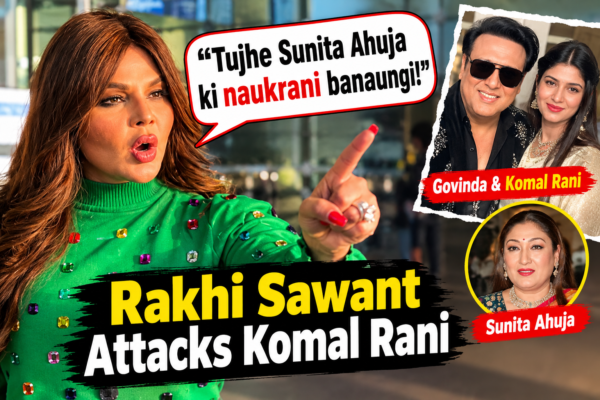
The latest chapter in that familiar cycle involves veteran actor Govinda, his wife Sunita Ahuja, actress Komal Rani Swarnkar and outspoken entertainer Rakhi Sawant.
Rakhi has once again publicly backed Sunita and launched a fierce verbal attack on Komal, whom sections of the media have described as Govinda’s “rumoured girlfriend.” Rakhi accused Komal of interfering in Govinda and Sunita’s marriage, called her a “husband stealer” and “gold digger,” and issued a series of highly aggressive warnings while speaking to paparazzi. She also claimed that she had spent ₹65,999 watching Govinda’s films over the years and jokingly demanded the money back.
But there is an important point that should not disappear beneath the noise:
A rumour is not a confirmed relationship, an accusation is not a proven fact, and a celebrity statement is not a court verdict.

Komal Rani Swarnkar has publicly denied the romantic interpretation of her association with Govinda, saying their connection is professional and linked to their upcoming film work. Govinda’s manager has also denied reports that the actor was planning to marry Komal.
That makes the controversy much more interesting than a simple celebrity fight.
It raises a broader question: When does defending someone become public interference, and when does entertainment journalism turn somebody’s private life into a permanent public spectacle?

Rakhi Sawant Turns the Volume Up
Rakhi Sawant is hardly a newcomer to headline-making controversy.
Her public persona has long been built around outspoken statements, dramatic reactions and an ability to turn ordinary celebrity developments into theatrical moments.
This time, however, she says her intervention is motivated by support for Sunita Ahuja.
Speaking to paparazzi, Rakhi reportedly directed a series of harsh remarks at Komal and warned her against interfering in Sunita and Govinda’s relationship. She also used highly insulting language and described Komal as a “gold digger” and “husband stealer.”
Rakhi also suggested that she would become wealthy herself and joked about using Govinda’s money to produce films.
The remarks were clearly designed for a public audience.
And that is where the modern celebrity ecosystem becomes fascinating.
The airport is no longer simply an airport.
The paparazzi camera is no longer simply a camera.
And a celebrity statement is no longer simply a statement.
Everything can become content.

The ₹65,999 Question
Perhaps the most entertaining part of Rakhi’s latest intervention was her demand that Govinda return ₹65,999.
Her reasoning was deliberately dramatic: she claimed that she had spent that amount over the years watching Govinda’s films since childhood.
It was obviously presented as a humorous and exaggerated demand rather than a conventional financial claim.
But beneath the joke lies an interesting idea about celebrity economics.
Fans spend money on movies.
They buy tickets.
They subscribe to platforms.
They purchase merchandise.
They follow stars on social media.
They defend them during controversies.
They contribute to the commercial ecosystem that makes celebrity possible.
So when Rakhi jokingly says, “Give my money back,” she is turning the relationship between celebrity and audience into a comedy.
The fan says:
“I invested in your entertainment. Now I want a refund for the drama.”
Of course, nobody seriously expects a veteran actor to refund decades of movie tickets.
But the joke works because Bollywood audiences increasingly feel like participants rather than passive spectators.
The Govinda-Sunita Story Has Become Bigger Than One Rumour
The current controversy did not begin with Rakhi.
Govinda and Sunita Ahuja’s marriage has been the subject of public discussion for months.
Sunita has made several public comments about difficulties in the relationship. In August, she reportedly claimed that Govinda had been considering marriage to Komal if she had proceeded with divorce. Govinda’s manager subsequently denied that there was any plan for a second marriage.
That distinction is extremely important.
There are competing public claims.
There are media reports.
There are statements from individuals.
There are denials.
And there are social media interpretations.
But none of those automatically establish what happened privately between the people involved.
The public sees fragments.
The people inside the relationship know the complete story.
That difference is often forgotten in the age of instant entertainment.
Who Is Komal Rani Swarnkar?
Komal Rani Swarnkar has attracted significant attention after appearing publicly with Govinda.
The two have been associated professionally and are connected through upcoming film projects. Their appearance together at Mumbai airport earlier this year triggered speculation about their personal relationship. Neither had publicly confirmed a romantic relationship at the time the rumours began.
More recently, Komal addressed the controversy herself.
She argued that she should not be blamed for problems in a relationship that existed before her association with Govinda and rejected the idea that she was responsible for “breaking” a marriage.
A newer statement from Komal has gone even further, saying that her association with Govinda is professional and that the public should not automatically interpret professional appearances as evidence of a romantic relationship.
This creates a fascinating contradiction at the heart of the controversy.
Rakhi says:
“There is a problem.”
Komal says:
“There is no romantic relationship.”
Govinda’s manager says:
“There is no second marriage plan.”
And the internet says:
“We have already decided what happened.”
That last voice may be the loudest—but it is not necessarily the most reliable.

The Lalbaugcha Raja Episode Changed the Temperature
The controversy intensified after Govinda and Komal were seen together at Mumbai’s Lalbaugcha Raja.
Sunita visited the famous Ganpati pandal separately, while Govinda later arrived with Komal. Photographs and videos quickly circulated online.
Rakhi had already expressed her opinion about the situation.
She questioned why Govinda was attending such an important religious occasion without Sunita and argued that, after decades of marriage, the couple should have appeared together.
Her criticism was not merely about a religious visit.
It was about symbolism.
For many Indians, a major family or religious occasion represents togetherness.
Therefore, seeing a married celebrity arrive with another woman naturally created a visual narrative.
But visual narratives can be misleading.
A photograph can show who stood beside whom.
It cannot automatically explain what relationship exists between those people.
That is a crucial distinction in celebrity reporting.
Bollywood’s Favourite Formula: One Photograph, Ten Theories
Modern celebrity culture has created an almost automatic formula.
One photograph appears.
Social media notices it.
A headline asks a question.
Another platform turns the question into a statement.
A video adds background music.
A commentator gives an opinion.
Another celebrity reacts.
Then the original people involved have to explain themselves.
By that point, the story has become bigger than the original event.
The Govinda-Komal controversy demonstrates exactly how this cycle works.
A professional association becomes a relationship rumour.
The relationship rumour becomes a marriage controversy.
The marriage controversy produces statements.
Those statements generate reactions.
The reactions create more headlines.
And finally, the entertainment industry ends up discussing the discussion.
It is almost a self-sustaining media machine.
Rakhi’s Defence of Sunita Raises Another Question
There is nothing unusual about a celebrity supporting another celebrity.
Rakhi has every right to express sympathy for Sunita.
The question is about how that support is delivered.
When support becomes personal insults and threats, the conversation moves away from the original issue.
Instead of discussing whether Govinda and Sunita are facing genuine marital problems, the public begins debating Rakhi’s language.
That may actually benefit the entertainment cycle.
The more dramatic the statement, the more attention it receives.
The more attention it receives, the more headlines it generates.
And the more headlines it generates, the greater the incentive for another statement.
This is the modern attention economy.
Calm statements receive limited attention.
Explosive statements receive millions of views.
Is Celebrity Privacy Still Possible?
This controversy also raises an uncomfortable question about privacy.
Should celebrities be expected to explain their marriages?
Should actors have to publicly justify who they attend a religious event with?
Should a professional association automatically become a subject of public investigation?
And should another celebrity be able to publicly attack someone based on speculation?
The answer is complicated.
Celebrities voluntarily live much of their lives in public.
They promote films, attend events, post photographs and interact with fans.
But public visibility does not automatically eliminate the right to privacy.
A celebrity can be famous and still have personal boundaries.
That principle applies equally to Govinda, Sunita and Komal.
The “Husband Stealer” Label
The most controversial part of Rakhi’s comments is perhaps the use of labels such as “husband stealer.”
Such language may generate strong headlines, but it also simplifies complicated personal relationships.
A marriage involves at least two people.
If there is a genuine marital dispute, responsibility cannot automatically be assigned to an outsider simply because that person is associated with one spouse.
Similarly, if a married person is involved in an inappropriate relationship, the married person’s own responsibility cannot simply disappear from the discussion.
This is why celebrity relationship controversies should not become one-woman blame games.
If there is a problem inside a marriage, the individuals within that marriage ultimately have to address it.
The public can comment.
The paparazzi can record.
The television channels can debate.
But none of them can actually repair the relationship.
“Gold Digger” Is Another Dangerous Shortcut
Rakhi also described Komal as a “gold digger.”
Again, this is an accusation rather than an established fact.
There is no responsible basis for presenting such a label as a confirmed description of a person’s motives.
The term has become common in celebrity culture because it is dramatic, simple and instantly understandable.
But real relationships are rarely that simple.
People work together.
People become friends.
People develop professional associations.
People form personal relationships.
And people can also be misunderstood.
Without reliable evidence, financial motives should not be treated as established facts.
Govinda’s Silence Becomes Part of the Story
Interestingly, every controversy surrounding a celebrity creates a strange situation.
If the celebrity speaks, the statement becomes news.
If the celebrity remains silent, the silence becomes news.
If the celebrity denies the story, people ask why the denial was necessary.
If the celebrity refuses to comment, people ask what is being hidden.
There is no easy exit.
Govinda has reportedly described aspects of his personal life as private, while his manager has rejected the reported second-marriage claim involving Komal.
That suggests one sensible approach:
Allow the people directly involved to define their own relationships.
The Real Entertainment Story Is Not the Fight
The deeper entertainment story is not whether Rakhi can outshout Komal.
It is not whether Sunita can win public sympathy.
It is not whether paparazzi cameras can capture another dramatic moment.
The bigger story is how Bollywood’s private relationships are increasingly becoming public entertainment products.
The industry now operates in an environment where personal life can influence film publicity, social media engagement and public image.
A romantic rumour can create publicity.
A controversy can increase visibility.
A public argument can generate millions of views.
And an actor’s personal life can suddenly become part of a film’s marketing conversation.
This is where entertainment journalism needs responsibility.
When Personal Drama Becomes Promotional Currency
There is also a business angle.
Govinda and Komal are associated with film projects.
That means every appearance together automatically receives additional attention.
Whether intentional or not, controversy can create awareness.
A film that might otherwise receive limited coverage suddenly becomes part of a national celebrity conversation.
That does not mean the people involved deliberately created the controversy.
It simply means the entertainment ecosystem knows how to convert attention into publicity.
Hollywood has experienced this phenomenon.
Bollywood has experienced it.
Reality television built an entire business model around it.
Social media has now made it faster.
Rakhi Sawant Knows the Attention Economy
Perhaps nobody understands this attention economy better than Rakhi Sawant.
Her public personality has always operated at the intersection of entertainment, controversy and performance.
Her latest comments follow that established pattern.
Whether people agree with her or disagree with her, they listen.
Whether they support her or criticize her, they share the video.
And once the video is shared, the controversy becomes larger.
That is the paradox of celebrity outrage:
The people who condemn the drama often help make the drama bigger.
But There Is a Line
Entertainment should be entertaining.
Celebrity opinions can be funny.
Paparazzi conversations can be spontaneous.
Public disagreements can attract attention.
But personal attacks can cross a line.
Calling someone a “home breaker,” “gold digger” or “husband stealer” can have consequences beyond entertainment headlines.
The public may remember the accusation long after the original controversy has disappeared.
That is why responsible reporting should consistently use words such as “alleged,” “rumoured,” “claimed” and “denied” when facts remain disputed.
The difference between:
“Komal broke the marriage”
and
“Rakhi accused Komal of interfering in the marriage”
is not merely a grammatical difference.
It is the difference between reporting an allegation and presenting an allegation as fact.
Bollywood Needs Less Judgment and More Context
There is a temptation to turn every celebrity controversy into a morality play.
One person becomes the victim.
Another becomes the villain.
Someone becomes the hero.
The audience chooses sides.
But real life rarely follows a three-character screenplay.
Marriage is complicated.
Friendship is complicated.
Professional relationships are complicated.
Celebrity life is complicated.
And media coverage often reduces all of that complexity to a headline.
The Govinda-Sunita-Komal controversy deserves careful reporting precisely because several competing claims are now public.
Komal has rejected the romantic interpretation of her relationship with Govinda. Govinda’s manager has rejected the second-marriage claim. Sunita has publicly discussed difficulties in her marriage. Rakhi has strongly sided with Sunita and attacked Komal.
Those are the documented positions.
Everything beyond them should be treated carefully.
The Bigger Question: Who Owns a Celebrity’s Personal Story?
The answer should probably be simple:
The people living it.
The audience can watch.
The media can report.
Friends can express opinions.
Other celebrities can offer support.
But nobody outside the relationship should pretend to know every private detail.
Rakhi’s emotional defence of Sunita may resonate with some viewers.
Komal’s denial may resonate with others.
Govinda’s position may eventually clarify more.
But until the people directly involved provide a consistent and verified account, the public should resist converting speculation into certainty.
Opinion: Bollywood’s Private Lives Should Not Become Public Property
Rakhi Sawant’s latest attack on Komal Rani Swarnkar has once again demonstrated how quickly a celebrity relationship controversy can become an entertainment spectacle.
Her support for Sunita Ahuja has been loud, emotional and unmistakably dramatic. Her ₹65,999 demand has added a comic layer to an otherwise complicated personal controversy. Meanwhile, Komal has rejected the romantic interpretation of her association with Govinda, and Govinda’s manager has denied reports of a planned second marriage.
The story therefore remains a mixture of public statements, rumours, denials, photographs and opinions.
And perhaps that is the most important lesson.
A photograph is not a relationship certificate.
A rumour is not a fact.
An accusation is not a verdict.
And a celebrity argument should not automatically become a public trial.
Bollywood thrives on drama because drama attracts attention.
But there is a difference between entertainment drama and real people’s lives.
Rakhi Sawant may continue to speak loudly.
Komal Rani may continue to defend herself.
Sunita Ahuja may continue to express her feelings.
Govinda may choose to speak—or remain private.
The public will continue watching.
But responsible journalism should do something different from social media gossip: it should separate what was said from what is actually established.
In the end, the biggest question is not whether Rakhi will win the argument.
It is whether Bollywood—and its audience—can learn to distinguish between celebrity entertainment and someone else’s private life.
That distinction may not generate the loudest headline.
But it certainly deserves the most responsible one.