

POLICE VS. PUBLIC: IS THE INSTITUTION MEANT TO PROVIDE SECURITY BECOMING A SOURCE OF FEAR IN A DEMOCRACY?
From the Colonial Police System to Democratic Policing in Modern India — Serious Questions Over the Growing Trust Deficit Between Police and Citizens

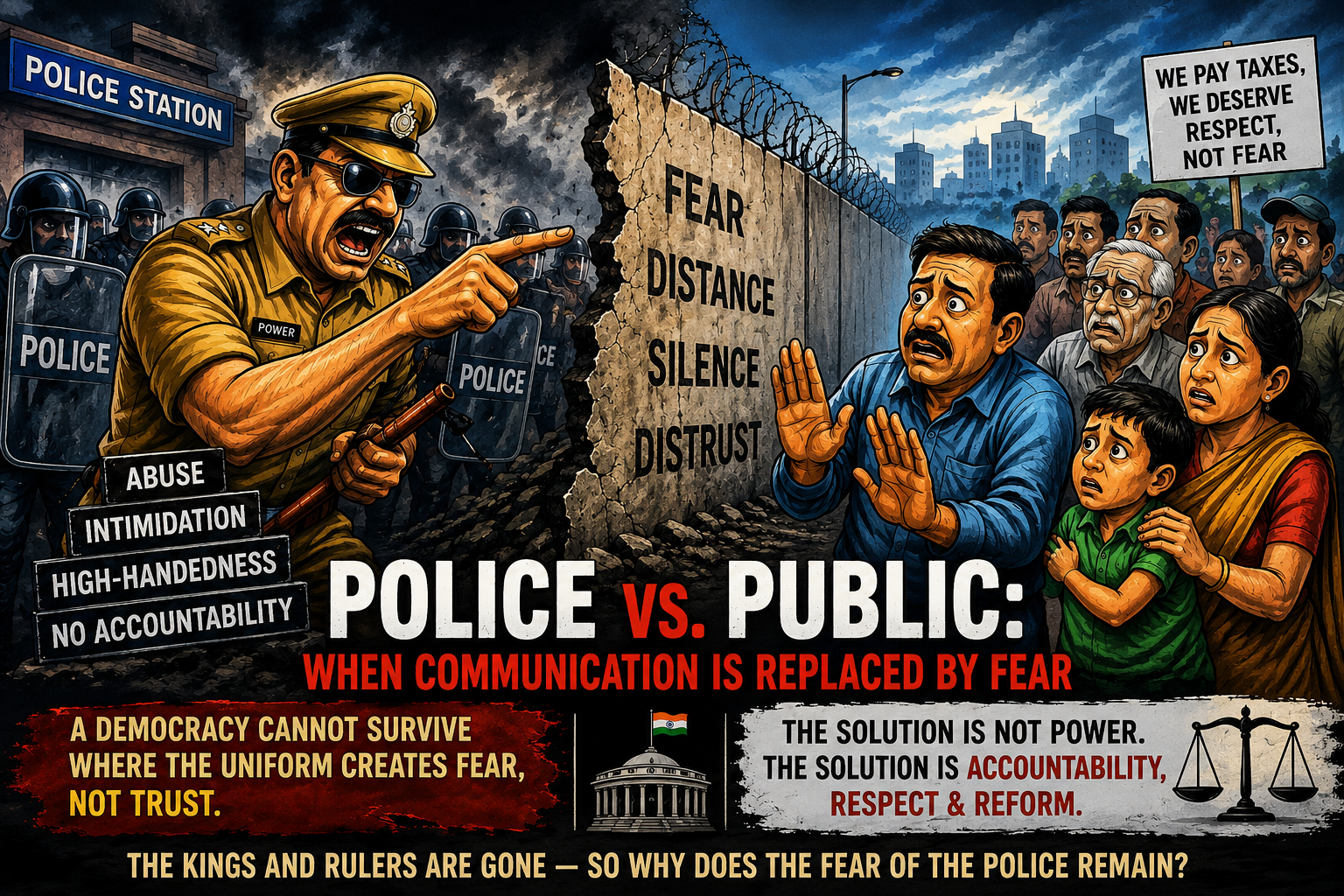
Opinion I Special Report : In India, the fundamental purpose of the police is clear: to maintain law and order, prevent crime, protect citizens, and ensure equality before the law. But when communication between the police and ordinary citizens is replaced by fear, allegations, verbal abuse, intimidation, physical confrontation, or hostility, the issue can no longer be viewed merely as an isolated incident. It raises deeper questions about the functioning of the system itself.
Across different parts of the country, incidents involving confrontations between police personnel and members of the public periodically come to light. At times, citizens accuse police personnel of misconduct or excessive behaviour. At other times, police officers report verbal abuse, threats, obstruction, or physical attacks against them. In the age of social media, audio recordings and videos of such incidents can become public within minutes, transforming what might initially be a local law-and-order issue into a major social and political controversy.
The recent controversy involving Jharkhand MLA Jairam Kumar Mahato and the officer-in-charge of Barwadda Police Station in Dhanbad has once again brought this larger question into focus. The dispute reportedly involved allegations concerning abusive language in a viral audio recording. While the police sought action in connection with the alleged remarks, Jairam Mahato questioned the authenticity and context of the recording and alleged that it was being used against him. An FIR has also been registered in connection with the matter.
The controversy subsequently intensified after a police association demanded an apology from the MLA and later issued an ultimatum regarding his arrest, along with a warning of statewide agitation.
But viewing the entire controversy simply as “an MLA versus the police” may not be enough to understand the larger issue.

The real question is:
Is the trust between the police and ordinary citizens steadily weakening in India?
Why Was the Police System Created — and Why Are Questions Being Raised Today?
In a democratic system, the police are among the most important public institutions. Citizens depend on them for the protection of their lives, property, dignity, and legal rights.
However, India’s police system developed under very different historical circumstances. During the colonial period, policing was significantly designed to maintain administrative control and protect the interests of the British government. After independence, India became a democratic republic, but several institutional structures and practices continued to carry elements of that colonial legacy.

Modern citizens are increasingly aware of their rights. They ask questions, access legal information, record incidents on mobile phones, and use social media to express grievances.
At the same time, police personnel operate under extremely difficult conditions. Long working hours, political and administrative pressures, shortage of resources, criminal investigations, VIP duties, crowd control, emergencies, and constant exposure to stressful situations can make policing an exceptionally demanding profession.
Therefore, it would also be wrong to portray every police officer as an enemy of the public.
There is, however, another equally important reality:
A uniform does not give anyone the right to humiliate, intimidate, or mistreat a citizen.
Why Is Trust Between Police and Public Breaking Down?
Trust is not created merely through laws or official statements.
Trust is created through behaviour.
When an ordinary citizen approaches a police station with a complaint and is treated respectfully, listens to carefully, and receives appropriate guidance, confidence in the police increases.
But if a complainant feels ignored, is made to wait unnecessarily, is allegedly humiliated, or encounters disrespectful behaviour, a negative perception of the police can quickly develop.
The reverse is also true.
When police officers face violence, threats, abuse, or obstruction while dealing with criminals or hostile crowds, they may begin to feel that society does not understand or appreciate the difficulties of their work.
The result is a cycle of mutual suspicion.
The police begin to view citizens with suspicion, while citizens begin to view the police with fear.
For a democracy, this is an extremely dangerous situation.
Why “Abuse for Abuse” Cannot Be the Answer
This is perhaps the most important question.
If a citizen abuses, threatens, or assaults a police officer, there must be a lawful mechanism for taking action against that person.
If a police officer abuses, threatens, intimidates, or uses excessive force against a citizen, there must equally be a lawful mechanism for accountability.
In both situations, the response must be the law — not personal power.
The same principle applies to elected representatives.
An MLA is a representative of the people in a democratic system. He or she has the right to question administrative decisions, raise public grievances, and seek explanations from the police.
But that authority cannot become a licence to insult, threaten, or intimidate a police officer.
Similarly, a police officer has legal authority to enforce the law. But that authority does not permit the officer to humiliate citizens or act arbitrarily.
What Larger Question Has the Jairam Mahato Controversy Raised?
The Barwadda controversy reportedly originated from a local matter, following which tension allegedly escalated during the presence of the MLA and his supporters at the police station. The police subsequently registered an FIR containing allegations including obstruction of government work and other offences.
The alleged viral audio recording added another dimension to the controversy.
Jairam Mahato questioned the authenticity and context of the recording and reportedly argued that the conversation had been longer and that only selected portions had surfaced.
On the other side, police organisations raised concerns about the dignity and security of police personnel, demanded an apology from the MLA, and warned of agitation.
This raises a broader constitutional question:
When allegations are made against a police officer, should the investigation be influenced by institutional pressure, or should it be conducted through an independent and transparent process?
And equally:
When a citizen alleges misconduct by a police officer, does that citizen have access to an equally effective institutional mechanism for justice?
These questions are not necessarily about supporting or opposing a particular MLA or police officer.
They are questions about institutional fairness and accountability.
Does a Police Association Have the Right to Speak?
Absolutely.
Police personnel also have rights.
If a police officer is threatened, assaulted, publicly humiliated, or subjected to political pressure, police organisations should have the right to defend the legitimate interests and safety of their members.
However, a problem arises when an organisation appears to defend its members while giving insufficient attention to citizens’ rights.
The strongest message from a police association should be:
“We will not allow injustice against our police personnel, and we will not allow injustice by police personnel against the public.”
If a police officer is wrong, the organisation should support a fair investigation.
If a citizen is wrong, the law should take its course.
If an elected representative is wrong, the law should take its course.
If a police officer is wrong, the law should take its course.
The authority of law must be greater than the power of an individual or position.
Should the Police System Itself Be Abolished?
Emotionally, such a question may appear attractive when people encounter alleged police misconduct.
Practically, however, the answer is no.
A modern democratic country cannot function without an effective police system.
Who will investigate crimes?
Who will trace missing persons?
Who will respond to complaints involving women, children, and vulnerable citizens?
Who will manage road accidents and public emergencies?
Who will investigate cybercrime?
Who will respond to riots, organised crime, violence, and serious threats to public safety?
The police are therefore indispensable.
The real problem is not the existence of the police; it is the quality, conduct, accountability, and institutional culture of policing.
India does need the police.
But India needs better policing.
What Needs to Change?
The first requirement is a transformation in the working culture of policing.
A police station should not be a place that citizens fear entering. It should be the first institutional point of contact for justice, assistance, and protection.
1. Respectful Treatment of Every Complainant
Whether a complaint ultimately proves to be genuine or false, the complainant should first be heard respectfully. Its credibility and legal merits can then be determined through investigation.
2. Greater Technological Transparency
CCTV cameras, digital complaint systems, electronic records, and properly regulated audio-video recording of certain investigative procedures can protect both citizens and police personnel.
Transparency is not a threat to policing.
Transparency can protect honest police officers while also protecting citizens from abuse.
3. Independent Mechanisms for Complaints Against Police
A citizen who has a complaint against a police officer should not be forced to navigate an unnecessarily complicated system within the same institutional hierarchy.
Independent police complaints mechanisms and clearly defined investigation procedures are essential.
4. Professional and Psychological Training
Police training should not focus exclusively on crime investigation, weapons, or legal procedures.
It should also include:
- Communication skills
- Conflict resolution
- Anger management
- Human rights
- Mediation
- De-escalation techniques
- Community policing
- Behavioural and psychological training
5. Protection From Unlawful Political Interference
Police must be professionally independent while remaining accountable to the Constitution and the law.
Political influence over operational policing can undermine public confidence and weaken institutional neutrality.
The Police Are Human — But the Uniform Carries Greater Responsibility
It is equally important to recognise that police officers are human beings.
They work under pressure. They may face violent criminals, dangerous situations, public disorder, emergencies, elections, festivals, disasters, and long periods away from their families.
Their working conditions deserve greater public understanding.
But the uniform also brings additional responsibility.
Those entrusted with the power of law must be expected to exercise a higher degree of restraint.
A citizen may lose his temper.
A police officer must still respond within the framework of law.
Does the Public Also Have Responsibilities?
Certainly.
Democracy gives citizens rights, but it also requires responsible conduct.
Abusing a police officer, threatening personnel, physically attacking them, creating violence inside a police station, or deliberately obstructing lawful government work cannot be justified.
If a police officer behaves improperly, citizens should complain.
If an officer violates the law, citizens should seek legal action.
But mob justice cannot replace due process.
That distinction separates democracy from disorder.
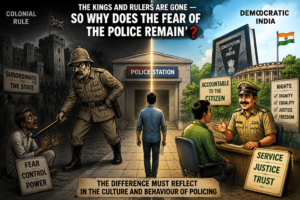
“The Kings and Rulers Are Gone — So Why Does the Fear of the Police Remain?”
The question may sound politically sharp, but it is important for a broader social discussion.
After independence, India adopted a democratic Constitution. Citizens received fundamental rights, governments became accountable to the people, and public institutions were expected to serve constitutional values.
Yet if an ordinary citizen still feels anxious before entering a police station because of uncertainty about how he or she might be treated, society must engage in serious self-reflection.
The objective of colonial rule and the objective of democratic governance are fundamentally different.
Under colonialism, the citizen was expected to remain subordinate to the state. In a democracy, the state is accountable to the citizen.
That difference must also be visible in the culture and behaviour of policing.
The Police Are Not the Masters of the Public — They Are a Public Service Institution
Perhaps the most important transformation must occur at the level of institutional mindset.
The police are not an institution created to rule over citizens.
They are a public institution entrusted with enforcing the law and protecting society.
Their authority comes from the Constitution and legislation. Their resources are ultimately supported by public funds. Their responsibility is therefore to serve society while remaining accountable to the law.
But the other side of the equation is equally important:
Citizens are not the masters of the police either.
Police personnel deserve dignity, safety, and respectful treatment.
A democratic system requires mutual respect.
What Is the Way Forward?
India does not need to abolish the police.
India needs meaningful police reform.
Police stations must evolve from places associated with fear into institutions associated with trust.
Police personnel must gradually move from an “authority-first” mindset toward a “service-and-law-first” approach.
Elected representatives must understand that a political mandate does not place anyone above the law.
Police associations should protect their members while also supporting the rights of citizens.
Citizens, meanwhile, must understand that disagreement with police action should be addressed through lawful complaints, judicial remedies, and institutional mechanisms—not through intimidation, violence, or demonstrations of personal power.
Conclusion: The Problem Is Not the Existence of the Police — It Is Conduct and Accountability
In a vast democracy like India, an effective police system is indispensable.
Without policing, it would be impossible to maintain public order, investigate crime, protect vulnerable citizens, and respond to emergencies.
But having police and living in fear of the police are two completely different things.
In a healthy democracy, citizens should not fear the police.
They should be able to approach the police when they need protection.
The police should not view citizens as adversaries.
They should protect them.
Elected representatives should demand that the police operate within the law, but they too must respect the law.
Police officers should respect citizens’ rights while firmly acting against crime and unlawful behaviour.
That is the democratic balance.
The Jairam Mahato–Barwadda Police Station controversy is moving toward its legal and political consequences. The allegations concerning the viral audio, the FIR, competing claims, and demands made by police organisations must ultimately be assessed through a fair investigation and due process of law.
But the most important question arising from the controversy is not about taking sides.
It is this:
Is India’s policing system creating a sense of security in the minds of citizens — or a sense of fear?
The answer cannot come from the police alone.
It must come collectively from governments, political leadership, police organisations, elected representatives, civil society, and citizens.
Because in a democracy, the police are not a power separate from the people. They exist for the people and must remain accountable to the people and the law.
Abuse cannot be answered with abuse.
Threats cannot be answered with threats.
Power cannot be answered with power.
In a democracy, the ultimate answer must be:
“THE LAW MUST ANSWER THE LAW.”