

National Mineral Wealth Being Looted: Fact-Finding Team Alarmed Over Mangampet Barytes Mine Closure Plan
Committee alleges 60-lakh tonne bulk tender favours single firm, flags fixed-price deal and rapid depletion of strategic reserves near Railway Koduru

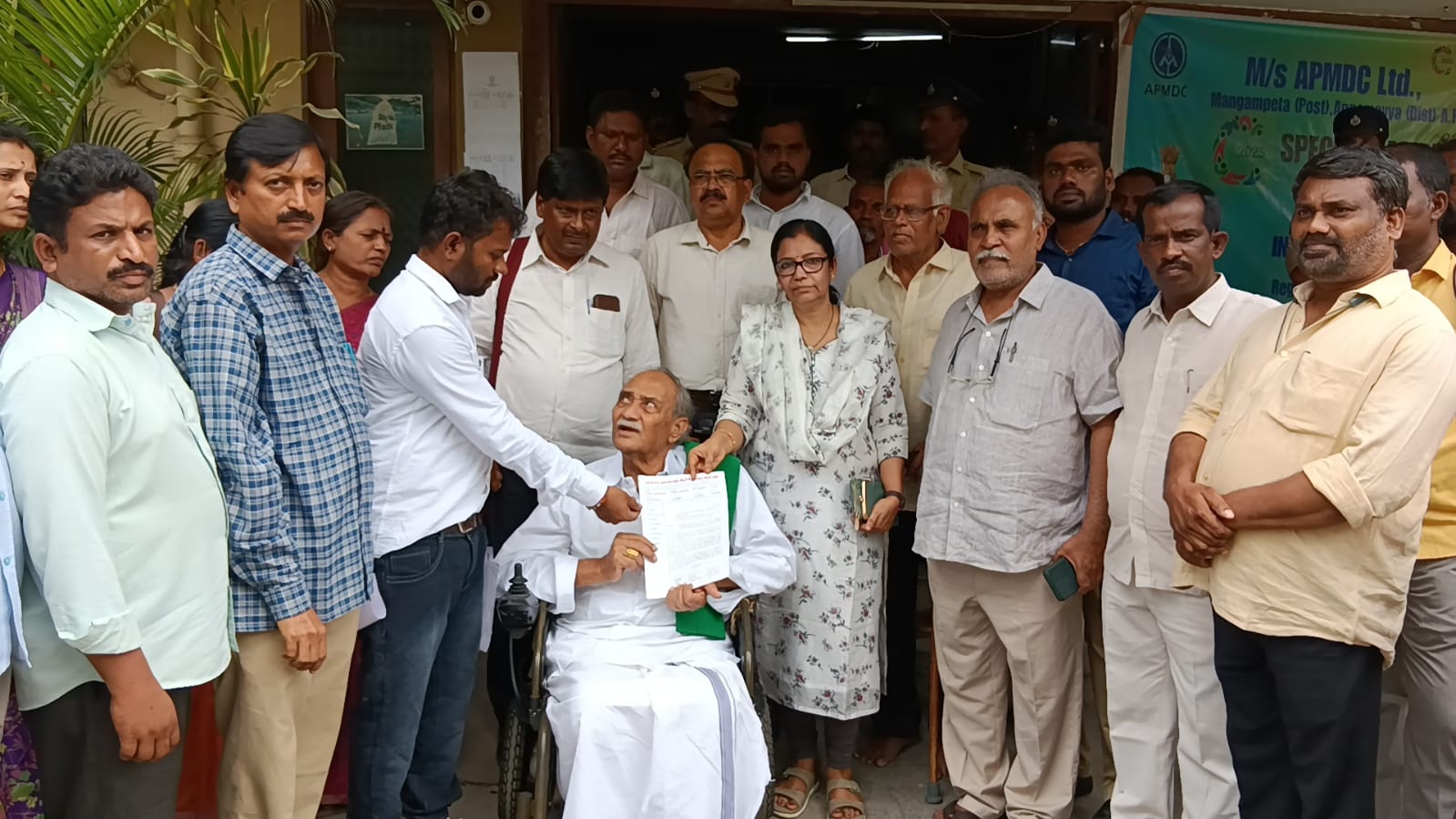
TIRUPATI – AP: Doruvu Paul Jagan Babu – Assistant Chief Editor: The proposed move to shut down the Mangampet Barytes mines near Railway Koduru in Tirupati district has triggered serious concern, with a fact-finding committee warning that the country’s most crucial, non-renewable strategic mineral is being exported in bulk, jeopardizing national interest. The committee, which visited the mines on Thursday, demanded an immediate halt to the mine closure plan and a comprehensive probe into the 2025 bulk tender policy.
Fact-finding team constituted after roundtable
The committee was formed at a recent roundtable conference held in Vijayawada to study the condition of Mangampet mines, bulk tender policy, mineral reserves, exports, APMDC policies and reasons behind the mine closure proposal. According to Kandarapu Murali, Convener of the Mangampet Barytes Parirakshana Porata Committee and CITU State Vice President, the committee comprises former minister Vadde Sobhanadreeswara Rao, retired IPS officer A.B. Venkateswara Rao, retired IAS officer B. Srinivasa Rao, former MLCs K.S. Lakshmana Rao and Dr. Geyanand, and social activist Dr. Vasundhara among others.
On September 3, the team including Vadde Sobhanadreeswara Rao, B. Srinivasa Rao, M. Geyanand, Prof. Ramachandraiah and Dr. Vasundhara inspected the mines along with CITU district general secretary T. Subrahmanyam, district president S. Jayachandra, local leaders Chandrasekhar, Srilakshmi, Venkatesh and others.
A mine with 50-year legacy

Central agencies had earlier identified Barytes reserves in Mangampet, Obulavaripalle and Govindapalle areas, estimating around 74 million tonnes. For over five decades, Mangampet has been crucial for the national economy, state revenue and local employment.
Even now, the area holds about 25 lakh tonnes of A and B grade barytes and a large quantity of C, D and other grades, besides crores of tonnes of overburden. Despite this, activities are being scaled down to close the mine in two years, the committee said.
Objection to 2025 bulk tender

The committee raised serious objections to the bulk tender floated by APMDC on January 24, 2025, for sale of C, D and waste grade barytes in huge quantities.
Under the deal finalized in February 2025, about 60 lakh metric tonnes were contracted for five years till February 2030 at roughly 10 lakh metric tonnes per year. The committee said a major share was cornered by a single firm.
The most alarming clause, it said, is fixing the price for five years without revision as per market conditions. Earlier prices were revised frequently based on international demand, and after 2015 on an annual basis. Fixing it for five years is against the interest of the public sector company.
The reserve price was exceeded by only a marginal amount. The committee argued that even an additional Rs.100 per metric tonne would have fetched crores of rupees, and Rs.500 to Rs.1000 would have meant hundreds of crores in extra revenue for APMDC and the state exchequer, but the fixed-price contract could cause huge future losses.
Tender conditions favoured one company?
The tender mandated three years of export experience, export of lakhs of tonnes in the last five financial years, hundreds of crores of turnover through exports, and capacity to buy 10 lakh tonnes per year. Such stringent eligibility, the committee alleged, eliminated small and medium domestic industries from competition and prima facie appears tailored to benefit a large private player.
Not an ordinary mineral
Barytes is a naturally occurring Barium Sulphate with high specific gravity, low solubility and chemical stability. It is strategically critical for oil and natural gas exploration and drilling operations and is directly linked to the country’s energy security.
It cannot be artificially manufactured and is non-renewable. If exported indiscriminately today, India may have to import it at higher prices tomorrow for domestic needs, the committee warned.
It pointed out that reserves estimated at 49 million tonnes in 2015 fell to about 23 million tonnes by 2024, more than half depleted in a decade. At this pace, the rare resource will not be available for future generations.
Violation of constitutional spirit, concerns over APMDC debt
Citing Articles 14 and 39(b) of the Constitution, the committee said allocation of natural resources must be transparent, non-discriminatory and for common public good. Handing over huge reserves to a single private entity for long term, with fixed price and thrust on export, violates that spirit.
It also sought clarity on how APMDC, despite holding such a lucrative resource, has accumulated debt of thousands of crores, where the loans were utilized and whether Mangampet revenue was diverted.
Impact on local industry and demands
Hundreds of small and medium mills and processing units around Railway Koduru, Kadapa and Tirupati depend on Mangampet barytes, providing livelihood to thousands of workers, transport workers and traders. Bulk exports could shut them down.
Committee places 10 demands
1. Comprehensive inquiry into the 2025 bulk tender agreement.
2. Full scientific survey of reserves by an independent agency.
3. Immediate withdrawal of mine closure proposal.
4. Review of bulk export policy.
5. Priority allocation to domestic industries and local mills.
6. Cancel the five-year fixed-price contract and ensure regular market-linked price revision.
7. Independent probe into whether tender conditions favoured one company.
8. White paper on APMDC debts, Mangampet income and sales.
9. Declare Mangampet barytes as a national strategic natural resource.
10. Protect livelihood of local mills, workers and dependent families.
“Mangampet Barytes is not the property of any government or corporate. It is the wealth of the people of this country. Once exhausted, it cannot be recreated,” the committee asserted.