


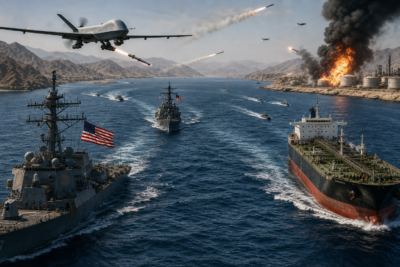
War-Report: A sharp escalation in tensions across the strategically vital Strait of Hormuz has brought global attention to Iran’s efforts to assert dominance over one of the world’s most critical maritime chokepoints. Recent developments indicate that Iran is actively attempting to demonstrate its control over the strait in response to United States initiatives aimed at ensuring the free flow of commercial shipping through the region.
The Strait of Hormuz, a narrow but crucial waterway connecting the Persian Gulf to global markets, handles a significant portion of the world’s oil exports. Control over this passage has long been viewed as a powerful geopolitical lever. Iranian leadership appears determined to maintain and project this leverage, particularly amid growing confrontation with the United States and its allies.
Iran–US Crisis Escalates in Strait of Hormuz
Iran’s strategy has reportedly included a combination of military signaling and direct action. These actions have ranged from targeting commercial vessels and energy infrastructure in the United Arab Emirates to launching strikes that have affected civilian areas in neighboring Oman. The objective, analysts suggest, is to reinforce the perception that Iran retains the capability to disrupt maritime traffic at will.
At the center of this confrontation is the United States’ decision to deploy naval escorts for commercial vessels transiting the strait. On May 3, US President Donald Trump announced that American naval forces would begin escorting ships through the waterway starting May 4. This move is widely interpreted as an effort to neutralize Iran’s threats and reassure global shipping operators.
The success of such escorted transits could significantly undermine Iran’s strategy. Tehran’s influence over the strait depends largely on its ability to create credible risks for commercial shipping. If vessels can pass safely under US protection, Iran’s ability to exert economic pressure by influencing oil prices may diminish.

Iranian officials responded swiftly and forcefully to the announcement. Hardline figures within the Iranian government warned that any interference with what they described as Iran’s blockade efforts would be treated as a violation of existing ceasefire understandings. Statements from senior officials emphasized that Iran would not tolerate foreign military intervention in what it considers a sphere of strategic importance.
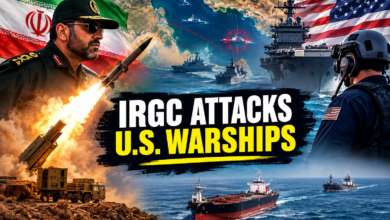
Military actions soon followed the rhetoric. Iranian forces reportedly targeted an Emirati-affiliated oil tanker using drones as it attempted to transit the strait. This incident marked a clear signal of Iran’s willingness to enforce its claims through force. Additional threats were issued against both US naval vessels and commercial ships that attempt to navigate the strait without Iranian approval.
Iran’s naval forces also released a map asserting full control over the Strait of Hormuz, further reinforcing their messaging campaign. Reports from Iranian-affiliated media claimed that warning shots had been fired at a US warship, although the extent and nature of the encounter remain contested.

In response, US Central Command confirmed that American destroyers successfully escorted commercial vessels through the strait without sustaining damage. During these operations, US forces reportedly engaged and neutralized multiple threats, including drones, cruise missiles, and fast attack craft launched by Iranian forces.
The confrontation quickly expanded beyond the immediate vicinity of the strait. Iran escalated its operations by targeting sites in the United Arab Emirates and Oman, potentially aiming to deter regional allies from supporting US-led maritime security efforts.
In the UAE, defense authorities reported intercepting several incoming cruise missiles, with at least one projectile falling into the sea. A drone strike near a major petroleum facility in Fujairah resulted in injuries, highlighting the vulnerability of critical energy infrastructure in the region.
Additional incidents involved attacks on commercial shipping. A South Korean cargo vessel and another unidentified ship were reportedly struck in separate incidents near UAE waters. These attacks underscore the widening scope of the conflict and the risks faced by international shipping companies operating in the region.
Air defense systems in the UAE were activated multiple times to counter incoming threats, reflecting the sustained nature of the assault. Meanwhile, in Oman, a projectile struck a residential building, raising concerns about the potential for civilian casualties and unintended escalation.
The broader implications of these developments are significant. The Strait of Hormuz is not only a regional concern but a global economic lifeline. Any sustained disruption to shipping in this area could have far-reaching consequences for energy markets, trade flows, and international stability.
Iran’s actions appear to be driven by a desire to maintain strategic leverage. By demonstrating its ability to disrupt maritime traffic, Tehran can influence global oil prices and exert pressure on adversaries. However, this strategy carries substantial risks, including the possibility of direct military confrontation with the United States and its allies.
For the United States, ensuring freedom of navigation in the strait is a critical objective. The deployment of naval escorts represents a commitment to protecting commercial shipping and maintaining open sea lanes. However, it also increases the likelihood of direct engagements with Iranian forces.
The situation remains highly volatile, with both sides signaling readiness to escalate if necessary. Diplomatic channels appear limited, and the potential for miscalculation is high. Each new incident adds to the complexity of an already tense geopolitical environment.
Experts warn that sustained conflict in the region could have cascading effects. Energy prices could surge, global supply chains could be disrupted, and regional security dynamics could shift dramatically. The involvement of multiple counties and benefit further complicates efforts to de-escalate the situation.
As events continue to unfold, the international community is closely monitoring developments in the Strait of Hormuz. The coming days will be critical in determining whether tensions can be contained or whether the situation will escalate into a broader conflict with global repercussions.
Our Media Expert Opinion, Iran’s efforts to assert control over the Strait of Hormuz have triggered a significant escalation in regional tensions. The United States’ response, centered on naval escorts and freedom of navigation, has set the stage for a high-stakes confrontation. With both sides unwilling to back down, the risk of further escalation remains a pressing concern for the global community.