


Delhi Police Arrest Bank Employee for Role in Cyber Fraud Network Using Fake Accounts
Editorial

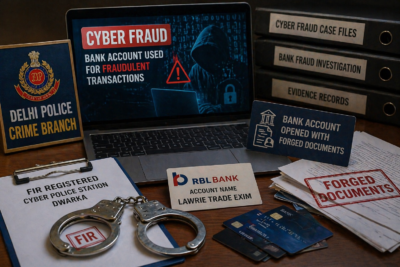
New Delhi : In a significant development in the fight against cybercrime, the Crime Branch of Delhi Police has arrested a 35-year-old bank employee for allegedly playing a key role in facilitating a cyber fraud racket. The accused is believed to have misused his professional position to open bank accounts using forged documents, which were later used to route illegally obtained money from multiple victims.
The accused has been identified as Irshad Malik, a resident of Ghaziabad. He was working as a Relationship Manager at a private bank at the time of the alleged offense. According to officials, Malik was arrested on April 10 following a targeted operation based on specific intelligence inputs. He was apprehended from New Friends Colony in southeast Delhi.

The case traces its origins back to October 2023, when a First Information Report was registered at the Cyber Police Station in Dwarka. The complaint was filed after an unauthorized debit of ₹88,000 was reported from a bank account held with the State Bank of India. Investigators began tracing the movement of the stolen funds and discovered that the money had been transferred to an account in RBL Bank under the name “Lawrie Trade Exim.”
Delhi Cyber Fraud Case: Bank Employee Arrested
As the investigation progressed, authorities uncovered a larger network involved in orchestrating cyber fraud operations. According to Harsh Indora, the accused had deliberately bypassed standard banking procedures, including Know Your Customer (KYC) verification norms, to open fraudulent accounts. These accounts were then used as channels to receive and distribute money obtained through cyber scams.

Police officials stated that Malik was fully aware of the illegal nature of these activities. He allegedly opened the account using forged documents and allowed it to be used for routing funds collected from victims of online fraud. In return, he is believed to have received financial compensation in the form of commissions.
Investigators emphasized that such insider involvement significantly increases the complexity of cybercrime cases. Banking professionals have access to sensitive systems and processes, and when misused, these can create loopholes that are difficult to detect in real time. Malik’s alleged actions highlight the risks posed by internal actors within financial institutions.
The investigation has also led to the earlier arrest of four other individuals believed to be part of the same network. These individuals—Harjinder, also known as Harji, Kulwinder Singh, Harjeet Singh, and Himanshu Kapoor—were taken into custody during earlier phases of the probe. They are currently out on bail but remain under investigation.

According to police sources, the group operated in a coordinated manner, with each member playing a specific role in the fraud scheme. While some were involved in identifying and targeting victims, others handled the movement and layering of funds through multiple bank accounts. The use of shell entities, such as “Lawrie Trade Exim,” allowed the group to disguise transactions and avoid immediate suspicion.
Cyber fraud experts note that such schemes often rely on a combination of social engineering techniques and financial manipulation. Victims are typically tricked into sharing sensitive information or making payments under false pretenses. Once the money is transferred, it is quickly moved through a series of accounts to make tracing and recovery more difficult.
The role of fraudulent accounts is central to these operations. By creating accounts under false identities or shell companies, criminals can receive funds without revealing their true identities. The involvement of bank employees in facilitating such accounts poses a serious challenge to regulatory frameworks and internal compliance systems.
Authorities have reiterated the importance of strict adherence to KYC norms and internal checks within banking institutions. Proper verification of customer identity and documentation is a critical safeguard against financial fraud. Any lapse in these procedures can be exploited by criminal networks to carry out illegal activities.
The arrest of Malik is being seen as a major step forward in dismantling the network. However, officials have indicated that the investigation is ongoing and that more arrests may follow. Efforts are also underway to identify additional accounts linked to the racket and to trace the flow of funds across different regions.
Law enforcement agencies are increasingly focusing on strengthening cybercrime detection and prevention mechanisms. Specialized units, advanced forensic tools, and inter-agency coordination are being used to tackle the growing threat of digital fraud. Public awareness campaigns are also being conducted to educate citizens about common scams and preventive measures.

This case underscores the evolving nature of cybercrime in India, where traditional financial systems are being exploited through digital means. As more people rely on online banking and digital transactions, the need for robust security measures and vigilant oversight becomes even more critical.
Our Media Opinion, the arrest of a bank employee for allegedly aiding a cyber fraud network highlights the importance of accountability at all levels of the financial system. While technology plays a vital role in enabling modern banking, human integrity and compliance remain equally essential in safeguarding public trust. The outcome of this investigation is expected to have significant implications for both law enforcement practices and banking regulations in the future.