

Russia’s Aggressive Russification Drive Deepens Crisis in Occupied Ukraine 2026
Education Programs and Population Control Measures

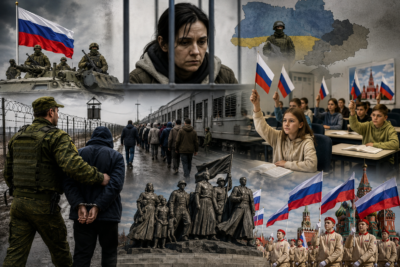
WAR-REPORT: Moscow-Donetsk: Russia is continuing to deepen its efforts to reshape the social, cultural, and political landscape of occupied Ukrainian territories through a broad policy of Russification aimed at integrating these regions into the Russian state structure while diminishing distinct Ukrainian identities.
Recent developments in occupied eastern and southern Ukraine indicate that Moscow’s long-term strategy extends beyond military control and increasingly focuses on demographic, educational, cultural, and ideological transformation. Analysts and human rights observers argue that these measures are designed to strengthen Russian influence over future generations while weakening local Ukrainian national identity.
Conference Promotes Russian National Identity in Occupied Donetsk
A major conference dedicated to the implementation of Russia’s state national policy was held in occupied Donetsk on May 23 as part of Moscow’s designation of 2026 as the “Year of the Unity of the Peoples of Russia.”
The event brought together occupation officials, political representatives, and supporters of Russian integration policies. During the conference, the head of the self-proclaimed Donetsk People’s Republic (DPR), Denis Pushilin, described occupied Donbas as a “stronghold of Russian civic unity” and emphasized the importance of strengthening Russian identity in the region.
Russian media outlets and pro-Kremlin commentators highlighted the event as evidence of what they described as the successful development of Russian statehood and national consciousness in occupied territories. Several prominent Russian military bloggers and nationalist commentators praised the conference, arguing that it demonstrated growing public acceptance of Russian identity among residents of occupied Donetsk Oblast.

Observers note that such events form part of a broader effort to normalize Russian governance structures and cultivate loyalty toward Moscow in areas seized since the beginning of Russia’s full-scale invasion of Ukraine.
State National Policy Institutionalizes Russification
The conference follows the implementation of a new Russian State National Policy framework approved by President Vladimir Putin in November 2025.
The policy, which will remain in force until 2036, seeks to strengthen what Moscow describes as the unity of the multinational people of the Russian Federation, promote Russian civic identity, reinforce patriotism, and ensure national security through cultural integration.

Critics argue that the policy effectively formalizes Russification efforts in occupied Ukrainian territories by encouraging the adoption of Russian language, culture, educational standards, and political values while reducing the visibility of Ukrainian history and identity.
According to experts monitoring developments in occupied regions, the policy represents one of the clearest indications that Moscow views the occupied territories not as temporary military gains but as areas intended for long-term incorporation into the Russian political and cultural sphere.

Deportation of Ukrainian Political Prisoners Continues
Human rights organizations continue to raise concerns regarding Russia’s treatment of Ukrainian political detainees from occupied territories.
According to reports from Crimea-based monitoring groups, Russia has continued transferring Ukrainian prisoners and political detainees from occupied regions to penal colonies deep inside Russian territory.
One recent case involves Crimean Tatar political prisoner Lera Dzhemilova, who is reportedly being transferred to a penal colony in Russia’s Volgograd region. Human rights advocates say that many Crimean Tatars and other Ukrainian citizens have faced charges of treason, terrorism, or espionage that they describe as politically motivated.
Observers note that Russia has been relocating political prisoners from occupied Crimea since the peninsula’s annexation in 2014. Since 2022, similar practices have reportedly expanded to include detainees from newly occupied Ukrainian regions.
Ukrainian authorities argue that the transfer of civilians from occupied territories into Russia violates international humanitarian law, including provisions of the Fourth Geneva Convention that prohibit the forcible transfer of protected persons from occupied territories.
Ukraine’s Prosecutor General recently stated that evidence has been submitted to international legal institutions documenting the transfer of more than 1,800 prisoners from occupied regions of southern Ukraine into Russian custody during 2022.
Educational Programs Target Ukrainian Youth
Alongside political and administrative measures, Russia is also investing heavily in programs designed to influence younger generations in occupied territories.
One such initiative, known as “University Shifts,” continues to receive significant federal funding. Russian Prime Minister Mikhail Mishustin recently approved additional financing exceeding 155 million rubles for the program’s 2026 activities.
The initiative allows school-age students from occupied Donetsk, Luhansk, Kherson, and Zaporizhzhia regions to travel to universities throughout Russia, where they participate in educational, cultural, and career-oriented programs.
Russian officials describe the project as an opportunity to provide students with educational experiences and professional guidance. However, critics argue that the program serves a broader political purpose by exposing Ukrainian youth to Russian narratives, institutions, and cultural values.
The program reportedly aims to bring at least 2,300 students from occupied territories to universities in cities including Samara, Tula, Volgograd, and Perm during the coming year.
Since its launch in 2022, tens of thousands of Ukrainian teenagers have reportedly participated in the initiative.
Long-Term Strategy of Integration
Analysts suggest that educational programs, cultural policies, citizenship initiatives, and administrative reforms form part of a coordinated long-term strategy designed to bind occupied territories more closely to Russia.
By integrating students into Russian educational systems, encouraging interaction with Russian institutions, and promoting Russian historical narratives, authorities seek to establish lasting social and cultural ties that may influence future generations.
At the same time, critics argue that these measures reduce opportunities for young people to maintain connections with Ukrainian language, culture, and national identity.
Growing International Concerns
Human rights organizations and international observers continue to express concern over the cumulative impact of these policies.
The combination of prisoner transfers, educational integration programs, identity-based policies, and cultural restructuring has prompted warnings that Russia is pursuing a systematic effort to transform the demographic and social character of occupied regions.
While Moscow maintains that these initiatives promote unity, stability, and development, Ukrainian officials and many international observers view them as part of a broader campaign aimed at eroding Ukrainian identity and consolidating Russian control over occupied territories.
As the conflict continues, the question of identity, culture, and political allegiance in occupied Ukraine is becoming an increasingly significant aspect of the broader struggle between Kyiv and Moscow. Developments in education, governance, and population policies suggest that the battle for influence in the region is being fought not only on the battlefield but also through institutions, cultural programs, and competing visions of national identity.