


Rajasthan Police Issue Urgent Warning Over Cyber Frauds Linked to Fake Digital Census Drive
Editorial
 war-times.com
Send an email
22 April 2026
war-times.com
Send an email
22 April 2026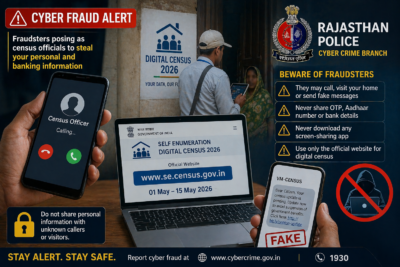
Jaipur-New Delhi : In a significant public safety advisory, Rajasthan Police has alerted citizens to a sharp rise in cyber fraud attempts being carried out under the false pretext of the Central Government’s upcoming digital census initiative. The warning comes amid growing concerns that fraudsters are exploiting public awareness about government programs to deceive individuals and extract sensitive personal and financial information.
The advisory was issued from Jaipur following directives from V.K. Singh, who heads the Cyber Crime division. Officials have observed a pattern in recent complaints indicating that cybercriminals are impersonating census officials and targeting unsuspecting citizens through multiple deceptive techniques.

According to the Cyber Crime Branch, fraudsters are using increasingly sophisticated methods to create a sense of urgency and legitimacy. By invoking a national initiative such as the digital census, they are able to gain the trust of victims more easily. Authorities have identified three primary methods currently being used by these criminal networks.
Rajasthan Police Issues Alert on Digital Census Scam
The first method involves fraudulent phone calls made by individuals posing as census officers. During these calls, victims are asked to provide detailed personal information, including family details, Aadhaar numbers, and bank account credentials. In many cases, callers persuade victims to install screen-sharing applications such as AnyDesk or TeamViewer. Once installed, these applications allow the fraudsters to remotely access the victim’s mobile device and carry out unauthorized transactions directly from banking applications.

Officials have emphasized that this method is particularly dangerous because it gives criminals full control over the device. Victims often remain unaware of the extent of access granted, and by the time they realize the fraud, significant financial losses may have already occurred.
The second method involves physical visits by individuals posing as government survey officials. These fraudsters visit homes carrying tablets or electronic devices to appear credible and professional. They collect household information under the guise of conducting a census survey. During the interaction, they may request a one-time password, claiming it is required for verification purposes. In reality, this OTP is linked to unauthorized banking transactions or account access.
Authorities have noted that the use of physical presence adds a layer of trust, making it easier for criminals to manipulate victims. Citizens are therefore advised to remain cautious and verify the identity of any individual claiming to represent government agencies.

The third method involves the use of fraudulent text messages. Victims receive SMS alerts warning that failure to update their census details will result in the suspension of government benefits. These messages often contain malicious links that direct users to fake websites designed to capture personal and financial data. Clicking on such links can also lead to the installation of harmful software on the device.
Cyber experts warn that these phishing techniques are becoming more advanced, with messages often appearing authentic and using official language. This makes it increasingly difficult for individuals to distinguish between legitimate communication and fraudulent attempts.
Addressing the issue, Shantanu Kumar Singh clarified that the Government of India has introduced a “Self-Enumeration” facility for the upcoming digital census. He stressed that citizens should only use the official portal, www.se.census.gov.in, for any related activity.
He further informed that the self-enumeration process will be open from May 1 to May 15, 2026. Importantly, he emphasized that the entire process is completely free of cost. Any request for payment, whether for registration, verification codes, or QR-based processes, should be immediately recognized as fraudulent.
Police officials have urged citizens to exercise caution and avoid sharing personal or financial information with unknown callers or visitors. They have also advised against downloading applications from unverified sources or clicking on suspicious links received through messages.
In addition to public advisories, the Cyber Crime Branch is actively monitoring these activities and working to identify and apprehend those involved. However, officials acknowledge that prevention through awareness remains the most effective defense against such crimes.
The rise in cyber fraud linked to government schemes highlights a broader trend in digital crime. As more services move online, criminals are adapting their strategies to exploit new opportunities. By impersonating trusted institutions and leveraging technology, they are able to target a wide range of victims across different regions.

Experts believe that strengthening digital literacy and promoting awareness about common fraud techniques are essential steps in combating this growing threat. Citizens are encouraged to remain vigilant, verify information through official channels, and report any suspicious activity to authorities promptly.
Our Media Opinion, the warning issued by Rajasthan Police serves as a critical reminder of the evolving nature of cybercrime. While digital initiatives offer convenience and efficiency, they also require individuals to be more cautious and informed. By staying alert and following official guidelines, citizens can protect themselves from falling victim to such deceptive schemes.
war-times.com
Send an email
22 April 2026