

North Korea Expands Naval and Nuclear Capabilities with Choe Hyon-Class Destroyer
Editorial : War Report
 war-times.com
Send an email
23 April 2026
war-times.com
Send an email
23 April 2026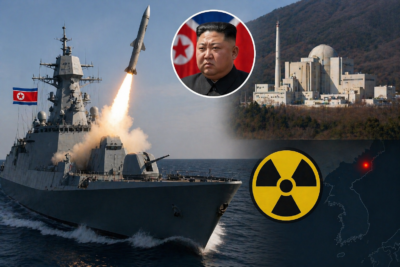
WAR-REPORT : North Korea appears to be entering a new phase in its military and strategic posture, as recent developments indicate a significant expansion of both its naval reach and nuclear capabilities. From the emergence of a new class of guided missile destroyers to renewed activity at uranium enrichment facilities, the country is demonstrating a coordinated effort to strengthen its deterrence and project power beyond its immediate region.
At the center of this shift is the Choe Hyon-class destroyer, a new class of surface combatants that is drawing attention from defense analysts and international observers. The lead vessel of this class, Choe Hyon, has recently been registered with the International Maritime Organization, marking a notable step in North Korea’s naval ambitions. This registration is significant because it signals the country’s intention to operate the vessel beyond its territorial waters, potentially enabling longer-range deployments across international seas.

The inclusion of the Choe Hyon in the global shipping database is particularly noteworthy, as it represents the first time a major North Korean warship has appeared in such an international registry. Analysts interpret this move as both a practical and symbolic step. On one hand, it facilitates navigation and identification in international waters. On the other, it may reflect an effort by North Korea to present itself as a more structured and recognized maritime actor on the global stage.
North Korea’s New Warship Signals Strategic Shift
Recent missile tests conducted from the Choe Hyon further underscore its evolving role. On April 12, North Korea carried out a test launch from the vessel, showcasing what appeared to be its anti-ship capabilities for the first time. Visual evidence suggests that the missile used was a domestic variant of the Kh-35 missile, a short-range anti-ship cruise missile originally developed in Russia.

Interestingly, the missile was launched from a box-type launcher positioned amidship rather than from the vessel’s more advanced vertical launch system. This distinction has important implications for the ship’s operational capabilities. The Choe Hyon is reportedly equipped with an 88-cell vertical launch system, which is typically used for a wide range of missiles, including long-range and strategic weapons. However, the apparent incompatibility of the Kh-35 variant with this system suggests that the vessel’s anti-ship capabilities may be limited in terms of the number of missiles it can carry and deploy.
This limitation has led analysts to question whether anti-ship warfare is the primary function of the Choe Hyon-class destroyers. Instead, evidence points to a different strategic focus. North Korean state media has repeatedly emphasized the “strategic” nature of the vessel, a term often associated with nuclear capabilities. In addition, multiple tests of land-attack cruise missiles launched from the ship’s vertical launch system indicate that the vessel is designed to deliver long-range strikes, potentially including nuclear payloads.
If this assessment is accurate, the Choe Hyon-class destroyers represent a shift in North Korea’s naval doctrine. Rather than serving as traditional surface warfare platforms focused on engaging enemy ships, these vessels may be intended as mobile launch platforms for strategic weapons. By deploying such capabilities at sea, North Korea could enhance the survivability and flexibility of its nuclear forces, making them more difficult to detect and neutralize.

The development of these naval assets is occurring alongside increased activity in North Korea’s nuclear infrastructure. Satellite imagery released by the Center for Strategic and International Studies has revealed the completion of a new building at the Yongbyon Nuclear Research Center, one of the country’s प्रमुख nuclear facilities. Analysts believe that this building is likely intended for uranium enrichment, a critical process in the production of nuclear weapons.
The imagery suggests that the facility is nearing operational readiness, which could significantly enhance North Korea’s ability to produce fissile material. This assessment was supported by Rafael Grossi, who confirmed that the structure bears similarities to existing uranium enrichment plants and noted increased activity across North Korean nuclear sites.
Further evidence of expansion comes from South Korea, where Chung Dong-young identified Kusong as a third confirmed uranium enrichment facility. Located in a region known for its military-industrial infrastructure, Kusong hosts a range of facilities that support North Korea’s weapons programs, including factories for missile components, uranium mining operations, and production units for detonators.
The expansion of uranium enrichment capacity aligns with the strategic goals outlined by Kim Jong Un during the 9th Congress of the Workers’ Party of Korea. At that event, Kim emphasized the importance of strengthening the country’s nuclear deterrent, including the development of more advanced and diverse delivery systems.
Taken together, these developments suggest a coordinated effort to enhance both the quantity and quality of North Korea’s nuclear arsenal. By increasing the production of warheads and improving the platforms used to deliver them, the country is working to create a more robust and flexible deterrent.
The integration of naval platforms like the Choe Hyon-class destroyers into this strategy could have significant implications for regional and global security. Maritime-based nuclear capabilities offer several advantages, including increased mobility and the ability to operate from unpredictable locations. This makes it more challenging for adversaries to track and counter such threats.
At the same time, these developments raise concerns among neighboring countries and the broader international community. The potential deployment of nuclear-capable vessels in international waters could heighten tensions and complicate efforts to maintain stability in the region. It also underscores the need for continued monitoring and diplomatic engagement to address the evolving security landscape.
North Korea’s decision to register the Choe Hyon with the International Maritime Organization may also be interpreted as part of a broader strategy to shape its international image. By participating in global systems and adhering to certain formalities, the country may seek to present itself as a responsible state actor, even as it continues to advance its military capabilities.

However, this dual approach—combining engagement with continued weapons development—poses challenges for policymakers. Balancing the need for dialogue with the imperative to address security concerns requires careful coordination among international stakeholders.
Our Media Opinion, the recent developments involving the Choe Hyon-class destroyer and expanded uranium enrichment facilities highlight a significant evolution in North Korea’s military strategy. By enhancing its ability to produce nuclear warheads and deploying new platforms capable of delivering them, the country is strengthening its deterrence in ways that could have far-reaching consequences. As these capabilities continue to develop, they will remain a central focus of international attention and a key factor in shaping the security dynamics of the region.
war-times.com
Send an email
23 April 2026