


When the Cameras Turn Away, Citizens Become the Media
By Doruvu Paul Jagan Babu: Assistant Chief Editor

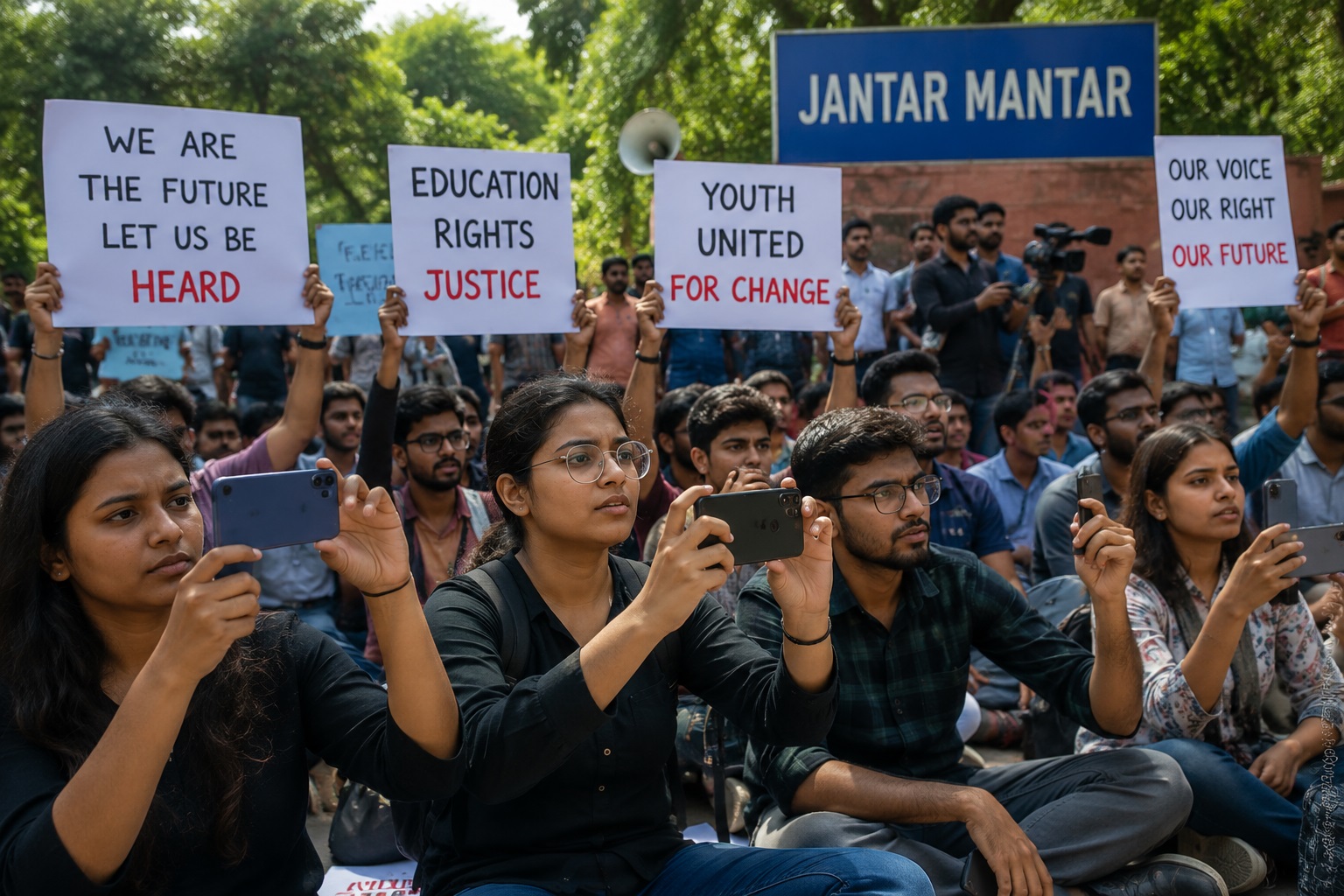
A protest gains national significance not merely because of the number of people gathered, but because of the issues it raises and the democratic space it occupies. The recent youth protest at Jantar Mantar, New Delhi, has sparked an important debate—not only over the demands of the protesters but also over the apparent lack of sustained coverage by many national and mainstream media organisations.
Whether this limited coverage resulted from editorial priorities, resource allocation or other considerations, the perception among many participants was that their movement did not receive the attention they believed it deserved. That perception itself has become part of the story.
When tMedia steps back, smartphones step forward
Perhaps the most striking feature of the protest was not the absence of television cameras but the presence of thousands of mobile phones.
Students and young participants documented speeches, interviews, marches and interactions with police using their own devices. Social media platforms became their newsroom. Livestreams, short videos, photographs and eyewitness accounts travelled across digital platforms within minutes, enabling people across the country to witness events directly.

Without expensive broadcasting equipment or satellite vans, protesters themselves became documentarians of their movement.
This is one of the defining characteristics of modern democracy: when people believe their voices are underrepresented in traditional media, they increasingly rely on digital platforms to communicate directly with the public.
The cost of editorial silence

Journalism does not lose relevance because citizens use social media. Rather, it risks losing relevance when audiences feel compelled to look elsewhere for coverage of matters they consider nationally significant.
The issue is not that every protest must dominate headlines. Newsrooms exercise editorial judgment every day. However, when a prolonged demonstration involving young people at the nation’s designated protest venue receives limited national attention, it naturally invites scrutiny of those editorial choices.
Silence, like coverage, shapes public understanding. What is omitted from the news can be almost as influential as what is included.
A digital public square has emerged
For decades, mainstream media largely determined which stories entered national debate. That landscape has changed.
Today, information flows through thousands of independent channels. Citizens no longer wait for the evening bulletin to know what happened. They witness events in real time through participants’ phones, independent journalists and online platforms.
The Jantar Mantar protest demonstrated that technology has fundamentally altered the relationship between media and the public. Information can now bypass traditional gatekeepers.
Journalism’s challenge is not competition—it is credibility
The rise of citizen journalism should not be viewed as a threat to professional journalism. It should serve as a reminder of journalism’s enduring value.
Professional media possess resources that individuals generally do not: the ability to verify claims, seek responses from authorities, provide legal and historical context, and examine issues in depth. These strengths become most meaningful when they are applied to stories of public importance.
If audiences increasingly feel that significant events are being documented more comprehensively by protesters than by established news organisations, journalism faces an important question about its role in the evolving information ecosystem.
The real story beyond Jantar Mantar
The central issue is larger than one protest.
The story is that a generation of young people no longer depends entirely on mainstream media to tell its story. Equipped with smartphones and social media, they have created their own channels of communication, reaching audiences directly and continuously.
That shift reflects both technological progress and changing public expectations. It also presents an opportunity for mainstream journalism to reflect on how it chooses stories of public significance.
The strength of journalism has always rested on its willingness to report events that matter to the public, regardless of who organises them or where they occur. When citizens increasingly feel the need to become reporters of their own movements, it is worth asking not only how media has changed, but also why many believe traditional journalism is stepping back from one of its most fundamental responsibilities: ensuring that the public knows what is happening in the public square.