

Kim Jong Un Tightens Grip on Power: Anti-Corruption Purge,
Military Expansion Signal New Phase in North Korea

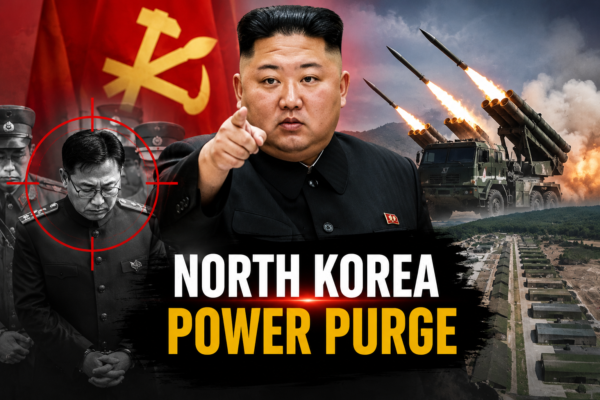
Pyongyang | North Korean leader Kim Jong Un has launched a sweeping anti-corruption campaign targeting senior officials while simultaneously accelerating military modernization near the inter-Korean border. The latest developments indicate a broader strategy aimed at reinforcing his absolute authority, eliminating internal dissent, and strengthening North Korea’s frontline military capabilities amid rising regional tensions.
Senior Military Official Charged in Major Corruption Case
During a rare joint meeting of the Workers’ Party of Korea (WPK), the North Korean government, and the Korean People’s Army (KPA) held on July 11, Kim Jong Un announced disciplinary action against Pak Hee Chol, the former Vice Director of the Organizational Department of the KPA’s powerful General Political Bureau (GPB).
According to North Korean state media, Pak has been formally referred to judicial authorities on allegations of corruption. He is accused of accepting bribes and selling official positions during his four-year tenure, a scandal that has drawn significant attention within the country’s political establishment.
The GPB is one of North Korea’s most influential institutions, overseeing the ideological and political supervision of the armed forces while directly implementing directives issued by Kim Jong Un and the ruling Workers’ Party.
Rare High-Level Assembly Sends Strong Political Message
The July 11 gathering was the first time since Kim assumed power in 2011 that he convened such a comprehensive meeting involving the ruling party, government, and military leadership.

Political analysts believe the move was carefully designed to send a clear warning to officials across all branches of the North Korean system that corruption and disloyalty will not be tolerated.
During the meeting, Kim emphasized that officials must eliminate corrupt practices and faithfully serve the interests of the people.
Consolidating Absolute Authority
Observers say the anti-corruption campaign extends beyond administrative reform.

Kim Jong Un appears to be dismantling potential independent power centers within the government and military while reinforcing a centralized command structure entirely centered on his leadership.
North Korea has witnessed similar political purges before. In 2013, Kim ordered the execution of his uncle Jang Song Thaek, once considered one of the country’s most influential figures, after accusing him of anti-state activities and abuse of power.
The latest purge suggests Kim continues to rely on strict internal discipline and high-profile accountability measures to maintain political control.
“People-First” Governance Narrative
The campaign also aligns with Kim Jong Un’s evolving political messaging.
In recent years, Kim has increasingly promoted what North Korean officials describe as a “people-first” governance philosophy, placing greater emphasis on public welfare and administrative accountability.
At the Ninth Party Congress, Kim reportedly elevated this policy above the traditional ideological framework centered on Kim Il Sung and Kim Jong Il, signaling an effort to redefine the regime’s political legitimacy around improving citizens’ lives while preserving centralized authority.
Analysts believe public anti-corruption measures are intended to reinforce domestic support by portraying Kim as a leader committed to protecting ordinary citizens from official misconduct.
Military Modernization Continues Near South Korean Border
Alongside political reforms, North Korea is also continuing to strengthen its military infrastructure.
Reports indicate that between 2023 and 2025, North Korea constructed 21 reinforced military structures less than 10 kilometers from the inter-Korean border near Kaesong.
Each structure is approximately 52 meters long and is reportedly capable of housing multiple Multiple Launch Rocket Systems (MLRS) or Transporter Erector Launchers (TELs) used for tactical missile deployments.
The facilities are located roughly 52 kilometers from Seoul, placing South Korea’s capital well within the operational range of many North Korean long-range artillery systems.
Precision Strike Capability Expanding
Military experts believe these new facilities are designed to support North Korea’s growing inventory of precision-guided strike systems.
Earlier this year, Pyongyang unveiled 50 new 600mm multiple launch rocket systems, significantly enhancing its long-range artillery capabilities.
In June, North Korea also showcased a new modular missile launcher resembling the U.S.-made HIMARS (High Mobility Artillery Rocket System), indicating continued efforts to modernize its battlefield technology.
The newly built frontline facilities could improve storage, maintenance, rapid deployment, and operational readiness of these advanced systems during any future conflict.
Strategic Implications for Regional Security
The combination of political consolidation and military expansion is likely to draw close attention from South Korea, the United States, and regional allies.
Strengthening missile infrastructure near the Demilitarized Zone (DMZ) could increase North Korea’s ability to rapidly deploy precision strike weapons in the early stages of a crisis.
At the same time, Kim Jong Un’s domestic political actions suggest an ongoing effort to ensure complete loyalty within the country’s military and administrative institutions.
International Observers Monitoring Developments
Regional security experts believe North Korea is simultaneously pursuing two interconnected objectives:
- Eliminating internal political risks through anti-corruption purges.
- Enhancing military readiness with modern missile and artillery infrastructure.
These developments come amid continued concerns over North Korea’s missile programs and broader regional security challenges in Northeast Asia.
Our Media Opinion
Kim Jong Un’s latest actions illustrate a dual strategy of tightening political control at home while strengthening military preparedness abroad. The prosecution of a senior military official on corruption charges, combined with expanded missile infrastructure near the South Korean border, signals Pyongyang’s determination to reinforce both internal stability and external deterrence.
As North Korea continues to reshape its political and military landscape, regional governments are expected to closely monitor further personnel changes, military deployments, and strategic developments that could influence security dynamics across the Korean Peninsula.