


Israeli Actors Should Face a Choice: Building in E1 or Business with Europe
Israel’s proposed settlement construction in the E1 area could deepen the political divide over Palestinian statehood, putting European governments under growing pressure to respond
 Samir Singh 'Bharat'-Editor-in-Chief
Send an email
6 September 2026
Samir Singh 'Bharat'-Editor-in-Chief
Send an email
6 September 2026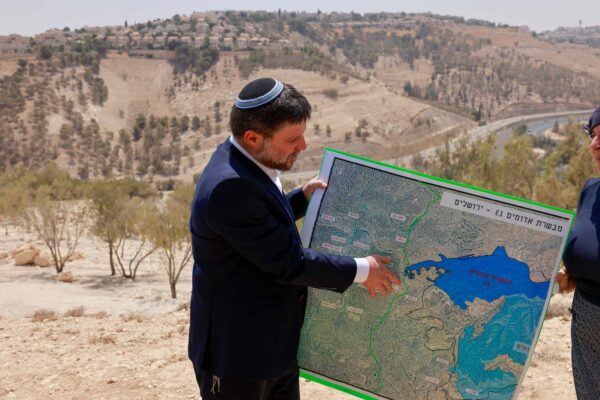
Opinion | International Affairs :The latest Israeli settlement construction plan in the occupied West Bank has once again placed the future of the region at the centre of an increasingly difficult political debate. According to the material provided for this article, Israel’s Ministry of Housing issued a call for tenders on 18 August for 1,234 housing units in E1, a roughly 12-square-kilometre area located between Jerusalem and the large Israeli settlement of Ma’ale Adumim.
The proposal is significant not simply because of the number of housing units involved, but because of the location. E1 has long been regarded as an especially sensitive area in discussions surrounding the territorial continuity of a future Palestinian state. Construction there is therefore being viewed by supporters of Palestinian statehood as a development that could make an already complicated political and geographical situation even more difficult.
The central question is no longer merely whether another settlement project is being planned. The larger question is what political consequences such construction could create—and what responsibility international actors, particularly European governments, are prepared to assume.
The debate also raises an uncomfortable choice for Israel’s international partners: Can economic and political relationships with Europe continue to expand without consequences when policies on the ground are seen by European governments as undermining the possibility of Palestinian statehood?
That is where the discussion surrounding E1 becomes much larger than a housing project.

E1 Is More Than a Housing Project
At first glance, the construction of 1,234 housing units may appear to be another development project. But geography often gives political decisions a meaning that goes far beyond their immediate purpose.
E1 is described as a 12-square-kilometre area situated between Jerusalem and Ma’ale Adumim in the occupied West Bank. Its location makes it particularly important in the wider debate over the territorial shape of the West Bank and the prospects for Palestinian statehood.
Supporters of Palestinian statehood argue that settlement construction in strategically located areas could contribute to the fragmentation of Palestinian territory.

This is why the latest tender announcement has attracted attention.
The issue is not simply about concrete, roads, houses or new neighbourhoods. It is about whether political decisions made today could influence the geographic possibilities available for a political settlement tomorrow.
Once large-scale construction takes place, reversing the situation can become politically, economically and practically difficult.
That is why settlement-related decisions have repeatedly generated international debate.
A Political Message Beyond the Construction Site
Every government has the right to develop housing and infrastructure within areas under its administration. But in contested territories, construction can acquire an additional political dimension.
For supporters of Palestinian statehood, the E1 proposal sends a particularly troubling message.
The concern is that construction in this area could contribute to dividing the occupied West Bank, making territorial continuity more difficult.
In political terms, that means the argument over E1 is also an argument about the future map of the region.
A map is not merely a collection of lines.
It determines where people live, how communities connect, how economies function and how political entities can operate.
Therefore, when construction occurs in a strategically important location, its consequences may extend well beyond the immediate development.
The question becomes whether the project is simply a housing initiative or part of a broader settlement policy with long-term political consequences.
That distinction is at the heart of the controversy.
Why Europe Matters
The material provided for this article places particular responsibility on European governments.
That argument deserves attention because Europe has significant political and economic relationships with Israel. European governments have also traditionally been important voices in international discussions concerning the Israeli-Palestinian conflict.
If the United States remains relatively quiet on the issue, as suggested in the source material, European governments may face greater pressure to determine whether they are willing to use their diplomatic and economic influence.
This does not necessarily mean confrontation.
Diplomacy rarely operates through simple choices between friendship and hostility.
But diplomacy does require consistency.
If European governments publicly support the possibility of Palestinian statehood while remaining unwilling to respond when developments on the ground are perceived as threatening that possibility, their position could face questions about credibility.
The challenge is therefore not merely what Europe says.
It is what Europe is prepared to do.
The Question of European Leverage
European countries possess multiple forms of influence.
There is diplomatic influence.
There is economic influence.
There is political influence.
And there is the collective influence that comes from coordination among several governments.
The difficult question is whether these forms of influence should be used in response to the E1 development.
Some governments may prefer dialogue and quiet diplomacy. Others may believe that stronger measures are necessary to communicate opposition to settlement expansion.
There will also be disagreements within Europe itself.
Not every European government will necessarily view the issue in exactly the same way, and different national political calculations can shape foreign policy.
That makes a coordinated European response difficult.
Yet the absence of a response can also become a form of policy.
When governments decide not to act, they are still making a choice.
That is why the E1 issue presents European governments with a particularly uncomfortable diplomatic test.
Should Economic Relations Become Part of the Debate?
The title of this opinion piece deliberately uses the phrase “Business with Europe.”
That raises an important but complicated question.
Should political disputes surrounding settlements affect economic relations between Israel and European countries?
There is no easy answer.
Economic relationships can create opportunities for cooperation, investment, employment, innovation and mutual benefit. They can also provide channels through which governments and societies remain connected even when political disagreements are serious.
However, economic relationships can also become a source of leverage.
If one side believes that the other is pursuing policies that directly contradict its political objectives, it may eventually ask whether normal economic engagement can continue without conditions.
This is where the idea of a choice emerges.
The argument is not necessarily that Europe should immediately end all economic relations with Israel.
Rather, the debate is whether economic and political relationships should remain completely separate from actions that European governments believe could undermine a negotiated political future.
That is a question European capitals will have to answer for themselves.
The Risk of Making Palestinian Statehood More Difficult
The most important concern raised by the E1 controversy is the future of Palestinian statehood.
For decades, political negotiations have attempted to address questions of territory, security, governance and the status of Jerusalem.
But negotiations ultimately depend on the possibility of creating a workable political and territorial arrangement.
If territorial developments make that arrangement increasingly difficult, negotiations can lose practical meaning.
This is why settlement construction is viewed by critics not as an isolated policy but as something that can influence the broader political environment.
The source material describes the E1 project as threatening to split the occupied West Bank.
Whether one agrees completely with that assessment or not, the concern itself cannot simply be dismissed.
Any development located in an area considered strategically important to a future political settlement deserves serious international attention.
Israel’s International Relationships Face Another Test
Israel has important relationships with European countries.
Those relationships involve far more than the Israeli-Palestinian conflict.
They include trade, technology, research, diplomacy, security cooperation and other areas of mutual interest.
That complexity makes the E1 issue particularly sensitive.
A dispute over settlement construction does not automatically erase decades of broader cooperation.
But neither can broader cooperation automatically eliminate disagreement over policies that partners consider problematic.
This creates a familiar dilemma in international politics.
How does one country maintain a strategic relationship while communicating that certain actions are unacceptable?
And how does the other country respond without allowing disagreement to damage relationships across every other area?
These questions have no simple answers.
The United States Factor
The source material argues that the Trump administration has largely remained quiet regarding the E1 project.
That observation adds another dimension to the debate.
The United States has historically played a major role in Middle Eastern diplomacy. When Washington takes a strong position, it can influence calculations in Israel, Palestine and among other international actors.
If Washington remains less vocal, European governments may find themselves under greater pressure to fill part of the diplomatic space.
But Europe cannot simply replace the United States.
The political weight, diplomatic history and strategic role of Washington in the region are unique.
Nevertheless, a relatively quiet American position can make European decisions more visible.
European governments may therefore face increased scrutiny over whether they are willing to translate their support for Palestinian statehood into concrete diplomatic action.
The Meaning of “Choice”
The phrase “Israeli actors should face a choice” is deliberately provocative.
But the purpose of an opinion article is to provoke debate—not to pretend that complicated geopolitical questions have simple answers.
The choice could be framed in several ways.
One approach is to continue settlement construction while accepting that it could generate greater criticism and diplomatic pressure from Europe.
Another approach would be to reconsider policies that European governments believe threaten the possibility of Palestinian statehood in exchange for maintaining stronger political and economic relations.
Neither option is politically easy.
For Israel, settlement policy has domestic political significance.
For Europe, any attempt to exert pressure on Israel can produce its own diplomatic and political challenges.
The issue is therefore not simply about one side forcing another to surrender.
It is about consequences.
Every foreign-policy decision creates consequences, and governments must ultimately decide which consequences they are willing to accept.
The Danger of International Silence
There is another issue that deserves consideration: what happens when international governments repeatedly express concern but little changes?
Statements of concern can lose their impact if they are not followed by meaningful diplomacy.
When governments publicly defend a political objective but appear unable or unwilling to respond when developments move in the opposite direction, people may begin to question whether those statements have practical value.
That is particularly important in the context of Palestinian statehood.
If European governments genuinely believe that territorial continuity is essential to a viable political solution, then developments that they consider damaging to that objective require more than routine expressions of concern.
They require a strategy.
That strategy could involve diplomacy, coordinated international engagement and clearly communicating the political and economic implications of continued settlement construction.
The precise response is a matter for governments.
But the absence of any credible strategy can itself become consequential.
The Human Dimension Must Not Be Forgotten
Behind every discussion about territory are people.
Maps and political boundaries can sometimes make conflicts appear abstract.
But housing projects, roads and territorial changes affect communities directly.
For Palestinians, questions surrounding land, mobility and territorial continuity are connected to everyday life and political aspirations.
For Israelis, housing, security and access to communities are also deeply connected to questions of safety and national identity.
Any responsible discussion therefore has to recognise that both sides have human concerns.
The challenge is to prevent political decisions from making coexistence even more difficult.
That requires looking beyond immediate political gains.
A policy that satisfies one political constituency today may make a negotiated settlement harder tomorrow.
That is the fundamental concern surrounding developments such as E1.
Europe Cannot Avoid the Question Forever
European governments now face a difficult policy calculation.
If they believe that E1 construction could undermine the prospects for Palestinian statehood, they must decide how strongly they are prepared to respond.
If they decide that their relationship with Israel should remain largely unaffected, they must also explain how that position fits with their stated commitment to a political solution.
Either way, the issue requires clarity.
Silence may appear to be the easiest option in the short term.
But international disputes rarely disappear because governments stop talking about them.
Sometimes silence simply allows developments on the ground to determine the future.
A Larger Question About Diplomacy
The E1 controversy ultimately raises a larger question about the meaning of international diplomacy.
Is diplomacy simply the expression of concern?
Or should diplomacy also involve consequences when agreed political principles appear to be threatened?
There is no universal answer.
Governments balance security, economics, domestic politics, international law, strategic interests and humanitarian concerns.
But credibility remains essential.
If European governments want to play a meaningful role in the Israeli-Palestinian question, their policies must demonstrate that their stated objectives matter.
That does not necessarily require punitive measures.
It requires consistency.
It requires engagement.
And above all, it requires a willingness to confront difficult questions rather than postpone them indefinitely.
E1 Could Become a Symbol of a Larger Conflict
The proposed 1,234 housing units may eventually become more than a number in a government tender.
E1 could become a symbol of the wider argument over whether the two-state vision remains geographically and politically achievable.
That is why the international response matters.
If construction proceeds, critics may argue that another step has been taken toward making Palestinian territorial continuity more difficult.
If international governments respond forcefully, Israel may argue that its sovereignty and domestic policy are being subjected to unacceptable external pressure.
Either way, the political debate will continue.
The challenge for policymakers is to prevent the disagreement from becoming another permanent obstacle to dialogue.
Conclusion: Development, Diplomacy and the Cost of Choices
The E1 issue is ultimately about choices.
Israel must decide how it wants its settlement policies to interact with its relationships with international partners.
European governments must decide how far they are prepared to go to defend their stated support for Palestinian statehood.
The United States must decide how actively it wants to engage with developments that could affect the region’s political future.
And the international community must decide whether statements about a political settlement are enough—or whether they need to be supported by sustained diplomatic action.
The proposed construction of 1,234 housing units in E1 is therefore not merely a question of building homes.
It is a question about geography, diplomacy, political credibility and the future possibilities of the region.
For Europe, the dilemma is particularly sharp: how can it maintain meaningful economic and political relations with Israel while responding to policies it believes could undermine Palestinian statehood?
For Israel, the question is equally consequential: how much international pressure is it willing to accept in pursuit of settlement policies?
And for Palestinians, the concern is perhaps the most fundamental—whether the political and territorial conditions required for statehood will remain possible in the future.
The answers will not come from headlines alone.
They will come from decisions made by governments, from diplomatic pressure, from negotiations and from developments on the ground.
The E1 project has therefore created another moment in which words must eventually give way to choices.
For Europe, the real test is not whether it can issue another statement. The real test is whether its diplomatic and economic policies are consistent with the political future it says it wants to protect.
Source: IMAGE CRISIS GROUP

Samir Singh 'Bharat'-Editor-in-Chief
Send an email
6 September 2026