

Israel Allegedly Deployed Elite Forces in Azerbaijan During Iran Conflict:
Report Reveals Expanding Regional Shadow Network

Hidden Military Presence, Intelligence Operations, and Regional Alliances Highlight the Growing Complexity of the Israel-Iran Confrontation
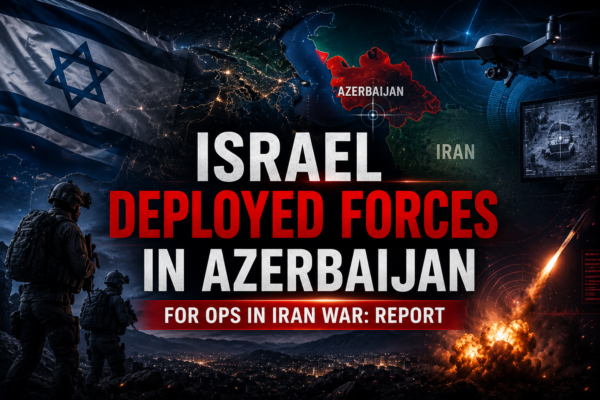
WAR-REPORT : The geopolitical rivalry between Israel and Iran has entered an increasingly sophisticated phase, extending far beyond conventional military operations. A recent media report has claimed that Israel secretly deployed elite military personnel, intelligence officers, and special operations units inside Azerbaijan during its recent conflict with Iran. If accurate, the revelations underscore the extent to which regional partnerships, covert operations, and intelligence networks have become central components of modern Middle Eastern security strategy.
According to the report, Israeli forces initially arrived in Azerbaijan as contingency rescue teams but gradually expanded their mission into intelligence gathering, surveillance, drone operations, and support for military activities targeting Iranian assets. The alleged deployment would represent one of several covert positions maintained by Israel around Iran’s borders, complementing reported operations in Iraq, the United Arab Emirates (UAE), and Somaliland.
However, Azerbaijan has firmly denied that its territory was used for military operations against any third country, emphasizing that the allegations are unfounded. Similar denials have also been issued by other regional governments named in various reports.
Covert Operations Beyond the Battlefield
Military conflicts today are rarely confined to traditional frontlines. Intelligence agencies increasingly rely on regional partnerships, surveillance networks, cyber capabilities, and special operations forces to gain strategic advantages long before open hostilities begin.
The report suggests that Israel’s alleged activities in Azerbaijan formed part of a broader intelligence architecture designed to monitor Iranian military movements, missile deployments, drone activity, and command infrastructure.

Rather than serving solely as combat forces, the deployed personnel reportedly carried out reconnaissance, communications monitoring, intelligence coordination, and logistical planning.
Why Azerbaijan Matters Strategically
Azerbaijan occupies one of the most strategically sensitive locations in Eurasia.
The country shares a lengthy border with northwestern Iran, providing a geographical position that could theoretically offer valuable intelligence access to Iranian military installations located in the country’s northern provinces.

The report claims Israeli personnel operated from multiple sites in southern Azerbaijan, with some positions reportedly located less than 100 kilometers from the Iranian city of Tabriz.
Tabriz has long been considered strategically important due to its transportation infrastructure, military facilities, and industrial significance.
Its proximity makes Azerbaijan an area of considerable geopolitical interest for numerous regional and international intelligence agencies.
Elite Forces Reportedly Involved
According to the report, the deployment allegedly included:
- Israeli Special Operations Forces
- Elite airborne rescue units
- Intelligence officers
- Mossad personnel
- Drone operators
- Communications specialists
- Surveillance teams
Initially described as emergency rescue teams intended to recover personnel if necessary, the units reportedly evolved into broader operational groups supporting intelligence and military planning.
Such dual-purpose deployments are not uncommon in modern military doctrine, where rescue units often possess advanced reconnaissance capabilities.
Intelligence Gathering Along Iran’s Northern Border
The report alleges that surveillance infrastructure was established weeks before the conflict intensified.
These activities reportedly included:
- Electronic listening systems
- Signals intelligence collection
- Drone surveillance
- Monitoring military communications
- Tracking missile movements
- Observation of troop deployments
Such intelligence would provide commanders with improved situational awareness before and during military operations.
Modern conflicts increasingly depend upon real-time intelligence rather than overwhelming troop numbers.
Preparations Allegedly Began Months Earlier
The report claims planning for the deployment started several weeks before direct hostilities.
Israeli planners reportedly anticipated deteriorating diplomatic conditions between Iran and the United States and prepared contingency intelligence positions accordingly.
According to the allegations, surveillance equipment was quietly installed near the Azerbaijan-Iran border during a covert operation conducted in January.
If accurate, such preparations would indicate that intelligence planning significantly preceded open military confrontation.
Operations Beyond Azerbaijan
The report further alleges that Israel maintained additional covert facilities elsewhere in the region.
These reportedly included:
Iraq
Facilities allegedly used for logistics, communications, and possible search-and-rescue operations.
United Arab Emirates
Reports claim Israel temporarily deployed defensive systems, including Iron Dome personnel, although UAE officials have denied hosting such operations.
Somaliland
The Horn of Africa territory was reportedly considered a possible logistical waypoint for long-range missions because of its strategic location near the Red Sea and Gulf of Aden.
These alleged deployments would collectively create a network surrounding much of Iran’s northern, western, and southern approaches.
Azerbaijan Rejects the Allegations
The Azerbaijani government has categorically rejected reports suggesting that its territory was used for military operations against Iran.
Officials stated that claims regarding foreign military activity targeting neighboring countries from Azerbaijani soil are entirely unfounded.
Such denials are unsurprising given Azerbaijan’s delicate diplomatic position.
Although Azerbaijan maintains close defense cooperation with Israel, it also shares extensive economic, cultural, and geographic ties with neighboring Iran.
Maintaining balanced regional relations remains a key priority for Baku.
Iraq Also Denies Foreign Military Presence
Reports alleging covert Israeli logistical sites inside Iraq have likewise been denied by Iraqi authorities.
Government officials have stated that no unauthorized foreign military bases or combat forces operate within Iraqi territory.
Iraq has repeatedly emphasized its commitment to preserving national sovereignty while avoiding becoming a battlefield for regional rivalries.
UAE Rejects Operational Claims
Reports suggesting Israeli military deployments inside the United Arab Emirates have also been rejected.
While Israel and the UAE have expanded diplomatic and economic relations following normalization agreements in recent years, Emirati officials have denied allegations that their territory hosted military operations against Iran during the conflict.
Regional Intelligence Cooperation
Even where governments deny operational involvement, intelligence cooperation between friendly nations often exists in various forms.
Modern intelligence collaboration may include:
- Counter-terrorism information sharing
- Airspace monitoring
- Cybersecurity cooperation
- Maritime surveillance
- Missile early-warning systems
- Counter-drone technology
Such cooperation does not necessarily imply participation in offensive military operations.
Reported Assassination Operation
Among the report’s most notable claims is the allegation that operations launched from Azerbaijan contributed to the targeted killing of an Iranian Revolutionary Guard intelligence official.
The report alleges Israeli intelligence considered the official responsible for coordinating hostile activities against Israeli interests.
These claims have not been independently verified and remain part of broader reporting surrounding covert regional operations.
Azerbaijan and Israel: A Long Strategic Partnership
Regardless of the current allegations, Azerbaijan and Israel have maintained close strategic relations for many years.
Their cooperation includes:
- Defense technology
- Energy trade
- Intelligence dialogue
- Agricultural cooperation
- Cybersecurity
- Aviation
- Advanced military equipment
Israel has reportedly been one of Azerbaijan’s major defense suppliers, while Azerbaijan remains an important energy partner for Israel.
These longstanding ties have often attracted regional attention.
Intelligence Networks Shape Modern Warfare
Unlike conventional wars of previous decades, modern conflicts increasingly depend on intelligence superiority.
Success often relies upon:
- Satellite imagery
- Artificial intelligence
- Electronic surveillance
- Cyber operations
- Drone reconnaissance
- Human intelligence networks
- Special operations forces
Rather than large troop movements, many strategic advantages now emerge through covert capabilities operating behind the scenes.
Regional Implications
Whether or not every reported deployment is ultimately confirmed, the allegations illustrate the increasingly interconnected nature of Middle Eastern security dynamics.
Neighboring states often find themselves balancing complex diplomatic relationships while navigating strategic competition among larger regional powers.
The alleged use of multiple countries for intelligence, logistics, and surveillance demonstrates how contemporary conflicts extend well beyond national borders.
Our Media Opinion
The report alleging that Israel secretly deployed elite military and intelligence personnel in Azerbaijan during the conflict with Iran has added a new dimension to discussions surrounding regional security and covert operations. While Azerbaijan, Iraq, and the UAE have strongly denied claims that their territories were used for offensive operations against Iran, the allegations highlight the growing role of intelligence networks, strategic partnerships, and special operations in modern warfare.
As tensions continue to shape the Middle East’s security landscape, many of these claims remain contested and independently unverified. Nevertheless, they underscore how geopolitical competition increasingly unfolds through intelligence cooperation, surveillance capabilities, and covert planning rather than solely through conventional military engagements.