

Fuel Shortages Deepen Across Occupied Ukraine as Ukrainian Strikes
Disrupt Russian Supply Lines
 Samir Singh 'Bharat'-Editor-in-Chief
Send an email
5 June 2026
Samir Singh 'Bharat'-Editor-in-Chief
Send an email
5 June 2026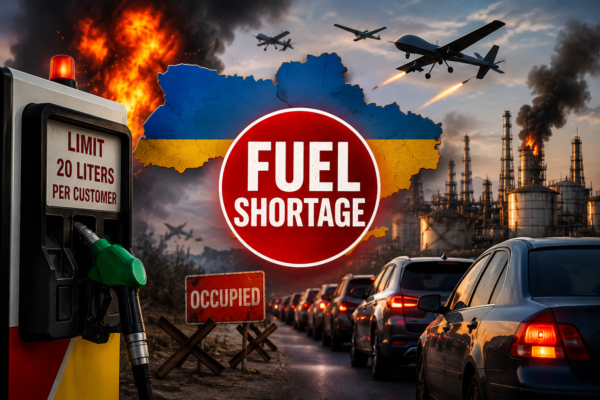
Kyiv-Moscow: Fuel shortages are worsening across Russian-occupied territories of Ukraine, highlighting the growing impact of Ukraine’s expanding campaign against Russian military logistics and energy infrastructure. Occupation authorities in Crimea, Luhansk, and Kherson regions have begun imposing restrictions on gasoline sales as supply disruptions spread throughout areas controlled by Russian forces.
The shortages come amid a sustained Ukrainian effort to target Russian transportation routes, fuel distribution networks, and oil-processing facilities, creating mounting challenges for Moscow’s military and civilian supply chains in occupied regions.
Crimea Introduces Fuel Rationing Measures
Authorities in occupied Crimea have introduced emergency restrictions following reports of rapidly depleting fuel supplies. Crimea’s Russian-installed administration announced that gasoline sales would be limited to 20 liters per customer beginning on May 30 in an effort to manage dwindling reserves.
The situation quickly deteriorated as residents rushed to fuel stations, leading to shortages across major urban centers. Occupation officials in Sevastopol acknowledged that many fuel stations exhausted their gasoline supplies within hours of opening.
In response, authorities tightened controls further by introducing a coupon-based distribution system. However, reports indicate that even this mechanism faced difficulties after several major fuel suppliers reportedly suspended coupon sales, creating additional uncertainty for consumers and businesses.

The fuel crisis has gradually expanded beyond Crimea, with occupation administrations in parts of Luhansk and Kherson regions also implementing restrictions on gasoline purchases.
Ukrainian Strikes Target Key Russian Supply Routes
Military analysts believe the shortages are closely linked to Ukraine’s intensified campaign against Russian ground lines of communication (GLOCs) in occupied territories.
Since early May, Ukrainian forces have increasingly targeted transportation corridors used by Russia to move military equipment, fuel, ammunition, and personnel between occupied regions and mainland Russia.

One of the primary targets has been the strategically important M-14 highway, which connects occupied Berdyansk and Mariupol to Russia’s Rostov region. The route serves as a critical logistics artery supporting Russian military operations in southern Ukraine.
Ukrainian forces have also conducted strikes along the H-20 highway, another major transportation corridor linking Donetsk City with Mariupol. Disruptions along these routes have complicated Russian efforts to maintain a steady flow of fuel and military supplies.
Reports from the battlefield suggest that fuel trucks and logistical convoys have become frequent targets of Ukrainian precision strikes, further straining Russian distribution capabilities.
Drone Operations Expand Pressure on Russian Logistics
Ukraine’s growing use of long-range drones has significantly expanded the reach of its operational capabilities behind Russian front lines.
Ukrainian military officials recently claimed that their forces have established drone-assisted fire control over several important occupied cities in Luhansk Oblast, including Luhansk City, Starobilsk, Alchevsk, Bryanka, and Kadiivka.
This expanded surveillance and strike capability has increased risks for Russian military movements and fuel transportation networks operating in the region.
As a result, occupation authorities have reportedly restricted civilian traffic in some areas, citing security concerns and the increasing threat of Ukrainian drone attacks.
Military commentators sympathetic to Russia have acknowledged that Ukrainian strikes are creating serious logistical challenges, forcing commanders to alter transportation routes and adapt supply operations.
Energy Infrastructure Under Sustained Attack
Beyond transportation networks, Ukraine has continued an extensive long-range campaign targeting Russia’s energy sector deep inside Russian territory.
Throughout 2026, Ukrainian forces have repeatedly attacked oil refineries, export terminals, fuel storage facilities, and pumping stations that play critical roles in Russia’s energy production and distribution network.
Several major refining facilities have reportedly been struck multiple times, including installations in Tuapse, Volgograd, Saratov, Yaroslavl, Afipsky, and Ilsky.
These attacks are aimed not only at reducing fuel availability for Russian military operations but also at increasing economic pressure on Moscow by disrupting energy production and export capabilities.
Russian Refining Capacity Faces Growing Challenges
The cumulative impact of these strikes is increasingly visible in Russia’s refining sector.
Industry data indicates that Russian oil refinery output has fallen significantly in recent months. Reports suggest that April 2026 recorded the country’s lowest average daily refinery production since late 2009.
Several major refining facilities have either temporarily halted operations or reduced production because of damage, maintenance requirements, or heightened security concerns following repeated attacks.
Experts estimate that affected refineries account for more than 30 percent of Russia’s total gasoline production capacity, creating substantial pressure on domestic fuel supplies.
Although Russia remains one of the world’s largest oil producers, refining disruptions can create localized shortages even when crude oil production remains relatively stable.
Dual Pressure Strategy
Analysts describe Ukraine’s approach as a two-layered strategy designed to simultaneously reduce fuel production and disrupt transportation networks.
The long-range campaign focuses on degrading Russia’s ability to refine crude oil into usable fuel products, while the mid-range strike campaign seeks to interrupt the transportation of gasoline and diesel to frontline forces and occupied territories.
Together, these operations create a compound effect. Even when fuel is produced, moving it safely and efficiently to military units and civilian markets becomes increasingly difficult.
This strategy forces Russian authorities to divert additional resources toward protecting infrastructure, repairing damaged facilities, and securing transportation routes.
Growing Economic and Military Consequences
The emerging fuel shortages could have implications beyond civilian inconvenience.
Reliable fuel supplies remain essential for military mobility, logistics, power generation, agricultural operations, and public transportation. Any prolonged disruption could increase operational costs for Russian forces while affecting daily life in occupied territories.
For residents of occupied regions, rationing measures raise concerns about future availability and pricing. Businesses dependent on transportation and fuel-intensive operations may also face increased challenges if shortages persist.
Meanwhile, military observers note that logistics often play a decisive role in prolonged conflicts. Sustained disruptions to transportation and fuel networks can gradually reduce operational flexibility and complicate military planning.
War-times Outlook
As Ukraine continues its campaign against Russian logistics and energy infrastructure, the fuel situation in occupied territories is likely to remain under pressure. Russian authorities are expected to seek alternative supply routes and increase protective measures around key facilities, but repeated attacks have demonstrated the vulnerability of both transportation corridors and energy assets.
The developing fuel shortages underscore the increasingly strategic nature of the conflict, where battles over infrastructure, logistics, and supply chains are becoming as significant as operations on the front lines. With both sides continuing to adapt their tactics, the struggle over energy and transportation networks is expected to remain a central feature of the war in the months ahead.