

Myanmar’s New Government Takes Office, but Military Grip Remains Firm as Crisis Deepens
China-Backed Transition Fails to Resolve Political Turmoil,

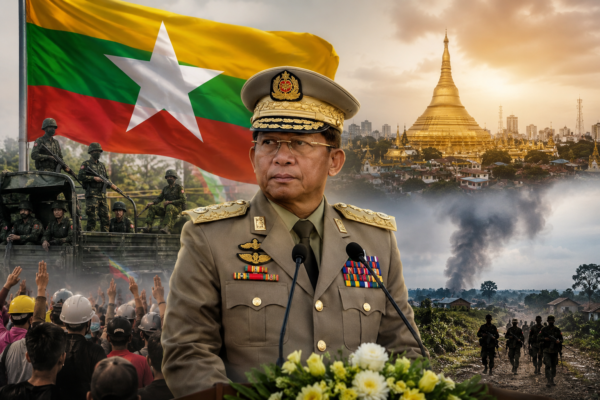
Myanmar-New Delhi: Myanmar has entered a new political chapter with the installation of a new administration following carefully managed national elections, but analysts say the transition has done little to alter the country’s fundamental power structure. Coup leader Senior General Min Aung Hlaing has now assumed the presidency, cementing the military’s dominance despite efforts to present the government as a civilian-led administration.
The latest political development comes more than five years after the military seized power in February 2021, overthrowing the elected government and plunging the Southeast Asian nation into one of the most severe political, humanitarian, and economic crises in its modern history. While the military leadership portrays the recent elections as a return to constitutional governance, critics argue that the process was heavily controlled, excluded major opposition forces, and lacked the credibility required to restore public confidence.
Observers believe the new administration represents a strategic attempt by the military establishment to gain domestic legitimacy and international recognition while maintaining effective control over the state apparatus. Although the government now includes civilian figures and operates under a constitutional framework, real authority remains concentrated in the hands of military leaders and institutions.
Military Influence Remains Unchanged
Political analysts note that the transition has altered appearances more than realities. The armed forces continue to wield decisive influence over key ministries, security agencies, economic assets, and administrative institutions.
Since the 2021 coup, Myanmar’s military has faced widespread resistance from pro-democracy groups, ethnic armed organizations, and local defense forces. Large portions of the country remain affected by conflict, with the military struggling to establish stable control over several regions.

Despite these challenges, recent developments have strengthened the regime’s position. The election process has provided the military with a platform to claim constitutional legitimacy, while growing diplomatic support from China has helped improve its international standing.
The government now seeks to project an image of stability and governance, emphasizing economic recovery, infrastructure development, and national unity. However, critics argue that these initiatives cannot succeed without addressing the underlying political crisis and widespread public opposition to military rule.
China Emerges as the Regime’s Most Important Partner
One of the most significant factors shaping Myanmar’s political landscape is the increasing role of China. Beijing has emerged as the military-led government’s most influential international supporter, providing diplomatic backing, economic engagement, and strategic cooperation.

China has significant interests in Myanmar, including major infrastructure projects, energy pipelines, mining investments, and trade routes that connect southwestern China to the Indian Ocean. Stability in Myanmar is therefore considered crucial for Beijing’s regional economic and security objectives.
Over the past year, Chinese engagement with Naypyitaw has intensified. High-level meetings, economic agreements, and security cooperation initiatives have signaled Beijing’s willingness to work closely with Myanmar’s military-backed administration despite criticism from Western governments.
Analysts believe Chinese support has improved the regime’s battlefield and diplomatic prospects. By strengthening relations with Beijing, Myanmar’s leadership has gained access to economic opportunities and political backing that help offset international isolation.
However, this growing dependence also raises concerns about Myanmar becoming increasingly reliant on China for economic survival and international legitimacy.
Legitimacy Challenges Continue
Despite the formation of a new administration, questions regarding legitimacy remain unresolved.
Many opposition groups rejected the elections, arguing that the process excluded key political actors and failed to meet international democratic standards. Several political parties were barred from participation, while large areas affected by conflict were unable to conduct meaningful voting.
Civil society organizations have also questioned voter turnout figures and the fairness of the electoral environment. As a result, the new government faces an uphill battle in convincing citizens and the international community that it represents a genuine democratic transition.
Political experts argue that legitimacy cannot be manufactured solely through elections. Sustainable stability requires broad political inclusion, meaningful dialogue, and reconciliation among competing stakeholders.
Without such measures, the administration may struggle to gain acceptance beyond its existing support base.
Economic Crisis Remains a Major Threat
Myanmar’s economy continues to face severe difficulties despite official claims of recovery.
Since the coup, foreign investment has declined significantly, international sanctions have expanded, and business confidence has deteriorated. Inflation, currency instability, and supply chain disruptions have affected both urban and rural populations.
The country’s manufacturing sector has experienced repeated setbacks due to conflict, labor shortages, and declining exports. Many businesses have relocated operations to neighboring countries, reducing employment opportunities for local communities.
Economic hardships have also contributed to rising poverty levels. Millions of people face reduced incomes, while humanitarian agencies warn that food insecurity and limited access to essential services remain widespread.
Experts caution that even with Chinese investment and government development initiatives, Myanmar’s economic recovery will remain fragile unless political stability improves.
Growing Transnational Security Concerns
Myanmar’s ongoing instability increasingly affects neighboring countries and the broader region.
One of the most alarming developments is the expansion of organized criminal networks operating across Myanmar’s border regions. Areas with weak governance have become hubs for illicit activities, including cyber fraud operations, online scam centers, narcotics production, human trafficking, money laundering, and illegal financial transactions.
International law enforcement agencies have repeatedly highlighted the growth of large-scale scam compounds in parts of Myanmar. These operations often involve victims trafficked from multiple countries and forced to participate in online fraud schemes.
The profits generated by such criminal enterprises have strengthened transnational networks that operate across Southeast Asia and beyond.
Drug trafficking also remains a significant challenge. Myanmar continues to be one of the world’s major producers of synthetic narcotics, with criminal groups exploiting instability to expand production and distribution networks.
Human Trafficking and Migration Risks Increase
Political uncertainty and economic difficulties have fueled risky migration patterns throughout the region.
Thousands of Myanmar citizens continue to seek employment opportunities abroad, often relying on informal recruitment channels that expose them to exploitation and trafficking.
Human rights organizations report increasing cases of forced labor, debt bondage, and unsafe working conditions affecting migrant workers.
Border communities in neighboring countries face growing pressures as migration flows increase. Governments across the region are struggling to balance humanitarian responsibilities with security concerns.
Experts warn that unless livelihoods improve within Myanmar, migration pressures are likely to continue rising.
Critical Minerals and Supply Chain Challenges
Myanmar’s mineral sector has become another area of international concern.
The country possesses significant reserves of rare earth elements and other critical minerals essential for modern technologies, renewable energy systems, and advanced manufacturing.
However, conflict, weak governance, and illicit extraction activities have raised questions about supply chain transparency and environmental sustainability.
International companies increasingly face pressure to ensure that mineral sourcing does not contribute to conflict financing, human rights abuses, or environmental degradation.
Analysts believe that stronger oversight mechanisms and responsible sourcing initiatives will be necessary to address these risks.
International Community Faces Difficult Choices
The emergence of the new administration presents foreign governments with complex policy decisions.
Many countries remain reluctant to grant full diplomatic recognition to Myanmar’s military-backed leadership, yet practical engagement may be necessary to address humanitarian needs and regional security concerns.
Experts argue that existing sanctions should remain in place while allowing targeted engagement on issues such as humanitarian assistance, disaster response, public health, and economic livelihoods.
Humanitarian organizations continue to call for expanded access to vulnerable populations across conflict-affected regions. Negotiating such access will require cooperation with multiple actors, including government authorities, ethnic organizations, and local community groups.
Supporting Civil Society and Local Communities
Civil society organizations remain critical to Myanmar’s future despite operating under difficult conditions.
International donors are increasingly exploring ways to support local organizations through flexible funding mechanisms and non-state delivery channels.
Programs focused on education, healthcare, livelihoods, and community resilience can help reduce the humanitarian impact of the crisis while strengthening local capacity.
Experts emphasize that long-term stability will depend not only on political agreements but also on the ability of communities to rebuild trust, economic opportunities, and social cohesion.
Outlook: Crisis Far From Over
While Myanmar’s new administration seeks to project an image of political normalization, underlying challenges remain profound. The military continues to dominate governance, armed conflict persists across large parts of the country, and economic difficulties continue to affect millions of citizens.
China’s support has undoubtedly improved the regime’s diplomatic and strategic position, but it has not resolved fundamental questions regarding legitimacy, governance, and national reconciliation.
As regional security concerns grow and transnational criminal networks expand, Myanmar’s crisis is no longer solely a domestic issue. Its consequences increasingly extend beyond national borders, affecting neighboring countries, international markets, and global security interests.
For now, the formation of a new government may mark a significant political milestone, but few observers believe it represents a definitive solution to Myanmar’s long-running turmoil. Instead, it appears to be the latest phase in a crisis that continues to reshape the country and the wider region.