

India Hosts Global ISO Space Summit: 131 Delegates Drive Major Space Breakthrough
By Doruvu Paul Jagan Babu: Assistant Chief Editor

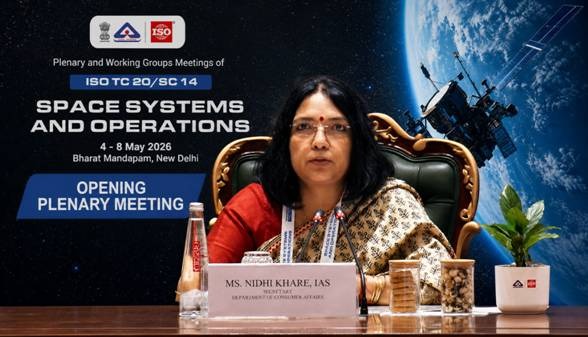
New Delhi: India strengthened its growing influence in the global space sector as the Bureau of Indian Standards (BIS) hosted the 35th Plenary and Working Groups meetings of ISO TC 20/SC 14 on “Space Systems and Operations” in New Delhi. The high-level international gathering brought together 131 delegates from 13 countries, including experts from global space agencies, industry leaders, academia, and standardisation bodies, to deliberate on the future of international space standards.
Held at Bharat Mandapam, the event underscored India’s expanding role in global space governance, driven by the achievements of ISRO and policy reforms enabling greater private sector participation through IN-SPACe.
India emerging as a global space hub
Addressing the opening plenary, Nidhi Khare, Secretary, Department of Consumer Affairs, Government of India, highlighted India’s growing leadership in the international space ecosystem and stressed the importance of global cooperation in developing standards for safe, sustainable, and inclusive space activities.
She stated that India is standing at the forefront of global space transformation, supported by reforms and the creation of Indian National Space Promotion and Authorization Center, which has opened new opportunities for startups and private industries in the space sector.
Khare noted that international standards developed through collaborative efforts would play a vital role in ensuring the long-term sustainability and safety of space exploration and operations.

BIS emphasises standards for quality and global competitiveness
Director General of Bureau of Indian Standards Sanjay Garg highlighted the critical role of standardisation in improving quality, safety, interoperability, and global competitiveness in India’s rapidly expanding space industry.

He said BIS is actively aligning Indian standards with international frameworks to meet the evolving demands of the space ecosystem. According to him, hosting the international meeting in India offers Indian experts direct exposure to global standardisation processes, strengthening both domestic capabilities and international cooperation.
He also pointed out that BIS standards are increasingly helping India’s private space sector compete in global markets.
IN-SPACe highlights private sector growth
Chairman of IN-SPACe Pawan Goenka underlined the transformative growth of India’s space ecosystem, attributing it to policy reforms and rising private sector participation.
He stressed that strong and globally accepted standards are essential for enabling innovation, enhancing industry confidence, and integrating India more deeply into the international space economy.
International participation from 13 countries
The summit witnessed participation from 131 international delegates representing 13 countries, including officials from national standards bodies, global space agencies, academia, and industry stakeholders.
Experts from Indian Space Research Organisation and several international institutions took part in the deliberations focused on strengthening international cooperation in space systems and operations.
The inaugural session was attended by senior officials including Reena Garg, Frederick Slane, and Rajeev Jyoti.
Focus on space sustainability and mission operations
ISO TC 20/SC 14 develops international standards covering the complete lifecycle of space systems — from design and manufacturing to launch, operations, and space-based services.
The New Delhi meeting focused on critical emerging areas such as:
Space sustainability
Space debris mitigation
Mission operations
Safety and interoperability
Global operational frameworks for space activities
The discussions reflected growing global concern over sustainable space operations as commercial and governmental activities in orbit continue to expand rapidly.
India’s rising influence in global space governance
India hosting the prestigious international standardisation meeting is being viewed as a recognition of the country’s rising stature in the global space domain.
With landmark achievements by Indian Space Research Organisation, increasing private investment, and reforms under Indian National Space Promotion and Authorization Center, India is positioning itself not only as a major spacefaring nation but also as an active contributor in shaping international policy and technical standards for future space exploration.
The summit reinforced India’s commitment to collaborative innovation, sustainable development, and global cooperation in the rapidly evolving space sector.