

Ethiopia Crisis, Middle East Tensions and Global Political Shifts
Dominate International Agenda
 Samir Singh 'Bharat'-Editor-in-Chief
Send an email
28 May 2026
Samir Singh 'Bharat'-Editor-in-Chief
Send an email
28 May 2026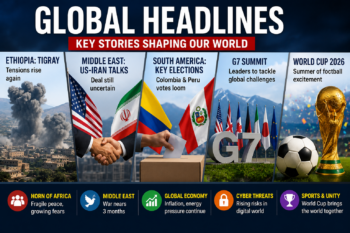
SPECIAL-REPORT : The global geopolitical landscape is entering another period of heightened uncertainty as tensions in Africa, the Middle East and South America continue to reshape international diplomacy and security calculations. From the growing instability in Ethiopia’s Tigray region to the ongoing conflict involving Iran and the United States, world leaders are increasingly facing interconnected crises that could significantly influence global politics, trade, migration and security in the months ahead.
Diplomatic discussions in Washington this month reportedly focused heavily on Ethiopia, particularly the fragile situation in the northern Tigray region, which many analysts now describe as a renewed powder keg for the Horn of Africa. At the same time, the Middle East conflict continues to escalate with uncertainty surrounding the possibility of a diplomatic agreement between Washington and Tehran. In South America, crucial presidential elections in Colombia and Peru are expected to determine whether the continent’s political direction will continue shifting toward conservative and right-leaning leadership.
Alongside these developments, the upcoming G7 summit is drawing global attention as major economies prepare to discuss war, energy security, inflation, technology competition and international trade. Even global sporting events such as the upcoming FIFA World Cup are becoming intertwined with international diplomacy, soft power and geopolitical messaging.
Ethiopia and Tigray Once Again at the Center of Global Concern
Ethiopia has re-emerged as one of the most closely watched countries in Africa due to rising political instability and fears of renewed conflict in Tigray. Policymakers and diplomats in Washington have reportedly expressed serious concern over deteriorating conditions in the northern region, where fragile peace arrangements remain under pressure.
The Tigray conflict previously caused massive humanitarian devastation, displacement and regional instability. Although ceasefire agreements and diplomatic interventions reduced direct fighting, unresolved political tensions, ethnic divisions and military distrust continue to threaten long-term peace.

Experts warn that another major escalation in Tigray could destabilize not only Ethiopia but also neighboring countries across the Horn of Africa, including Eritrea, Sudan and Somalia. The region already faces multiple security challenges including armed militias, refugee flows, food insecurity and cross-border tensions.
International observers believe that Ethiopia’s internal political divisions remain deep despite attempts at national reconciliation. Concerns are also growing over the economic impact of prolonged instability, with inflation, unemployment and humanitarian needs placing additional pressure on the Ethiopian government.
Diplomatic circles in Washington are increasingly viewing Ethiopia not only as a humanitarian concern but also as a strategic geopolitical issue. The Horn of Africa sits near major global shipping lanes connecting the Red Sea, the Suez Canal and the Indian Ocean, making stability in the region critically important for international trade and security.

Middle East Conflict Raises Questions About US-Iran Deal
As the conflict in the Middle East approaches the three-month mark, international attention remains focused on the possibility of renewed negotiations between the United States and Iran. Analysts believe that despite escalating tensions, both sides may still seek diplomatic pathways to avoid a wider regional war.
The situation remains extremely delicate. Iran continues to play a central role in regional security calculations, while the United States and its allies are attempting to prevent further escalation involving multiple armed groups and regional powers.
Diplomatic experts suggest that several factors could influence whether negotiations succeed or fail. These include sanctions relief, nuclear monitoring, regional military activities and broader security guarantees in the Gulf region.
The possibility of a limited agreement remains uncertain, but policymakers acknowledge that continued instability could severely impact global oil markets, maritime trade routes and regional alliances.
Energy security has become one of the most urgent concerns for global economies. Any prolonged disruption in the Middle East could push oil prices higher, intensify inflationary pressures and create additional economic stress for developing countries already struggling with financial instability.
The United States also faces increasing strategic pressure as it balances support for regional allies while attempting to avoid direct military escalation. Meanwhile, Iran continues to strengthen diplomatic and economic partnerships with countries seeking alternatives to Western influence.
Horn of Africa and Middle East Crises Becoming Interconnected
Security analysts now believe that the crises in the Horn of Africa and the Middle East are becoming increasingly interconnected. The Red Sea corridor links both regions economically and strategically, making instability in one area capable of affecting the other.
Shipping security, refugee movements, arms trafficking and militant activity are all contributing to growing international concern. Several global powers are increasing their diplomatic and military engagement in the region in an effort to protect trade routes and maintain influence.
The Red Sea remains one of the world’s most important maritime trade corridors. Any major disruption could affect global supply chains, fuel transportation costs and food security in several countries.
International humanitarian organizations are also warning that simultaneous crises in Africa and the Middle East could overwhelm global aid systems already under severe financial pressure.
Colombia and Peru Elections Could Reshape South American Politics
Attention is also turning toward South America, where upcoming presidential elections in Colombia and Peru may influence the broader political direction of the continent.
Political analysts say these elections could indicate whether South America will continue shifting toward conservative and center-right leadership after years of ideological fluctuations. Economic concerns, crime, inflation and public dissatisfaction with governance are expected to dominate voter sentiment.
In Colombia, security issues, organized crime and economic reforms remain major campaign themes. Voters are increasingly demanding stronger governance and economic stability amid ongoing concerns over violence and drug trafficking networks.
Peru, meanwhile, continues to face political instability after years of leadership crises, corruption scandals and public unrest. The presidential race is expected to focus heavily on economic recovery, democratic institutions and public trust in government.
Observers note that political shifts in Colombia and Peru could affect regional diplomacy, trade partnerships and international investment flows throughout Latin America.
The elections may also influence relations with the United States, China and other major global powers competing for economic and strategic influence in the region.
G7 Summit Expected to Address Global Instability
The upcoming G7 summit is expected to become one of the most significant diplomatic gatherings of the year as world leaders confront multiple simultaneous crises.
Among the major topics likely to dominate discussions are:
- Global economic slowdown
- Artificial intelligence and technology competition
- Energy security
- Climate change
- Supply chain disruptions
- The wars in Ukraine and the Middle East
- Security concerns in Africa
- China’s growing global influence
Western leaders are also expected to discuss coordinated responses to geopolitical instability and economic uncertainty. The summit could produce new agreements related to sanctions, defense cooperation and trade policy.
Developing nations are closely watching the summit outcomes, particularly regarding financial assistance, debt relief and climate financing commitments.
The G7 nations continue to face pressure to demonstrate unity at a time when global alliances are increasingly under strain. Differences over trade policies, defense spending and diplomatic priorities could also shape the summit’s final outcomes.
Global Economy Facing Multiple Pressures
The convergence of wars, political instability and economic uncertainty is creating major challenges for the global economy.
Energy prices remain vulnerable to geopolitical developments, while inflation continues affecting both developed and developing economies. International financial institutions are warning that prolonged instability could reduce global growth projections.
Supply chains disrupted by conflict and geopolitical competition continue to affect manufacturing, technology sectors and food distribution networks worldwide.
Emerging economies remain especially vulnerable to rising borrowing costs, currency instability and reduced foreign investment.
At the same time, governments across the world are attempting to balance defense spending with domestic economic priorities, creating additional political pressure on leadership.
Technology, Cybersecurity and Information Warfare
Another major concern discussed by policymakers is the growing role of cyber warfare, misinformation and digital influence campaigns in global conflicts.
Governments are increasingly worried about foreign interference, cyber attacks on infrastructure and the use of artificial intelligence in information operations.
Digital propaganda and online disinformation are becoming powerful tools in shaping public opinion during elections and conflicts. Intelligence agencies across several countries are expanding efforts to monitor and counter such activities.
Cybersecurity experts warn that future geopolitical conflicts may increasingly involve digital attacks targeting banking systems, transportation networks, communication systems and energy infrastructure.
Sports and Soft Power: World Cup Diplomacy
Even international sporting events are now becoming part of geopolitical strategy. Analysts believe the upcoming FIFA World Cup will serve not only as a major sporting spectacle but also as an important platform for global diplomacy and national image-building.
Countries increasingly use major sporting events to project influence, strengthen international relationships and promote tourism and investment opportunities.
Global sporting tournaments also provide opportunities for diplomatic engagement between countries that may otherwise have tense political relations.
Security agencies are expected to implement extensive international coordination during the tournament due to concerns about cyber threats, crowd management and geopolitical tensions.
International Community Facing a Defining Moment
The convergence of crises in Ethiopia, the Middle East, South America and other regions reflects a broader transformation in global politics. Governments are increasingly being forced to manage overlapping security, economic and humanitarian challenges simultaneously.
Diplomats and analysts believe the coming months could prove decisive for several international conflicts and political transitions. Whether through negotiations, elections or military developments, the outcomes of these unfolding situations may significantly influence global stability for years to come.
As world leaders prepare for critical diplomatic meetings and elections, the international community faces mounting pressure to strengthen cooperation, prevent escalation and address growing public concerns over security and economic uncertainty.
The evolving situations in Ethiopia, Iran, South America and beyond demonstrate that geopolitical instability is no longer confined to isolated regions. Instead, today’s interconnected world means that conflicts and political shifts in one part of the globe can rapidly influence economies, diplomacy and public sentiment worldwide.