

Ukraine Reshuffles Government as Drone Campaign Intensifies Pressure on Russia’s War Logistics
A War of Logistics as Much as Firepower
 Samir Singh 'Bharat'-Editor-in-Chief
Send an email
17 July 2026
Samir Singh 'Bharat'-Editor-in-Chief
Send an email
17 July 2026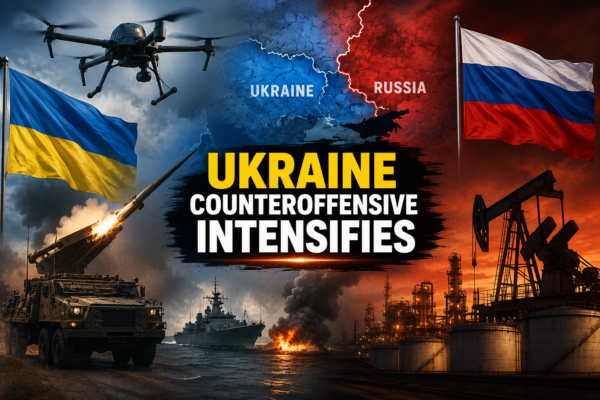
War-Report : Kyiv, Ukraine: Ukraine has announced a sweeping reshuffle of its Cabinet while simultaneously intensifying its long-range drone campaign against Russian military logistics, underscoring Kyiv’s dual strategy of strengthening domestic governance and increasing pressure on Moscow’s war capabilities.
The personnel changes, approved on July 16, come as Ukrainian forces continue to expand precision strikes targeting Russian fuel supplies, transport networks, and military infrastructure supporting operations in occupied Crimea and southern Ukraine.
Major Cabinet Reshuffle Approved
The Ukrainian Parliament (Verkhovna Rada) approved President Volodymyr Zelensky’s nominations for several key ministerial positions as part of a broader government reorganization.
Former Naftogaz Chief Executive Serhiy Koretsky was confirmed as Ukraine’s new Prime Minister, replacing Yulia Svyrydenko. The move is viewed as part of Kyiv’s effort to strengthen economic management and wartime governance amid continuing conflict.
Several senior officials retained their positions, including:

- Denys Shmyhal as First Deputy Prime Minister and Minister of Energy.
- Serhiy Marchenko as Minister of Finance.
The parliament also approved appointments to several strategic ministries:
- General Ivan Vyhivskyi, Chief of Ukraine’s National Police, as Minister of Internal Affairs.
- Oleksandr Kravchenko, formerly with McKinsey & Company, as Minister of Economy.
- Oksana Ferchuk as Minister of Digital Transformation.
- Vitaliy Kim, head of the Mykolaiv Regional Military Administration, as Minister for Veterans Affairs.
- Vitaliy Bezgin as Minister for Communities, Territories and Internally Displaced Persons.
- Mykola Kalashnyk as Minister for Reconstruction, Infrastructure and Transport.
The appointments are expected to reinforce Ukraine’s wartime administration while accelerating reconstruction planning and economic reforms.
Ukraine Expands Drone Campaign Against Russian Supply Routes
At the same time, Ukraine continues to intensify long-range drone operations aimed at disrupting Russia’s military logistics across the Azov-Black Sea region.

According to Ukrainian Navy spokesperson Captain Dmytro Pletenchuk, the campaign has significantly disrupted Russian fuel shipments and complicated military supply deliveries to occupied Crimea.
Ukraine’s unmanned systems have increasingly targeted maritime supply routes linking Russian ports to occupied territories, forcing Moscow to alter logistics strategies and devote additional air-defense resources to protect shipping lanes.
Officials say Ukrainian strikes are affecting:
- Fuel transportation to occupied Crimea.
- Maritime supply routes in the Black Sea and Azov Sea.
- Russian logistics supporting southern military operations.
- Aviation fuel deliveries to military airfields.
Military analysts believe these operations are placing additional strain on Russia’s already stretched air-defense network.
Pressure on Russian Air Defenses
Ukraine claims Russia now faces increasing difficulty protecting both military installations and commercial vessels transporting fuel and supplies.
According to Ukrainian officials, Russian forces have become increasingly dependent on maritime supply routes after repeated Ukrainian attacks disrupted several ground logistics corridors connecting occupied Crimea with southern Russia.
The campaign is also reportedly limiting Russia’s flexibility in protecting strategic infrastructure while maintaining offensive military operations.
Crimea Logistics Under Increasing Pressure
Ukraine has repeatedly targeted logistics supporting Russian military forces in occupied Crimea.
Officials argue that limiting fuel deliveries and transport capacity could reduce Russia’s operational effectiveness in the Black Sea region while increasing the cost of sustaining military deployments.
The campaign is also intended to complicate Russian troop movements and supply chains throughout southern Ukraine.
Russia Turns to India for Gasoline Supplies
As Ukrainian strikes continue to affect Russian refining infrastructure, reports indicate that Russia is seeking additional gasoline imports from India.
According to reports, several major Russian energy companies—including Rosneft, Gazprom Neft, and Lukoil—have approached Indian refiners to secure refined fuel supplies.
Industry sources suggest at least one shipment of Indian gasoline has already been dispatched, with additional deliveries expected through complex ship-to-ship transfers involving intermediary vessels.
Energy market analysts believe the move reflects mounting pressure on Russia’s domestic fuel production following repeated attacks on oil refining facilities.
Oil Refining Capacity Remains Under Strain
Industry estimates indicate that Russia may remain unable to restore a significant portion of its damaged refining capacity for several more months, even if attacks were to cease immediately.
The disruption has contributed to gasoline shortages in several Russian regions while increasing dependence on imported refined petroleum products.
Although Russian crude oil exports continue, the country is reportedly facing growing challenges in converting crude into refined fuels for domestic consumption.
Strategic Impact on the War
Military observers note that Ukraine’s expanding strike campaign is designed to weaken Russia without requiring large-scale frontline offensives.
Rather than focusing solely on battlefield engagements, Ukrainian forces are increasingly targeting logistics hubs, fuel infrastructure, transport routes, ports, and supply chains supporting Russian military operations.
If sustained, these operations could gradually reduce Russia’s operational flexibility while increasing the economic and logistical costs of continuing the war.
A War of Logistics as Much as Firepower
The latest developments illustrate that the conflict is increasingly becoming a contest of logistics, industrial resilience, and supply chain endurance.
While Ukraine restructures its government to strengthen wartime administration and long-term reconstruction planning, it is simultaneously attempting to erode Russia’s military capabilities by targeting critical infrastructure supporting its armed forces.
As both sides continue adapting their strategies, logistics, energy security, and economic resilience are likely to remain central factors shaping the next phase of the conflict.