


INTERPOL Warns of Rising Global Crime Threats
At Major European Security Conference in Spain
 Samir Singh 'Bharat'-Editor-in-Chief
Send an email
27 May 2026
Samir Singh 'Bharat'-Editor-in-Chief
Send an email
27 May 2026
Interol-Report : Senior law enforcement officials from across Europe and several other regions gathered in Toledo for a high-level international policing conference organized by INTERPOL, where growing threats from transnational organized crime, cyber-enabled fraud, drug trafficking and digital scam networks dominated discussions.
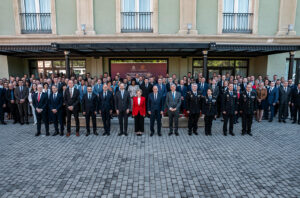
The two-day conference, held on May 20 and 21 in Spain, brought together more than 140 senior police officials and security experts to strengthen global police cooperation against rapidly evolving international criminal networks.
Officials warned that organized crime groups are increasingly using advanced digital tools, global financial systems and legitimate business structures to expand their operations across continents, making international cooperation more critical than ever.
Global Crime Networks Expanding Across Borders
During the conference, delegates examined how criminal organizations are becoming more sophisticated and interconnected, particularly in areas such as:
- drug trafficking,
- cybercrime,
- financial fraud,
- human trafficking,
- irregular migration networks,
- and online scam operations.
INTERPOL officials noted that drug trafficking routes stretching from Latin America into European ports continue to pose a major security challenge for European countries.

Authorities also highlighted concerns over fraud operations targeting victims across multiple continents while operating through complex international networks.
Experts warned that many criminal organizations are infiltrating legitimate businesses to launder money, hide illegal profits and strengthen their financial influence.
Digital Platforms Increasingly Exploited by Criminals
One of the key themes discussed at the conference was the growing use of digital platforms by transnational criminal groups.

Law enforcement officials said cybercriminals are now operating through highly organized “crime-as-a-service” ecosystems, where criminal tools and services are sold or rented online.
Delegates discussed how:
- industrial-scale scam centres,
- fake investment schemes,
- phishing networks,
- cryptocurrency fraud,
- and cyber-enabled financial crimes
are expanding rapidly and affecting millions of victims worldwide.
Officials warned that online fraud operations are becoming increasingly professional, using artificial intelligence, social engineering tactics and cross-border digital infrastructure to avoid detection.
Spain Emphasizes International Police Cooperation
Addressing the conference, Aina Calvo Sastre said Spain was honored to host the important gathering and reaffirmed the country’s strong commitment to international policing cooperation.
She stated that globalization has created new opportunities not only for economic development but also for transnational organized crime.
According to her remarks, strengthening both bilateral and multilateral cooperation is essential to effectively tackle shared global threats.
She specifically highlighted concerns related to:
- cybercrime,
- drug trafficking,
- irregular migration networks,
- and hate crimes.
Aina Calvo Sastre praised the role of INTERPOL professionals whose daily operational work contributes to the safety and security of millions of people worldwide.
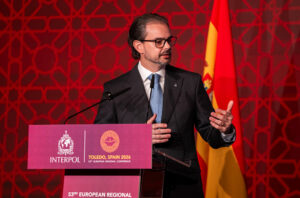
INTERPOL Calls for Action-Oriented Cooperation
Lucas Philippe emphasized the importance of turning international cooperation into concrete operational action.
He stated that INTERPOL’s greatest strength lies in its ability to create a common operational language for global policing despite differences in national systems and perspectives.
According to Lucas Philippe, the conference should not remain only a platform for discussions and assessments but must also strengthen practical coordination among police agencies worldwide.
He stressed the need for countries to improve:
- intelligence sharing,
- operational coordination,
- digital investigations,
- and joint enforcement actions.
Organized Crime Adapting Faster Than Ever
Security experts attending the conference warned that criminal organizations are evolving rapidly by exploiting:
- digital communication technologies,
- international logistics systems,
- encrypted platforms,
- online financial tools,
- and weak regulatory gaps between countries.
Officials noted that many criminal syndicates now operate like multinational corporations, with separate units handling:
- cyber operations,
- financial laundering,
- recruitment,
- logistics,
- and online propaganda.
This growing sophistication makes it increasingly difficult for individual countries to combat organized crime without international collaboration.
Cyber-Enabled Fraud Becoming Major Global Threat
Delegates at the conference expressed particular concern over the rise of cyber-enabled fraud schemes targeting people globally.
Authorities said online scam centres have evolved into large-scale criminal enterprises capable of:
- impersonating government agencies,
- operating fake investment platforms,
- conducting romance scams,
- creating phishing campaigns,
- and manipulating victims through social engineering techniques.
Many of these fraud operations operate across several countries simultaneously, making investigations more complicated and resource-intensive.
INTERPOL officials stressed the importance of stronger cyber policing capabilities and faster cross-border digital evidence sharing.
European Ports Facing Drug Trafficking Pressure
Another major issue discussed was the continued use of European ports by international drug trafficking networks.
Officials said criminal groups from Latin America continue attempting to move large quantities of narcotics into Europe through shipping routes and container networks.
Law enforcement agencies are increasingly concerned that organized crime groups are infiltrating port logistics systems and recruiting insiders to facilitate smuggling operations.
Experts also warned that profits from narcotics trafficking often fund other forms of organized crime, including cybercrime and illegal weapons trafficking.
Financial Crime and Money Laundering Under Spotlight
Delegates discussed how organized crime groups are using legitimate companies and financial systems to hide illegal earnings.
Authorities noted that modern criminal organizations frequently establish:
- shell companies,
- fake consulting firms,
- real estate investments,
- and international trade businesses
to launder money and disguise criminal proceeds.
INTERPOL officials stressed the need for stronger financial intelligence cooperation between countries and greater monitoring of suspicious international transactions.
Importance of Intelligence Sharing
One of the central messages of the conference was the importance of rapid intelligence sharing among police agencies worldwide.
Officials said delays in exchanging information can allow criminal groups to:
- move funds,
- destroy evidence,
- change digital identities,
- and relocate operations.
Delegates discussed strengthening:
- real-time data exchange,
- international alert systems,
- joint investigations,
- and coordinated enforcement operations.
Growing Need for Global Security Cooperation
Security analysts attending the conference noted that globalization and digitalization have transformed the nature of organized crime.
Criminal groups now exploit:
- international travel,
- digital banking,
- encrypted messaging apps,
- artificial intelligence,
- and social media platforms
to expand their reach far beyond national borders.
Experts warned that no country can effectively combat these threats in isolation.
The conference concluded with a strong message emphasizing that international unity, operational cooperation and technological preparedness will be essential in addressing the rapidly evolving landscape of global organized crime.
Officials expressed confidence that stronger cooperation through INTERPOL and allied policing agencies will help countries better respond to emerging criminal threats and protect public security worldwide.