

Trump’s Explosive Taiwan Arms Remarks Trigger Fresh US-China Tensions in 2026

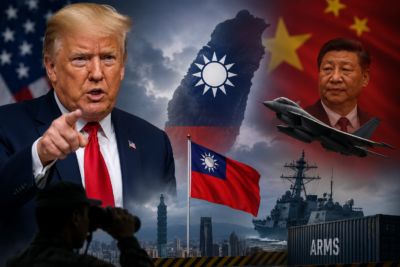
WAR-REPORT : Fresh remarks by Donald Trump regarding possible United States arms sales to Taiwan have triggered renewed debate over Washington’s long-standing policy toward the island and its increasingly tense relationship with the People’s Republic of China. Trump suggested that future American weapons sales to Taiwan could become a “negotiating chip” in broader US-China discussions while simultaneously warning Taiwan against pursuing formal independence. The comments have raised concern among analysts, policymakers, and observers in Taipei and Washington, who fear Beijing could exploit such statements to pressure both Taiwan and the United States.
The controversy emerged following a May 15 interview in which Trump urged Taiwan to “cool down” tensions with China and cautioned Taiwanese leaders against taking steps toward independence. The remarks immediately attracted attention because they appeared to diverge from decades of carefully balanced American policy toward Taiwan, which has historically combined military support with deliberate diplomatic ambiguity.
Taiwanese officials responded quickly, reiterating that Taipei has no intention of formally declaring independence and remains committed to maintaining stability across the Taiwan Strait. Nevertheless, the Chinese government has repeatedly portrayed Taiwan’s ruling administration as separatist in nature, using such claims to justify increasing military, diplomatic, and economic pressure on the island.
Taiwan Reaffirms Status Quo Policy
Taiwanese President William Lai Ching-te has consistently maintained that Taiwan already functions as a sovereign political entity and therefore does not require a formal declaration of independence. Lai’s administration argues that Taiwan possesses its own democratic government, military, economy, and constitution, making additional declarations unnecessary.
Taiwan’s Mainland Affairs Council reinforced this stance on May 18, emphasizing that the government seeks to preserve the existing cross-strait status quo rather than provoke confrontation with Beijing. Officials stressed that Taiwan’s objective remains peace and stability, despite increasing Chinese military activities around the island.

However, Beijing continues to accuse Lai and the governing Democratic Progressive Party of promoting separatism. Chinese authorities frequently describe Taiwan’s leadership as “independence activists” whose actions allegedly threaten regional peace. Such rhetoric has become a central component of Beijing’s messaging campaign toward Taiwan, particularly following Lai’s election victory.
Chinese state media and officials routinely argue that foreign support for Taiwan emboldens separatist forces. This narrative has intensified as the United States deepens military cooperation with Taipei and expands weapons transfers intended to strengthen Taiwan’s defense capabilities.
The Taiwan Relations Act and US Commitments
In response to Trump’s remarks, Taiwanese Presidential Office spokesperson Karen Kuo pointed to longstanding American legal commitments governing relations with Taiwan. Kuo specifically referenced the Taiwan Relations Act, which serves as the legal foundation for unofficial ties between Washington and Taipei after formal diplomatic relations shifted from Taiwan to Beijing in 1979.

The Taiwan Relations Act requires the United States to provide Taiwan with sufficient defensive capabilities to maintain self-defense. The legislation states that the United States “shall make available to Taiwan such defense articles and defense services in such quantity as may be necessary” for Taiwan’s security.
This framework has shaped American policy for decades and has enabled continuous US arms sales to Taiwan despite the absence of formal diplomatic recognition. Washington has repeatedly maintained that these sales are defensive in nature and intended to deter aggression rather than alter the political status of Taiwan.
In addition to the Taiwan Relations Act, American policy also rests on the “Six Assurances,” a set of commitments made to Taiwan during the Reagan administration. One key assurance states that the United States would not consult Beijing regarding arms sales decisions involving Taiwan.
Critics argue that Trump’s suggestion of using weapons sales as a bargaining tool contradicts the spirit of these assurances. Analysts warn that such statements could create uncertainty in Taiwan regarding America’s reliability as a security partner.
Concerns Over Strategic Ambiguity
For decades, US policy toward Taiwan has relied on a principle commonly known as “strategic ambiguity.” Under this approach, Washington deliberately avoids explicitly stating whether American forces would intervene militarily if China attacked Taiwan.
Supporters of strategic ambiguity believe the policy deters both sides from taking extreme actions. Taiwan is discouraged from declaring formal independence, while China remains uncertain about potential American military intervention.
Trump’s recent remarks have intensified debate over whether this delicate balance could weaken under future policy shifts. Some observers fear that presenting Taiwan-related defense support as negotiable may encourage Beijing to increase pressure on Washington.
Others argue that Trump’s statements reflect a transactional approach to foreign policy in which geopolitical commitments are treated as leverage during broader negotiations. Such an approach could complicate longstanding alliances and security partnerships throughout the Indo-Pacific region.
The situation becomes even more sensitive because Taiwan occupies a critical strategic position in East Asia. The island lies at the center of key maritime routes and is viewed by many American defense planners as an essential component of regional security architecture.
US Navy Official Reveals Weapons Pause
Additional concerns emerged after Acting Secretary of the US Navy Hung Cao stated on May 21 that the United States had paused a proposed 14-billion-dollar weapons package for Taiwan. According to Cao, the pause was intended to ensure sufficient munitions remained available for American military operations in the Middle East.
The revelation drew significant attention because Taiwan has increasingly sought advanced weapons systems amid growing Chinese military activity around the island. Delays in arms deliveries have already become a major concern for Taiwanese defense planners, particularly as Beijing rapidly modernizes its armed forces.
The suspension also fueled speculation regarding broader geopolitical calculations involving China. Reports indicated that Beijing may have delayed approval for discussions involving US Under Secretary of Defense for Policy Elbridge Colby amid tensions over Taiwan arms sales.
While official US statements linked the weapons pause to operational requirements in the Middle East rather than Chinese pressure, analysts believe Beijing could attempt to frame the development as evidence of weakening American commitment to Taiwan.
Chinese officials consistently oppose US arms sales to Taiwan and argue that such transfers violate China’s sovereignty claims. Beijing frequently connects these weapons packages to what it calls “separatist activities” on the island.
Possible Trump-Lai Communication Raises Tensions
The geopolitical situation became even more complicated after Trump stated on May 20 that he intended to speak directly with President Lai. Such communication would represent a major diplomatic development because no sitting US president has publicly held direct talks with a Taiwanese president since 1979.
American administrations have historically avoided high-level official contact with Taiwan’s leadership in order to preserve unofficial relations while maintaining formal diplomatic ties with Beijing.
Even symbolic gestures involving Taiwan often trigger sharp reactions from China. Beijing views Taiwan as part of its territory and strongly opposes any actions that could imply recognition of Taiwanese sovereignty.
Past interactions between American and Taiwanese leaders have repeatedly sparked diplomatic crises. In 2016, Trump’s phone conversation with then-Taiwanese President Tsai Ing-wen broke decades of protocol and angered Beijing shortly before Trump entered office.
Analysts believe Trump’s latest comments may have influenced China’s decision to suspend earlier diplomatic exchanges concerning defense discussions involving Elbridge Colby. Beijing reportedly canceled talks linked to a Taiwan-related arms package announced in December 2025.
Beijing’s Pressure Campaign Against Taiwan
China has significantly expanded pressure on Taiwan in recent years through military exercises, air patrols, naval deployments, cyber operations, and economic coercion. Chinese warplanes now regularly enter Taiwan’s Air Defense Identification Zone, forcing Taiwanese forces to respond frequently.
Large-scale Chinese military drills near Taiwan have become increasingly common, especially following political developments that Beijing perceives as supportive of Taiwanese sovereignty. Chinese leaders insist that reunification with Taiwan remains a historic mission and have refused to rule out the use of force.
At the same time, Beijing seeks to influence public opinion inside Taiwan by portraying the United States as an unreliable partner. Chinese officials and state media frequently argue that Washington would abandon Taiwan during a crisis.
Trump’s remarks could strengthen these narratives by creating doubts among Taiwanese citizens regarding future American support. Analysts warn that uncertainty surrounding US commitments could undermine morale and influence Taiwan’s domestic political debate.
Taiwan’s government, however, continues to emphasize cooperation with the United States and other democratic partners. Taiwanese leaders argue that stronger international partnerships are essential for deterring aggression and preserving regional stability.
Regional Implications for Indo-Pacific Security
The Taiwan issue remains one of the most dangerous flashpoints in global geopolitics. A military conflict involving Taiwan could draw in major powers and severely disrupt global trade, particularly semiconductor supply chains.
Taiwan is home to some of the world’s most advanced semiconductor manufacturers, including Taiwan Semiconductor Manufacturing Company, commonly known as TSMC. These companies play a vital role in producing advanced computer chips used in smartphones, automobiles, military systems, and artificial intelligence technologies.
Any instability in the Taiwan Strait could therefore have enormous economic consequences far beyond Asia. Governments worldwide closely monitor cross-strait developments due to the strategic and commercial importance of the region.
American allies such as Japan and South Korea also view Taiwan’s security as closely linked to broader regional stability. Japanese officials have increasingly warned that a Taiwan contingency could directly affect Japan’s own national security.
Meanwhile, China continues to expand its military capabilities at a rapid pace, including advanced naval assets, missile systems, and air power designed to challenge US influence in the Pacific.
Debate Over Future US Policy
Trump’s comments have reignited broader debate within the United States over how Washington should approach Taiwan in the coming years. Some policymakers advocate stronger and clearer support for Taiwan to deter Chinese aggression, while others argue that excessive commitments risk escalating tensions unnecessarily.
Supporters of stronger ties with Taiwan emphasize the island’s democratic system and strategic importance. Critics caution that symbolic or provocative moves could trigger dangerous escalation with China.
The debate also reflects broader divisions over America’s global role and foreign policy priorities. Questions surrounding military commitments, defense spending, and alliance obligations continue to shape political discourse in Washington.
For Taiwan, maintaining confidence in American support remains critically important. Any perception of uncertainty could embolden Beijing while increasing anxiety within Taiwanese society.
At the same time, Chinese leaders are likely to continue testing Washington’s resolve through diplomatic pressure, military demonstrations, and information campaigns aimed at weakening US-Taiwan relations.
A Growing Diplomatic Challenge
As tensions continue to rise across the Taiwan Strait, Trump’s statements highlight the fragile and increasingly complex nature of US-China-Taiwan relations. What may appear as political rhetoric can carry major geopolitical consequences in one of the world’s most strategically sensitive regions.
Taiwan remains caught between strengthening international support and intensifying Chinese pressure. The United States continues balancing its commitments to Taiwan with its broader relationship with China, a task that has challenged American administrations for decades.
Whether future US policy maintains strategic ambiguity or shifts toward a more explicit stance may significantly shape the security environment across the Indo-Pacific. For now, uncertainty surrounding arms sales, diplomatic engagement, and political messaging continues to fuel concerns about stability in the region.
With China determined to assert its claims over Taiwan and Taiwan equally determined to preserve its democratic system and autonomy, every statement from Washington carries enormous weight. Trump’s remarks have once again demonstrated how delicate the balance remains — and how easily geopolitical tensions can intensify in the evolving struggle over Taiwan’s future.