

Trump Praises Beijing Talks as Xi Calls US-China Ties World’s Most Important 2026
Trump and Xi signal cautious optimism amid efforts to stabilize US-China relations.
 Samir Singh 'Bharat'-Editor-in-Chief
Send an email
14 May 2026
Samir Singh 'Bharat'-Editor-in-Chief
Send an email
14 May 2026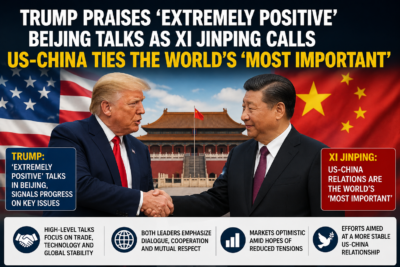
World Report : A renewed wave of diplomatic optimism emerged between the world’s two largest economies after Donald Trump praised recent discussions in Beijing as “extremely positive,” while Chinese President Xi Jinping described relations between the United States and China as the “most important” bilateral relationship in the world.
The remarks, made amid ongoing efforts to stabilize ties between United States and China, have sparked global attention as governments, investors, and international markets closely watch the direction of relations between the two economic superpowers.
For years, Washington and Beijing have been locked in a complex rivalry involving trade disputes, technology restrictions, military tensions, Taiwan, supply chain competition, cybersecurity concerns, and geopolitical influence across Asia and beyond. However, the latest round of talks appears to indicate a mutual willingness to reduce tensions and improve strategic communication.
The positive tone coming from both sides has raised hopes that the two countries may be attempting to rebuild trust after years of confrontation and uncertainty.
Trump Signals Optimism After Beijing Discussions
Speaking after high-level engagements involving American and Chinese representatives, Donald Trump described the talks as “extremely positive,” suggesting that progress had been made on several key issues affecting bilateral relations.

Although specific details of the discussions were not fully disclosed, officials familiar with the meetings indicated that trade cooperation, technology concerns, economic stability, tariffs, and geopolitical communication were among the major subjects addressed during the dialogue.
Trump’s remarks were seen as particularly significant given the history of tensions between Washington and Beijing during his previous administration.
During his earlier presidency, Trump launched a major trade confrontation with China, imposing tariffs on hundreds of billions of dollars’ worth of Chinese goods. The trade war disrupted global supply chains, increased uncertainty in international markets, and intensified strategic competition between the two powers.

At the same time, Trump repeatedly accused China of unfair trade practices, intellectual property theft, currency manipulation, and economic imbalance.
Yet despite the history of confrontation, Trump’s latest comments suggested a more cooperative tone.
Political analysts believe the positive messaging may reflect broader concerns about global economic stability and growing international pressure for the two countries to maintain constructive engagement.
Xi Jinping Emphasizes Importance of Bilateral Relationship
Chinese President Xi Jinping also adopted conciliatory language, emphasizing the global significance of stable relations between China and the United States.
Xi reportedly described the US-China relationship as “the world’s most important,” underscoring the enormous impact the two nations have on international economics, security, climate policy, technology, and global governance.
Chinese officials have repeatedly argued that confrontation between Beijing and Washington would create instability not only for the two countries but for the entire international system.
Xi’s remarks are being interpreted by observers as an attempt to project stability and openness at a time when China faces slowing economic growth, international trade pressure, and increasing strategic competition with Western powers.
Chinese leadership has consistently stressed the need for “mutual respect,” economic cooperation, and peaceful coexistence despite disagreements on sensitive political and security issues.
Diplomatic observers say Beijing appears eager to avoid deeper economic decoupling from the United States while also defending its national interests and geopolitical ambitions.
A Relationship That Shapes the Global Economy
The importance of US-China relations extends far beyond bilateral politics.
Together, the United States and China account for a massive share of the global economy, international trade, manufacturing, technology development, and financial markets.
Any major disruption between the two countries can trigger worldwide consequences affecting:
- Global stock markets
- Energy prices
- Semiconductor supply chains
- Manufacturing industries
- International shipping
- Currency markets
- Consumer prices
- Technology sectors
- Agricultural exports
Over the past decade, tensions between Washington and Beijing have repeatedly shaken investor confidence and disrupted international commerce.
Tariffs imposed during earlier trade disputes affected industries ranging from electronics and automobiles to agriculture and pharmaceuticals. Companies were forced to rethink supply chains, while governments worldwide worried about the possibility of a broader economic split between East and West.
The latest positive statements from both Trump and Xi therefore carry significance not only diplomatically but economically.
Financial analysts say even modest improvements in communication between the two countries can calm markets and reduce fears of escalating confrontation.
Trade Remains Central to the Relationship
Trade continues to be one of the most sensitive and strategically important aspects of US-China relations.
Despite years of tensions, China remains one of America’s largest trading partners, while the United States continues to be a major destination for Chinese exports.
Key areas of dispute have included:
- Trade imbalances
- Tariff policies
- Market access
- Technology restrictions
- Semiconductor exports
- Intellectual property rights
- Industrial subsidies
- Manufacturing competition
American officials have long argued that Chinese economic practices disadvantage foreign companies and distort global competition.
Meanwhile, Chinese authorities have accused Washington of attempting to contain China’s economic rise through restrictions on technology and trade.
Recent discussions reportedly explored ways to improve economic communication and reduce uncertainty for businesses operating across both markets.
While no major agreements have yet been announced, experts say the willingness to maintain dialogue itself is an important development.
Technology Rivalry Still a Major Flashpoint
One of the biggest challenges in US-China relations remains the battle over advanced technology.
The two countries are competing intensely in areas such as:
- Artificial intelligence
- Semiconductors
- Telecommunications
- Quantum computing
- Cybersecurity
- Electric vehicles
- Green energy technologies
Washington has imposed restrictions on Chinese access to advanced semiconductor technologies and high-end chips, citing national security concerns.
The United States has also pressured allies to limit the use of Chinese technology infrastructure in sensitive sectors.
China, meanwhile, has accelerated efforts to achieve technological self-sufficiency and reduce dependence on Western technology.
Despite the recent positive diplomatic language, analysts believe technology competition will remain a core source of tension between the two powers for years to come.
However, both sides may be seeking ways to prevent that competition from escalating into direct economic or political confrontation.
Taiwan Continues to Be a Sensitive Issue
Although economic matters dominated headlines, geopolitical issues remain deeply embedded in US-China relations.
Taiwan continues to be one of the most sensitive and potentially dangerous flashpoints between Washington and Beijing.
China considers Taiwan part of its territory and has repeatedly warned against foreign interference in what it describes as internal affairs.
The United States, while officially recognizing the “One China” policy, maintains unofficial ties with Taiwan and continues supplying defensive military equipment to the island.
Military activity around the Taiwan Strait has increased significantly in recent years, raising international concerns about regional stability.
Diplomatic experts say ongoing communication between US and Chinese leadership is critical to preventing misunderstandings or accidental escalation over Taiwan-related tensions.
Military Communication and Global Security
Beyond economics, security experts say improved communication between Washington and Beijing is essential for global stability.
The United States and China maintain significant military presence across the Indo-Pacific region, including naval operations, surveillance activities, and strategic alliances.
Tensions in the South China Sea, cybersecurity disputes, and military exercises have repeatedly created friction between the two governments.
Analysts believe direct diplomatic engagement helps reduce the risk of unintended military escalation.
In recent years, several close encounters involving military aircraft and naval vessels from both countries heightened fears of accidental conflict.
As a result, restoring communication channels has become an important priority for international security observers.
Climate Change and Global Cooperation
Another area where cooperation between the United States and China is considered essential is climate policy.
The two countries are among the world’s largest greenhouse gas emitters, making their collaboration crucial for global climate goals.
Previous rounds of US-China climate cooperation contributed significantly to international agreements and emissions discussions.
Although political tensions have sometimes disrupted environmental cooperation, experts say neither country can effectively address climate challenges without engaging the other.
Discussions in Beijing reportedly included broader global issues where coordinated action may benefit both countries and the international community.
International Reaction to the Positive Tone
The positive statements from Trump and Xi were closely watched by governments around the world.
European nations, Asian economies, and emerging markets have all faced pressure from growing US-China competition in recent years.
Many countries have attempted to maintain economic relationships with both powers while avoiding becoming caught in geopolitical rivalry.
Improved communication between Washington and Beijing is therefore seen by many governments as beneficial for global economic stability.
International investors also reacted cautiously positively to the diplomatic messaging, with analysts noting that reduced tension between the two superpowers could support global trade confidence.
However, experts warn that symbolic statements alone are unlikely to resolve the deeper structural disagreements between the two nations.
Challenges Still Remain
Despite the optimistic tone, major differences continue to divide the United States and China.
These include disagreements over:
- Human rights
- Trade practices
- Military influence
- Taiwan
- Technology controls
- Cybersecurity
- Regional alliances
- Strategic competition in Asia
Political analysts caution that relations between the two countries remain fundamentally competitive even during periods of diplomatic engagement.
The positive language from both leaders may help reduce immediate tensions, but long-term rivalry is expected to continue.
Some observers believe both governments are attempting to manage competition more carefully rather than eliminate it entirely.
A Delicate Balance Between Rivalry and Cooperation
The current state of US-China relations reflects a complicated balance between cooperation and competition.
The two countries depend heavily on one another economically, yet increasingly view each other as strategic rivals.
They compete for influence globally while simultaneously needing collaboration on issues such as trade, climate change, financial stability, and international security.
This contradiction defines much of modern geopolitics.
Donald Trump’s description of the Beijing talks as “extremely positive” and Xi Jinping’s characterization of the relationship as the world’s “most important” suggest both sides recognize the risks of uncontrolled escalation.
Whether the recent diplomatic momentum leads to meaningful policy breakthroughs remains uncertain.
But for now, the renewed dialogue has provided at least a temporary signal of stability in one of the world’s most consequential international relationships.
As global markets, governments, and industries continue monitoring every development between Washington and Beijing, the future of US-China relations may ultimately shape not only the balance of power in the 21st century — but the future direction of the global economy itself.