

NEET UG 2026 Crisis Could Waste ₹500 Crore, Trigger Massive Student Panic
By Doruvu Paul Jagan Babu: Assistant Chief Editor

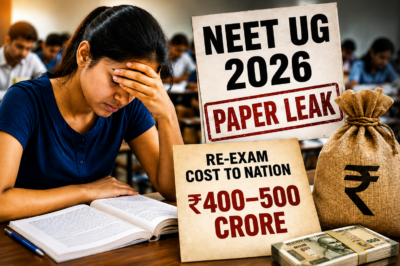
Andhra Pradesh: The Parents Association of Andhra Pradesh (PAAP) has strongly condemned the alleged irregularities and administrative failures surrounding the NEET UG 2026 examination, stating that the controversy has not only jeopardized the future of lakhs of students but also threatens to waste nearly ₹400–500 crore in public funds due to the proposed re-examination process. The association demanded strict action against those responsible and called for sweeping reforms in the national examination system.
“Not just an exam failure, but a national crisis”
In a statement issued on Thursday, the association said the issue should not be viewed merely as a procedural lapse in conducting an entrance examination, but as a serious national concern affecting students, parents, and public finances.
PAAP stated that millions of middle-class families across the country invest years of effort, emotional commitment, and substantial financial resources to prepare their children for competitive examinations like NEET.
According to the association, the alleged paper leak and the possibility of a re-examination have shattered the confidence of students and created widespread uncertainty about the credibility of the examination system.

Public funds worth hundreds of crores at stake NEET
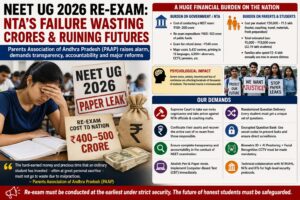
The association estimated that the cancellation and re-conduct of NEET UG 2026 could result in a loss of approximately ₹400–500 crore in public funds.
Major expenditure components and the estimated expenditure reportedly include:

Operations at 5,432 examination centres
Printing question papers in 13 languages
Deployment of over 6,000 observers
CCTV surveillance arrangements
Signal jamming systems and security protocols
Administrative and logistical expenses
The association noted that examination fee refunds alone could reportedly cost around ₹340 crore.
“These are taxpayer funds and hard-earned public money. Such massive wastage due to negligence and corruption is unacceptable,” the association stated.
Parents and students facing massive financial losses
PAAP highlighted the enormous financial burden already borne by families preparing students for medical entrance examinations.
According to the association:
Students spend between ₹30,000 and ₹1.5 lakh additionally for travel, hostel expenses, study materials, and repeated preparation.
Families often invest ₹2–6 lakh annually on coaching centres and hostel facilities.
The overall estimated financial impact on students and families could range between ₹5,000 crore and ₹13,000 crore.
The association said middle-class and economically struggling families are now facing severe distress after years of sacrifices aimed at securing their children’s futures.
“Psychological damage cannot be measured”
Apart from financial losses, the association expressed concern over the emotional and psychological toll on students.
It said lakhs of aspirants are reportedly suffering from:
Severe stress and anxiety
Insomnia and emotional exhaustion
Fear regarding career uncertainty
Loss of concentration and confidence
The association observed that repeated controversies surrounding national-level examinations are damaging students’ mental well-being during crucial years of their academic lives.
Supreme Court urged to take suo motu action
The Parents Association demanded that the Supreme Court take suo motu cognizance of the issue and initiate action against those allegedly involved in the irregularities.
The association specifically called for:
Strict action against NTA officials responsible for lapses
Investigation into the alleged “medical coaching mafia”
Confiscation of personal assets of those found guilty
Recovery of re-examination costs from the accused individuals
Demand for transparent and technology-driven examination system
PAAP urged authorities to implement major technological reforms to ensure examination integrity in future.
Key recommendations by the association
Shift to Computer-Based Testing (CBT)
The association demanded the complete abolition of the traditional “Pen and Paper” examination system and called for the immediate introduction of a secure Computer-Based Test (CBT) format.
Randomized question delivery
It suggested that each student should receive a unique set of randomly generated questions to eliminate the possibility of mass paper leaks.
Encrypted question banks
The association proposed encrypted digital security systems with “secret codes” to prevent unauthorized access to question papers.
AI surveillance and biometric verification
The association also recommended:
Fingerprint and iris-based biometric identification
AI-driven monitoring systems
Facial recognition CCTV surveillance
Real-time suspicious activity detection mechanisms
Collaboration with premier institutions
PAAP suggested that institutions such as NTR University of Health Sciences, IITs, and NITs should assist in designing and implementing advanced security protocols for national examinations.
Call for immediate and secure re-examination
The association urged authorities to conduct the re-examination at the earliest under the strictest security arrangements to ensure that honest students are not further affected.
“The hard-earned money, years of effort, and valuable time invested by ordinary students must not be destroyed because of malpractice and administrative failure,” the association said.
Debate over examination integrity intensifies
The NEET controversy has once again triggered nationwide debate over transparency, accountability, and the commercialization of competitive examinations in India.
Educational experts and parent groups have repeatedly argued that recurring paper leak allegations not only undermine merit-based selection but also deepen distrust in national institutions responsible for conducting high-stakes examinations.