

Shooting Suspect Charged with Attempted Assassination of Trump at Washington Press Dinner
Special Report

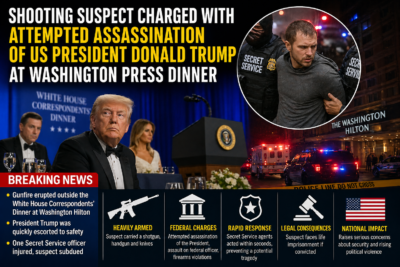
Special Report: A dramatic and alarming security breach at one of Washington’s most high-profile political gatherings has sent shockwaves across the United States and beyond. A 31-year-old suspect has been formally charged with attempting to assassinate Donald Trump during the prestigious White House Correspondents’ Dinner, an annual event that brings together top political leaders, journalists, and public figures.
The incident, which unfolded at the Washington Hilton, has raised serious questions about security preparedness, political polarization, and the growing threat of violence in American public life. Authorities have described the attack as a “deliberate and targeted attempt” to harm the U.S. president and senior government officials.

A Night of Celebration Turns Into Chaos
The White House Correspondents’ Dinner is traditionally a symbol of democratic values, celebrating free speech and the relationship between the press and political leadership. However, the 2026 event took a terrifying turn when gunfire erupted near a security checkpoint outside the main ballroom.
Eyewitnesses described scenes of panic as attendees ducked under tables, security personnel rushed to secure the venue, and the president was swiftly escorted to safety. What was meant to be an evening of speeches and camaraderie turned into a moment of national crisis.

According to investigators, the suspect approached a secured entry point and suddenly attempted to breach the perimeter while carrying multiple weapons. Within seconds, U.S. Secret Service agents responded, preventing what could have been a catastrophic attack.
The Accused: A Calculated Plan
The suspect, identified as Cole Tomas Allen, has been charged with multiple federal offenses, including attempted assassination of the president, firearms violations, and assault on a federal officer. Prosecutors allege that Allen traveled across the country with the intent to carry out the attack, arriving in Washington just days before the event.
Authorities revealed that the suspect was heavily armed, carrying a shotgun, a handgun, and multiple knives. Investigators also uncovered evidence suggesting premeditation, including messages and a manifesto allegedly sent shortly before the incident outlining his intentions.

The suspect reportedly referred to himself as a “federal assassin” in communications sent to family members, raising concerns about ideological motivations and mental state.
The Moment of the Attack
According to official accounts, the suspect ran through a magnetometer checkpoint while holding a long firearm. A gunshot was heard almost immediately, and a U.S. Secret Service officer was struck in the chest. Fortunately, the officer was wearing a ballistic vest, which prevented serious injury.
In response, the officer returned fire, and additional agents quickly subdued the suspect. Despite the chaos, no fatalities were reported, and the president remained unharmed.
Security experts have described the rapid response as a critical factor in preventing a potentially devastating outcome.
Federal Charges and Legal Consequences
The U.S. Department of Justice has filed a three-count criminal complaint against the suspect. The charges include:
- Attempted assassination of the President of the United States
- Discharging a firearm during a violent crime
- Assault on a federal officer
If convicted, the suspect could face life imprisonment.
Prosecutors emphasized the seriousness of the case, stating that the suspect’s actions posed a direct threat not only to the president but also to numerous high-ranking officials present at the event.
Security Response: Success or Warning Sign?
The incident has sparked an intense debate over security protocols at high-profile events. On one hand, officials have praised the Secret Service for their swift and effective response, which neutralized the threat within seconds.
On the other hand, critics argue that the suspect’s ability to approach the checkpoint with weapons raises concerns about potential vulnerabilities in the system.
Video footage reviewed by investigators shows the suspect moving quickly through the checkpoint before being confronted by agents, highlighting the speed at which such situations can escalate.
Despite the breach, authorities maintain that the security system functioned as intended, ultimately preventing harm to the president and attendees.
Political Fallout and National Reactions
The attempted assassination has intensified political tensions in an already polarized environment. Leaders across the political spectrum have condemned the attack, calling for unity and restraint in public discourse.
The White House described the incident as a reflection of the dangerous consequences of extreme rhetoric and misinformation. At the same time, analysts warn that such events can further deepen divisions and fuel conspiracy theories.
Indeed, in the aftermath of the attack, various unverified claims and narratives began circulating online, underscoring the challenges of managing information in the digital age.
A Pattern of Escalating Threats
This incident is reportedly one of several serious threats faced by Donald Trump in recent years. Security officials have noted an increase in attempted attacks against political figures, reflecting broader concerns about the rise of politically motivated violence in the United States.
Experts point to several contributing factors:
- Increased political polarization
- Easy access to firearms
- Spread of extremist ideologies online
- Growing distrust in institutions
These elements create an environment where isolated individuals may be driven to commit acts of violence.
The Suspect’s Background Under Scrutiny
Investigators are continuing to examine the suspect’s background, including his education, personal history, and possible affiliations. Early reports suggest that he was highly educated and previously involved in religious and academic communities.
Former acquaintances have expressed shock at the allegations, describing him as intelligent and deeply ideological but not overtly violent.
Authorities are now working to determine whether the suspect acted alone or had any connections to organized groups.
Implications for National Security
The attempted attack has prompted a broader reassessment of security measures for public events involving political leaders. Experts warn that even with advanced technology and protocols, no system is entirely foolproof.
Key areas of concern include:
- Screening procedures at event venues
- Intelligence gathering and threat detection
- Coordination between agencies
- Rapid response capabilities
The incident may lead to stricter security measures at future events, including expanded perimeter controls and enhanced surveillance.
Legal and Investigative Path Ahead
The case is expected to proceed through federal courts, where prosecutors will present evidence of premeditation and intent. Defense attorneys may challenge the charges by examining the suspect’s mental state and the circumstances of the incident.
Meanwhile, federal agencies continue to analyze digital evidence, including communications, travel records, and financial transactions, to build a comprehensive picture of the suspect’s actions.
A Wake-Up Call for Democracy
Beyond the immediate legal and security implications, the incident serves as a stark reminder of the fragility of democratic institutions in the face of violence.
The White House Correspondents’ Dinner, an event symbolizing transparency and free expression, became the site of a near-tragedy. The attack underscores the need for vigilance, not only from law enforcement but also from society as a whole.
Our Media Opinion : Prevented Tragedy, Lingering Questions
The swift action of security personnel prevented what could have been a historic tragedy. However, the attempted assassination of Donald Trump has left behind a trail of questions about security, political climate, and the future of public safety in the United States.
As investigations continue, authorities remain focused on ensuring accountability and preventing similar incidents in the future. At the same time, the nation is grappling with the deeper issues that gave rise to such an act.
The incident stands as both a testament to the effectiveness of rapid security response and a warning about the evolving threats facing modern democracies.