

Swedish Intelligence Warns of Deepening Strains on Russia’s War Economy
Editorial
 war-times.com
Send an email
21 April 2026
war-times.com
Send an email
21 April 2026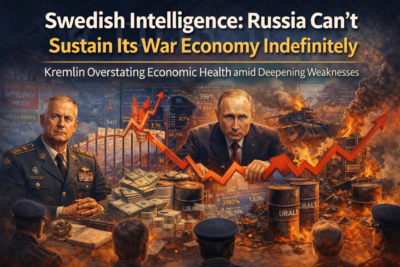
WAR-REPORT : Sweden’s latest intelligence assessments have raised serious concerns about the long-term sustainability of Russia’s war-driven economy, revealing structural weaknesses, hidden financial stress, and a widening gap between official claims and economic realities. According to senior Swedish defense officials, Russia’s economic resilience, often projected by the Kremlin as a sign of enduring strength, is increasingly dependent on fragile and uncertain conditions.

The analysis presented by Thomas Nilsson, head of Sweden’s Military Intelligence and Security Service, closely aligns with long-standing evaluations by the Institute for the Study of War. Both assessments suggest that while Russia has managed to stabilize certain sectors under wartime pressure, it faces mounting economic challenges that could significantly limit its ability to sustain prolonged military operations, especially in Ukraine.
At the core of these concerns is Russia’s heavy reliance on energy revenues. Nilsson emphasized that the Russian government requires the price of Urals crude oil to remain above one hundred dollars per barrel for at least a year simply to close its current budget deficit. Even under such conditions, he noted, oil prices would need to remain elevated for a longer period to address deeper structural issues within the economy.
This dependence on high oil prices represents a major vulnerability. Although global energy markets have seen fluctuations due to geopolitical tensions, including instability in the Middle East, there is no assurance that prices will remain high enough to support Russia’s fiscal needs. Nilsson warned that if oil prices stabilize or decline, particularly in the case of a ceasefire in the Middle East, Russia may face increasing difficulty in financing its ongoing war effort.

Beyond energy dependence, Sweden’s intelligence findings highlight deeper structural problems within Russia’s economic model. The current growth pattern, heavily driven by military production and state-directed investment, is widely viewed as unsustainable. While defense spending has provided a temporary boost to certain industries, it has simultaneously weakened civilian sectors, which are now experiencing stagnation or decline.
This imbalance has created a distorted economic environment in which resources are concentrated in war-related industries at the expense of broader development. Nilsson pointed out that many parts of Russia’s defense industrial base, excluding the rapidly expanding drone sector, are operating at a loss. These industries are affected by inefficiency, corruption, and heavy reliance on loans from state-controlled banks, raising serious concerns about their long-term viability.
Swedish Intelligence Warns of Fragile Russian War Economy
The strain on the economy is further intensified by the high cost of replacing military equipment lost on the battlefield. Russia’s ongoing operations in Ukraine have resulted in substantial material losses, putting additional pressure on industrial production and financial resources. The inability to efficiently replace these losses contributes to growing economic stress, as more funds are diverted away from essential civilian needs.

Another major concern raised in the Swedish assessment is the manipulation of economic data by the Kremlin. Nilsson stated that intelligence suggests systematic efforts to present a more positive picture of Russia’s economic performance than what actually exists. Official statistics on inflation, budget deficits, and economic growth are believed to be understated or selectively reported to maintain domestic confidence and influence international perception.
For example, while Russian authorities claim an inflation rate of around five point eight six percent, Swedish intelligence estimates suggest that the real figure may be closer to fifteen percent. This discrepancy has serious implications for purchasing power, living standards, and overall economic stability. Similarly, Russia’s budget deficit is believed to be underreported by approximately thirty billion dollars, concealing the true extent of fiscal pressure.
These efforts to shape economic perception are not limited to domestic audiences. By projecting an image of resilience, the Kremlin aims to strengthen its position in international negotiations and counter the narrative that sanctions and high military spending are weakening its economy. However, analysts warn that such a strategy may eventually fail if underlying weaknesses become too significant to hide.
In addition to economic challenges, Russia is facing increasing difficulty in protecting its critical infrastructure from repeated Ukrainian strikes. Recent attacks have targeted key energy facilities and logistical hubs, further complicating Russia’s ability to sustain both its economy and military operations.
According to reports from Ukrainian military sources, Ukrainian forces struck the oil storage facilities at the Tuapse refinery in Krasnodar region, causing large-scale fires. Visual evidence confirmed extensive damage, and local authorities acknowledged the incident. This strike is part of a broader campaign aimed at disrupting Russia’s energy supply chains and military logistics.
In recent weeks, Ukrainian operations have targeted multiple strategic sites, including oil terminals, pumping stations, and port facilities in southern Russia. These attacks are designed to increase operational costs and create logistical challenges for Russian forces.
The repeated success of such strikes has exposed weaknesses in Russia’s air defense systems and its ability to secure widely distributed infrastructure. Experts note that Russia’s vast geographic size makes it extremely difficult to defend all critical locations effectively, creating ongoing vulnerabilities.
Domestic criticism of the government’s handling of the situation has also begun to emerge. A Russian nationalist media outlet criticized regional authorities for presenting overly optimistic reports to central leadership while failing to address the real risks posed by ongoing attacks and environmental damage. The outlet argued that officials were more focused on maintaining normal economic activity, including tourism, rather than addressing security threats.
This criticism is significant because it reflects growing concern within segments of society that typically support government policies. The tension between maintaining a positive public image and addressing real challenges is becoming increasingly visible.
At the same time, some regional leaders are taking a more proactive stance. Officials in certain regions have acknowledged the impact of recent attacks and have begun strengthening local air defense systems. This uneven response highlights differences in how various parts of Russia are dealing with the evolving threat environment.
The broader implications of these developments are considerable. As Russia continues to prioritize military objectives, the pressure on its economy is expected to increase. The combination of high military spending, declining civilian output, sanctions, and infrastructure damage creates a complex situation that is difficult to manage.
Sweden’s intelligence assessment underscores the critical link between economic strength and military capability. While Russia has demonstrated some resilience, the structural weaknesses identified by analysts suggest that this resilience may not be sustainable over the long term.
For the international community, these findings provide valuable insight into the actual condition of Russia’s economy and its capacity to continue the conflict. They also highlight the importance of coordinated policies and continued support for Ukraine.

Our Media Opinion, the narrative of a strong and stable Russian war economy is increasingly being challenged. Evidence from Swedish intelligence and independent research organizations points to a more fragile reality marked by structural imbalances, financial strain, and growing operational challenges. As the conflict continues, Russia’s ability to sustain its efforts will depend not only on military strategy but also on its capacity to address these deep economic issues.
war-times.com
Send an email
21 April 2026