

Proddatur Govt Junior College Students Shine in Inter Exams; Principal Highlights Benefits of Public Education
By Doruvu Paul Jagan Babu: Assistant Chief Editor

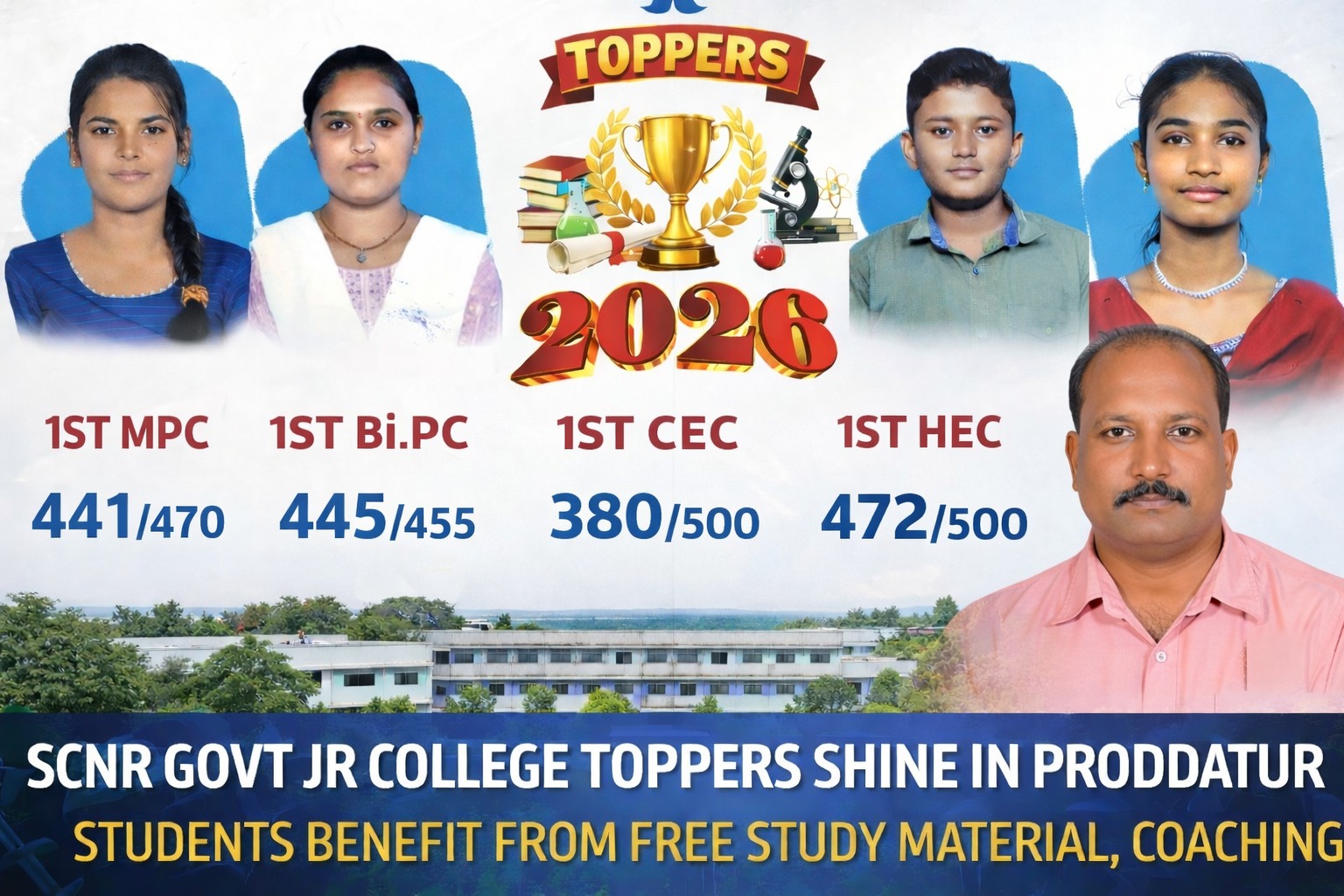
Proddatur – Andhra Pradesh: Students of SCNR Government Junior College, Proddatur, delivered an impressive performance in the Intermediate examinations, securing top marks across all streams. The college principal attributed the success to structured academic support, dedicated faculty, and government-backed welfare measures that make quality education accessible to rural and economically weaker students.
Top performers shine across streams
Students of SCNR Government Junior College secured top marks in various groups:
K. Pavani (MPC) – 441/470
S. Haritha Lakshmi (BiPC) – 445/455
N. Mahaboobvalli (CEC) – 380/500
G. Samatha Rani (HEC) – 472/500
Their performance reflects consistent academic training and focused preparation provided by the college.
Free study material and exam-oriented training

Speaking to WAR-TIMES, Principal M Chandraobula Reddy said that students are provided with free textbooks, notebooks, and comprehensive study material, including question banks and model papers.
He highlighted that regular slip tests, unit tests, and pre-final exams help students stay exam-ready and improve performance through continuous assessment.
Additional academic support and coaching

Government junior colleges in Andhra Pradesh also offer free coaching for competitive exams like NEET and JEE, helping students compete with their private college counterparts. Special academic initiatives and revision programs are conducted to support students, particularly during crucial exam periods.
Affordable education for all
The principal emphasized that affordability remains a key advantage.
“While private colleges charge tens of thousands, students in government colleges complete their two-year intermediate education at a nominal cost of just a few thousand rupees,” he said.
Typically, students incur only minimal expenses towards admission and examination fees, making education accessible to all sections of society.
Welfare schemes support student growth
Students benefit from multiple government initiatives, including:
Mid-day meal scheme to ensure proper nutrition
Scholarships and fee reimbursement via Talliki Vandanam for eligible categories
Hostel facilities for students from remote areas
These schemes help reduce financial burden and improve attendance and performance.
Focus on rural and economically weaker students
The principal noted that a majority of students come from rural and low-income backgrounds, yet the college ensures equal emphasis on their academic development. “We focus on understanding students’ psychology and provide guidance accordingly to help them succeed,” he said.
Qualified faculty and holistic development
Reinforcing the strength of government colleges, he said the college has well-qualified and trained lecturers committed to students’ overall growth. He also urged parents to recognize that government colleges offer quality education comparable to private institutions.
Structured monitoring and board support
The Board of Intermediate Education plays a key role by ensuring academic standards, conducting examinations, and supporting institutions with structured guidelines and evaluation systems. Regular monitoring and standardized assessments contribute to improved outcomes across government colleges.
A growing alternative to private colleges
With low costs, strong academic systems, and government-backed support, junior colleges in Andhra Pradesh are increasingly emerging as a viable alternative to expensive private institutions.
Our Media Opinion
The success of students from Proddatur Government Junior College is not just an academic achievement but a strong statement about the growing relevance of public education in India. In a system where private institutions often dominate perception, such results challenge the assumption that quality education comes only at a high cost. The performance of these students highlights how structured teaching, regular evaluation, and access to essential resources can create equal opportunities for all.
What stands out is the role of government support systems in bridging the gap between urban and rural education. Schemes like free study material, mid-day meals, and financial assistance reduce barriers that often prevent talented students from continuing their studies. When combined with dedicated faculty and disciplined academic planning, these initiatives create an environment where students can truly focus on learning.
However, sustaining such success will require consistency. Infrastructure improvements, continuous teacher training, and stronger career guidance programs are essential to maintain momentum. If replicated across more institutions, this model can significantly transform the education landscape.
Proddatur’s achievement is a reminder that with the right support and intent, government colleges can compete with—and even outperform—private institutions while remaining accessible to all.