

7 Critical Realities in the Bangsamoro Peace Process: A Moment of Truth for Mindanao
By Samir Singh 'Bharat': Editor In Chief
 war-times.com
Send an email
10 March 2026
war-times.com
Send an email
10 March 2026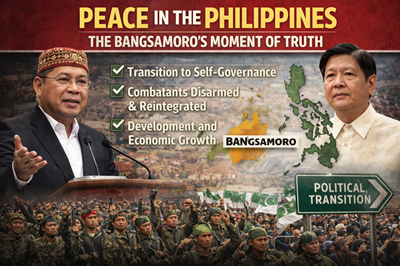
WAR-REPORT : The southern region of the Philippines has long been associated with conflict, rebellion, and decades of negotiations aimed at resolving one of Southeast Asia’s most enduring insurgencies. Today, however, the Bangsamoro region stands at a critical crossroads—a moment many observers describe as its “moment of truth.” The peace process that began decades ago between the Philippine government and Muslim insurgent groups has reached a phase where promises of autonomy, stability, and development must translate into real and lasting change.
For generations, the people of Mindanao have endured violence, political instability, and economic neglect. The establishment of the Bangsamoro Autonomous Region in Muslim Mindanao (BARMM) raised hopes that a political solution could finally replace armed struggle. Yet the success of this experiment in self-governance will depend on whether political leaders, former rebels, and communities can overcome deep-rooted challenges and build a peaceful and inclusive future.
A Long History of Conflict
The roots of the conflict in southern Philippines date back centuries, long before the formation of the modern Philippine state. Muslim communities in Mindanao and the Sulu archipelago historically maintained independent sultanates that resisted colonial rule by Spain and later the United States.
After the Philippines gained independence in 1946, tensions between the Muslim minority and the predominantly Christian national government intensified. Many Muslims believed that government policies marginalized their communities and encouraged migration from other parts of the country into traditionally Muslim areas.
By the late 1960s and early 1970s, these grievances gave rise to organized armed movements seeking autonomy or independence. One of the most influential groups to emerge during this period was the Moro National Liberation Front (MNLF), which began a rebellion against the Philippine government demanding self-determination for Muslim communities.

The conflict escalated into full-scale fighting during the 1970s, leading to thousands of casualties and widespread displacement across Mindanao.
The Emergence of the Moro Islamic Liberation Front
While the MNLF initially dominated the insurgency, internal disagreements eventually led to the formation of another powerful group: the Moro Islamic Liberation Front (MILF). The MILF broke away from the MNLF in the late 1970s and gradually became the largest armed organization fighting the government.
For decades, the Philippine military and the MILF engaged in sporadic clashes while attempts at negotiation repeatedly faltered. The violence affected not only combatants but also civilians caught in the crossfire.

Entire communities were uprooted by military operations, rebel offensives, and clan feuds known locally as rido. Poverty and underdevelopment deepened as investment avoided conflict-prone areas.
Despite the difficulties, both sides eventually recognized that a purely military solution was unlikely to resolve the conflict. This realization laid the groundwork for a renewed commitment to peace talks in the early 2000s.
The Road to a Historic Peace Agreement
After years of negotiations mediated by international partners, the Philippine government and the MILF reached a breakthrough agreement in 2014 known as the Comprehensive Agreement on the Bangsamoro. The accord outlined a framework for establishing a new autonomous political entity to replace earlier autonomy arrangements that had failed to deliver meaningful self-governance.
The agreement represented a landmark achievement for the administration of Benigno Aquino III, whose government invested significant political capital in advancing the peace process.
Under the agreement, former rebel leaders would transition from armed struggle to democratic governance. In return, the Philippine government would grant the Bangsamoro region expanded powers over local governance, economic development, and cultural preservation.
The Creation of Bangsamoro Autonomous Governance
The peace agreement eventually led to the passage of the Bangsamoro Organic Law, which established the Bangsamoro Autonomous Region in Muslim Mindanao in 2019. This new political entity replaced the previous Autonomous Region in Muslim Mindanao (ARMM), which many critics had viewed as ineffective and underfunded.
The BARMM was designed to provide greater autonomy, allowing local leaders to control key areas such as education, health services, natural resources, and taxation. It also created a parliamentary system of governance intended to encourage coalition-building and inclusive representation.
Former MILF commanders became central figures in the region’s transitional government, marking a dramatic shift from insurgency to political leadership.
This transformation represented one of the most ambitious peacebuilding experiments in Southeast Asia.
Challenges Facing the Bangsamoro Government
Despite the optimism surrounding the new political arrangement, the Bangsamoro government faces enormous challenges.
One of the most pressing tasks is the demobilization and reintegration of former fighters. Thousands of MILF combatants agreed to lay down their weapons as part of the peace agreement. In return, they were promised economic assistance, education opportunities, and integration into civilian life.
Successfully managing this transition is essential to preventing former fighters from returning to armed conflict or joining extremist groups.
Another major challenge is governance capacity. Many leaders in the Bangsamoro government come from military backgrounds and have limited experience managing complex administrative systems. Building effective institutions, ensuring transparency, and delivering public services will require significant training and support.
Failure to meet these expectations could erode public confidence in the new autonomous government.

The Threat of Extremist Groups
While the peace agreement with the MILF significantly reduced large-scale fighting, extremist groups continue to operate in parts of Mindanao.
Organizations such as Abu Sayyaf and factions aligned with the Islamic State have carried out attacks targeting civilians, government forces, and even former MILF members.
The 2017 siege of the city of Marawi highlighted the persistent threat posed by militant networks. During the siege, extremists linked to ISIS seized control of large parts of the city, triggering a months-long battle with Philippine security forces.
Although the militants were eventually defeated, the destruction of Marawi underscored the fragility of peace in the region.
For the Bangsamoro government, preventing the spread of extremist ideology will require effective policing, economic opportunities for youth, and cooperation with national security agencies.
Economic Development as the Key to Stability
Economic development is widely regarded as the cornerstone of lasting peace in Bangsamoro. For decades, the region has ranked among the poorest areas in the Philippines, with limited infrastructure, high unemployment, and low levels of investment.
Many communities lack access to reliable electricity, healthcare facilities, and quality education. Addressing these gaps is essential for demonstrating that autonomy can improve people’s lives.
The Bangsamoro government has launched initiatives aimed at improving agriculture, fisheries, and small-scale industries. Infrastructure projects—such as roads, ports, and telecommunications networks—are also expected to stimulate economic activity.
International donors and development organizations have pledged support for these efforts, recognizing that economic progress is closely tied to political stability.
The Role of Local Communities
Peacebuilding in Bangsamoro is not solely the responsibility of political leaders. Local communities, religious organizations, and civil society groups also play a vital role in shaping the region’s future.
Grassroots initiatives promoting dialogue, education, and conflict resolution have helped reduce tensions between different ethnic and religious communities. These programs aim to foster trust and cooperation after decades of violence.
Women’s organizations, in particular, have emerged as powerful advocates for peace. Their participation in community decision-making has brought new perspectives to issues such as education, healthcare, and social welfare.
Ensuring that diverse voices are included in governance will be essential for building a truly representative political system.
National and International Support
The Philippine government continues to play a crucial role in supporting the Bangsamoro transition. Successive administrations have pledged funding and technical assistance to help the autonomous region establish effective institutions.
Regional partners and international organizations have also contributed to the peace process. Countries such as Malaysia have acted as mediators during negotiations, while development agencies have supported reconstruction and capacity-building programs.
This international involvement reflects the broader importance of the Bangsamoro peace process. A successful transition could serve as a model for resolving other long-standing conflicts around the world.

Political Tests Ahead
The Bangsamoro region is approaching a series of political milestones that will test the durability of the peace agreement.
One of the most important will be the first fully democratic regional elections, during which voters will choose their representatives in the Bangsamoro parliament. These elections will mark the end of the transitional government led by former MILF officials.
The outcome will reveal whether political competition can replace armed struggle as the primary means of resolving disputes.
Ensuring that elections are free, fair, and peaceful will be critical for maintaining confidence in the democratic process.
A Moment of Truth for Peace
As Bangsamoro moves forward, the stakes could hardly be higher. The region has an opportunity to demonstrate that decades of conflict can give way to reconciliation and development.
Yet the challenges remain formidable. Weak institutions, lingering mistrust, extremist threats, and economic hardships all pose risks to the fragile peace.
The success or failure of the Bangsamoro project will ultimately depend on whether leaders and communities can work together to build a political system that delivers security, justice, and prosperity.
The story of Bangsamoro is one of resilience and transformation. From decades of armed rebellion to the establishment of a new autonomous government, the region has already achieved milestones that once seemed impossible.
But peace agreements alone cannot guarantee stability. They must be supported by effective governance, economic opportunity, and genuine reconciliation among communities.
Today, Bangsamoro stands at a defining moment. If its leaders succeed in translating autonomy into real improvements in people’s lives, the region could become a powerful example of how conflict can be resolved through dialogue and compromise.
If they fail, however, the hard-won gains of the peace process could be at risk.
For the people of Bangsamoro—and for the Philippines as a whole—the coming years will determine whether this historic opportunity leads to lasting peace or renewed uncertainty.
war-times.com
Send an email
10 March 2026