

Russia Expands Militarization of Ukrainian Youth Through Transfers
Editorial
 Samir Singh 'Bharat'-Editor-in-Chief
Send an email
24 April 2026
Samir Singh 'Bharat'-Editor-in-Chief
Send an email
24 April 2026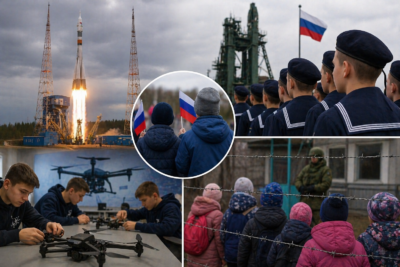
WAR-REPORT: Russia is intensifying efforts to shape the future of Ukrainian children living in occupied territories through a combination of forced transfers, exposure to military infrastructure, and structured training programs. Recent developments indicate a coordinated strategy involving state institutions, military organizations, and government-linked corporations aimed at integrating Ukrainian youth into Russia’s military and ideological framework.
According to statements released by the Russian Ministry of Defense, groups of schoolchildren from occupied regions of Ukraine were recently transported to key military facilities within Russia. Among the most notable visits was a trip to the Plesetsk Cosmodrome, a major launch site used by the Russian military for space and missile operations. The visit included cadets from naval academies located in occupied cities such as Mariupol and Sevastopol.

During their visit, the students were given guided tours of the cosmodrome, including access to launch facilities, and were able to witness the launch of a Soyuz-2.1b rocket. While such visits are often presented as educational opportunities, analysts suggest that they serve a broader purpose. By exposing children to advanced military and aerospace capabilities, authorities aim to foster interest in military careers and build a sense of identification with Russian state power.
The Plesetsk Cosmodrome plays a significant role in Russia’s defense infrastructure. It is used not only for satellite launches but also for testing and deploying systems associated with nuclear-capable intercontinental ballistic missiles. Introducing young students to such facilities underscores the strategic nature of these programs and raises concerns about the long-term objectives behind them.

Central to this effort are the Nakhimov naval schools, which have been established or expanded in occupied Ukrainian territories. These institutions, operating under the direction of Vladimir Putin, cater to children as young as ten years old. The Mariupol branch, opened in 2024, is one of the most prominent examples of this initiative.
The Nakhimov schools are designed to provide not only general education but also military-oriented training and ideological instruction. Students are introduced to naval traditions, discipline, and basic military skills at an early age. Over time, this curriculum is intended to prepare them for potential service in the Russian armed forces, effectively creating a pipeline from childhood education to military enlistment.
Experts argue that these programs go beyond conventional education and represent a systematic effort to reshape the identity and loyalties of Ukrainian children. By immersing them in a controlled environment that emphasizes Russian history, values, and military achievements, authorities seek to cultivate a generation that aligns more closely with Russian state interests.

The issue of child transfers has also drawn international attention. A recent investigation by Europol revealed additional details about the movement of Ukrainian children since the beginning of the conflict. During a coordinated investigative effort involving experts from multiple countries, information was uncovered about 45 children who had been forcibly relocated or deported.
This investigation, conducted through a collaborative “hackathon” session, brought together 40 investigators from 18 countries. Using digital tools and shared intelligence, participants were able to trace transportation routes, identify individuals involved in the transfers, and locate facilities where the children had been taken. The findings were subsequently shared with Ukrainian authorities to support ongoing efforts to locate and return affected children.
Ukraine has officially confirmed that more than 20,000 children have been subjected to forced transfer or deportation since 2022. These figures include both those moved within occupied territories and those taken across the border into Russia. Independent research conducted by the Yale Humanitarian Research Lab suggests that the actual number may be significantly higher, with estimates reaching up to 35,000 children currently being tracked.
These developments have raised serious humanitarian and legal concerns. International organizations and human rights groups have emphasized that the forced transfer of children during conflict violates established norms and may constitute a breach of international law. The long-term impact on the affected children, including issues related to identity, family separation, and psychological well-being, remains a major concern.
In addition to direct transfers and institutional education, Russia is also expanding its efforts through specialized training programs. The state-owned defense conglomerate Rostec has emerged as a key player in this aspect of the strategy. Through its subsidiary Technodinamika Holding, Rostec is introducing new educational initiatives aimed at developing technical and military skills among young participants.
One such program is being implemented at the Artek International Children’s Camp, a well-known facility that has increasingly been used for state-sponsored youth activities. The program, titled “First Height,” focuses on training teenagers in drone operation, including the use of first-person view quadcopter systems.
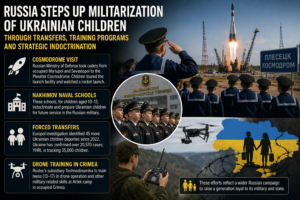
Participants, typically aged between 13 and 17, are taught how to operate both simulators and real drones. In addition to drone piloting, the curriculum includes modules on chemical engineering, artificial intelligence, robotics, and prototyping. While these subjects have civilian applications, their inclusion in a program linked to a defense company suggests a dual-use approach that combines education with military preparedness.
The involvement of Rostec highlights the broader role of state-owned enterprises in supporting government policies related to occupation and integration. By leveraging their resources and expertise, these corporations contribute to the development of programs that align with national strategic objectives.
The use of Artek as a coordinator for such activities has also attracted international scrutiny. In August 2023, the United States Department of State imposed sanctions on the camp, citing its role in hosting programs described as “patriotic re-education” and its involvement in preventing children from returning to their families. These measures reflect growing concern about the use of educational institutions for political and military purposes.
Observers note that the combination of educational initiatives, military exposure, and forced transfers represents a comprehensive approach to shaping the next generation. By targeting children at a formative stage, these programs aim to influence not only their career paths but also their sense of identity and belonging.
The broader implications of these developments extend beyond the immediate context of the conflict. The integration of Ukrainian youth into Russian systems could have lasting effects on regional dynamics, particularly if these individuals go on to serve in military or պետական roles. It also raises questions about the future of communities in occupied areas and the challenges of reintegration should political circumstances change.
International responses have focused on documentation, investigation, and advocacy. Efforts by organizations such as Europol and the Yale Humanitarian Research Lab demonstrate the importance of coordinated action in addressing complex issues that cross national boundaries. By gathering evidence and sharing information, these initiatives aim to support accountability and facilitate the eventual return of affected children.
At the same time, diplomatic and legal avenues are being explored to address the Situation. Calls for increased monitoring, transparency, and adherence to international norms have been made by various stakeholders. However, the effectiveness of these measures depends on broader geopolitical factors and the willingness of parties involved to engage in dialogue.

Our Media Opinion, the recent activities involving the transfer, education, and training of Ukrainian children highlight a multifaceted strategy that combines military, educational, and political elements. Through institutions such as the Nakhimov naval schools, facilities like the Plesetsk Cosmodrome, and programs supported by companies like Rostec, Russia appears to be investing in a long-term approach to influence the next generation in occupied territories.
As these developments continue to unfold, they will remain a focal point of international attention and debate. The balance between national security objectives and humanitarian considerations will be central to discussions about the future of the region and the protection of vulnerable populations.