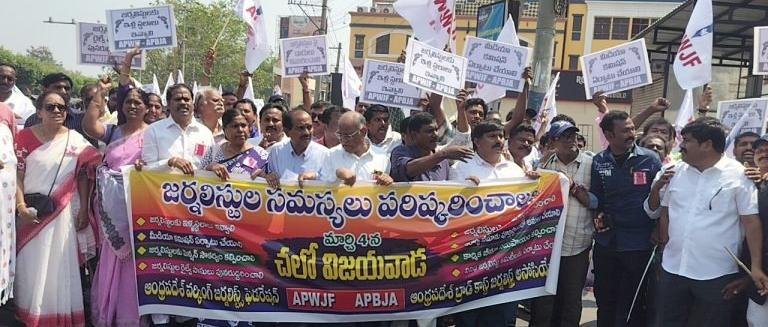
Vijayawada: Hundreds of journalists from across Andhra Pradesh gathered in Vijayawada on Wednesday under the banner of ‘Journalists Chalo Vijayawada,’ demanding comprehensive welfare measures, job security, and institutional support for media professionals.
The rally was jointly organized by the Andhra Pradesh Working Journalists Federation (APWJF) and the Andhra Pradesh Broadcast Journalists Association (APBJA), drawing participation from reporters, photographers, video journalists, and media workers from various districts.
Statewide mobilisation for journalists’ rights
Participants marched through key areas of the city, raising slogans and highlighting long-pending demands related to housing, healthcare, and employment security.
Representatives of the two associations said the rally was aimed at urging the government to recognize the challenges faced by journalists and take concrete steps to improve their working and living conditions.

Demand for housing plots and welfare schemes
Among the primary demands was the allotment of housing plots to eligible journalists. The associations stated that many media professionals, particularly in smaller towns and rural areas, lack basic housing security despite decades of service.
They also sought implementation of pension facilities and labor insurance coverage to ensure financial stability, especially for senior journalists and those working in unorganized sectors of the media industry.
Healthcare and insurance coverage
The rally highlighted the need for structured healthcare support, including free medical check-ups for journalists and their family members every six months.
In addition, participants called for a comprehensive health insurance scheme covering treatment costs, citing the high-risk nature of journalistic work, particularly for field reporters.
Education support for journalists’ children
Another key demand was the provision of free or subsidized education for the children of journalists. Association leaders argued that supporting education would offer long-term security to media families, many of whom face financial uncertainties due to irregular employment conditions.
Call for media commission and regulatory bodies
The associations urged the government to establish a dedicated Media Commission to study job security, wage structures, and welfare facilities for journalists.
They also demanded the formation of a governing council for the Media Academy to ensure transparency and effective functioning, along with the constitution of high-powered committees to prevent and address attacks on journalists.
Protection and concessions
Emphasizing safety concerns, the organizations sought stronger mechanisms to prevent assaults and intimidation targeting media professionals. They further appealed for the continuation of railway travel concessions and other logistical benefits extended to accredited journalists.
A unified appeal
Leaders of APWJF and APBJA stated that the rally reflects the collective voice of the journalistic community in Andhra Pradesh and expressed hope that the government would respond positively to their demands.
The event concluded with a memorandum outlining the proposals submitted to the concerned authorities for consideration.
Additional Things
The ‘Journalists Chalo Vijayawada’ rally has drawn attention to the growing concerns within the media fraternity in Andhra Pradesh regarding welfare, job stability, and institutional support. Journalists from various districts of the state traveled to Vijayawada to participate in the demonstration, reflecting a collective sentiment that the issues faced by media professionals require urgent attention from the government and policy makers.
Over the past decade, the journalism profession has undergone significant changes due to technological advancements and the rise of digital media platforms. While these developments have expanded the reach of news and information, they have also introduced new challenges for journalists. Many reporters, especially those working in smaller towns and rural areas, operate without permanent employment contracts or long-term financial security. Several participants at the rally pointed out that despite playing a critical role in informing the public and strengthening democratic processes, journalists often work under uncertain conditions.
One of the major concerns raised during the rally was the lack of structured welfare systems for journalists. Media associations highlighted that a large section of journalists work as freelance reporters, stringers, or contractual employees who are not covered by standard employment benefits. Without pension schemes, medical insurance, or stable income structures, many journalists face financial difficulties, particularly during emergencies or after retirement.
Speakers at the gathering emphasized that journalists frequently work in high-pressure environments. Covering political developments, natural disasters, crime incidents, and social movements requires reporters to remain active on the ground for long hours. These conditions often expose them to physical risks, health challenges, and psychological stress. Because of this, the associations stressed the need for comprehensive healthcare support, including regular medical check-ups and insurance coverage for journalists and their families.
Another important issue highlighted during the rally was the need for improved safety mechanisms. In recent years, journalists across the country have reported instances of harassment, intimidation, and even physical attacks while performing their professional duties. Media representatives urged the government to establish dedicated committees or special mechanisms that could quickly address complaints related to threats or violence against journalists.
The rally also brought attention to the economic pressures faced by many media workers. With the rapid expansion of online news platforms and changing advertising models, several traditional media organizations have experienced financial strain. As a result, many journalists work under short-term contracts or receive irregular payments. Association leaders argued that the government should consider forming a Media Commission that could study the employment conditions within the journalism sector and recommend policies for fair wages, job security, and welfare benefits.
Education support for journalists’ families was another key topic of discussion. Participants noted that many journalists dedicate long hours to their profession while managing limited financial resources. Providing scholarships or subsidized education for the children of journalists could significantly reduce financial stress and improve long-term family stability.
In addition to these demands, media associations proposed the creation of a centralized database of journalists across Andhra Pradesh. Such a system could help authorities identify eligible beneficiaries for welfare programs and ensure that support reaches journalists working at different levels, including district correspondents, video journalists, photographers, and digital media reporters.
The rally concluded with representatives of journalist unions submitting a memorandum to the authorities outlining their demands. Organizers expressed hope that the government would engage in constructive dialogue with journalist associations and consider introducing policy reforms that strengthen the media sector.
Overall, the ‘Journalists Chalo Vijayawada’ rally symbolized a unified effort by the journalism community to highlight their concerns and advocate for better welfare measures. Participants emphasized that the objective of the protest was not confrontation but collaboration, with the aim of ensuring dignity, security, and sustainable working conditions for journalists across Andhra Pradesh.