

Supreme Court Questions ECI Over Form 6 for Deleted Voters in Delhi SIR, Suggests Form 8 Option
Supreme Court Questions ECI Over Form 6 for Deleted Voters in Delhi SIR, Suggests Form 8 Option and Possible Extension of Deadline

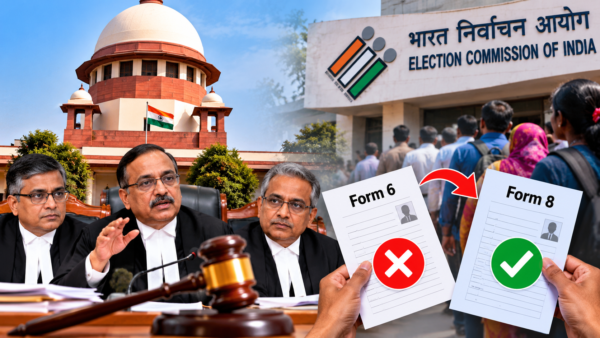
New Delhi| Area Correspondent: The Supreme Court on Wednesday questioned the Election Commission of India (ECI) over its decision to ask people whose names were deleted from the draft electoral roll during the Special Intensive Revision (SIR) in Delhi to submit Form 6 to register as new voters, even though they were listed in the 2026 electoral roll.
A Bench comprising Chief Justice of India Surya Kant and Justices Joymalya Bagchi and V. Mohana was hearing a petition filed by Anjali Bharadwaj and Amrita Johri challenging aspects of the Delhi SIR process.
The Court observed that Form 6 is intended for first-time voter registration and requires applicants to declare that they have not been registered as voters previously. It questioned why people whose enumeration forms could not be delivered because they had temporarily left Delhi or changed their addresses should not be allowed to submit enumeration forms or use Form 8 to update their addresses.
Court Seeks Solution for Missing Enumeration Forms
The Bench noted that Delhi has a highly mobile population, with many people moving between locations for employment or other reasons. It asked the ECI to consider reaching out to voters whose enumeration forms had not been delivered rather than placing the entire responsibility on them.
Senior Advocate Dama Seshadri Naidu, appearing for the ECI, said the Commission would examine the Court’s concerns and consider remedial measures, including a possible extension of the deadline.

Advocate Prashant Bhushan, representing the petitioners, submitted that of the 47 lakh voters whose names were deleted, around 43 lakh had been categorised as permanently shifted or absent. He argued that many had not received enumeration forms and were being asked to submit Form 6 instead of Form 8.
Bhushan said that voters who had already appeared on the electoral roll should not be required to make a declaration intended for first-time voters. He suggested allowing them to submit enumeration forms even at this stage, along with Form 8 where an address change was involved.
Bench Suggests a Separate Category for Unserved Voters
The judges questioned how the ECI had classified voters who did not respond to enumeration forms. Justice Bagchi observed that non-response could have several explanations, including temporary absence or failure to receive the form, and should not automatically mean that a voter had permanently shifted.

The Bench also asked whether the ECI’s reference point was the 2003 electoral roll or the latest roll published in 2026. Naidu said the 2026 electoral roll would serve as the basis for the exercise.
The Court observed that if a person was listed in the 2026 roll but could not receive an enumeration form, the process should provide a way to address that situation without requiring an inaccurate declaration that the person had never previously been registered.
Justice Bagchi suggested creating a separate category for people who could not respond because their enumeration forms were not served. Such voters could be asked to provide a declaration explaining why they had not responded.
Court Calls Right to Vote a Vital Right
Emphasising the importance of voting rights, Justice Bagchi questioned whether a person should permanently lose the opportunity to remain on the electoral roll simply because they had failed to submit an enumeration form.
The Chief Justice suggested that the ECI publish the list of deleted voters and ask those affected to contact their nearest Booth Level Officer (BLO). The Court also proposed that Form 8 should remain available for voters whose circumstances involved a change of address.
The Bench urged the Commission not to rush the process and suggested that the enumeration deadline could be extended. It also said that Forms 6 and 8 should continue to be accepted where applicable.
The ECI agreed to discuss the suggestions and examine possible solutions to reduce the gap between the earlier electoral roll and the draft list.
The Supreme Court will consider the matter again after two weeks. The proceedings concern the Delhi SIR process and the procedures available to voters whose names were not included in the draft electoral roll.