

Houthis Threaten Saudi Shipping as Red Sea Tensions Escalate
Raising Fears of Wider Maritime Crisis

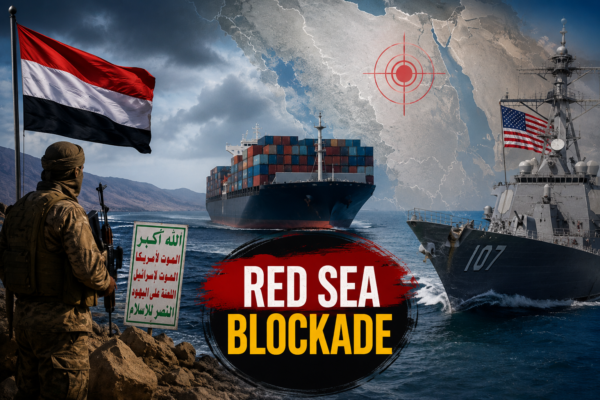
War-Report : Middle East | The security situation in the Red Sea has entered a new phase after Yemen’s Houthi movement announced a naval blockade targeting Saudi Arabia, raising concerns over a broader shipping crisis across one of the world’s busiest maritime trade routes. Although no Houthi attacks on commercial vessels have been officially recorded since July 7, 2025, the group’s latest warning has already begun affecting global shipping costs and regional stability.
According to reports, Houthi forces instructed vessels heading toward Saudi ports to turn back via radio communications on July 20. Maritime analysts believe that even without direct attacks, the announcement is likely to discourage commercial shipping through the Red Sea, increasing transportation risks and insurance premiums.
Shipping Costs Rise as Industry Reacts
Insurance providers have reportedly raised premiums for ships transiting the Red Sea following the Houthi declaration. The higher insurance costs are expected to increase freight expenses, potentially affecting global supply chains and energy markets.
The Red Sea serves as a critical corridor connecting Europe, Asia, and the Middle East through the Bab al-Mandeb Strait. Any disruption along this route could significantly impact international trade, particularly oil and container shipping.
Iran Allegedly Expanding Regional Pressure
Regional security analysts suggest that Iran may be attempting to widen the scope of its confrontation with the United States by encouraging instability in the Red Sea. Reports citing senior Iranian and regional sources indicate that Tehran has allegedly asked the Houthis to prepare for attacks on maritime shipping should the United States expand military strikes against Iranian energy infrastructure.

Senior Iranian officials, including commanders of the Islamic Revolutionary Guard Corps (IRGC), have also warned that the Houthis could resume operations targeting vessels passing through the Bab al-Mandeb Strait—one of the world’s most strategically important maritime chokepoints.
Saudi Arabia has increasingly relied on this route in recent months to export crude oil to Asian markets, making the region particularly vulnerable to any disruption.
Houthi Justification Raises Questions
Houthi military spokesperson Yahya Sarea stated that the blockade was imposed in response to what he described as Saudi Arabia’s “unjust siege” on Yemen over the past twelve years.

However, many regional observers question this explanation, pointing instead to recent military developments. On July 13, Saudi forces reportedly conducted strikes on Sanaa International Airport over concerns that Iran could use direct air links to transfer weapons and military advisers to Houthi-controlled areas. In response, the Houthis launched an attack targeting Abha International Airport in Saudi Arabia.
Since those exchanges, no additional direct military strikes have been officially reported.
Fragile Ceasefire Under Pressure
The latest tensions emerge despite a United Nations-brokered ceasefire that has largely remained in place since 2022 between the Houthis, the internationally recognized Yemeni government, and Saudi Arabia.
Security experts warn that the announcement of a naval blockade could place additional strain on the already fragile peace process and increase uncertainty across the region.
Strategic Importance of the Red Sea
The Bab al-Mandeb Strait remains one of the world’s most vital maritime passages, linking the Red Sea to the Gulf of Aden and the Indian Ocean. A significant share of global oil exports and international cargo shipments passes through this narrow waterway every year.
Any sustained disruption could have consequences extending well beyond the Middle East, affecting global energy prices, shipping schedules, supply chains, and international trade.
Global Outlook
While the blockade announcement has not yet translated into a renewed wave of attacks on commercial shipping, maritime security experts remain on high alert. Shipping companies, insurers, and regional governments are closely monitoring developments as tensions between Iran, the United States, Saudi Arabia, and the Houthis continue to evolve.
The coming weeks will likely determine whether the situation remains a psychological and economic pressure campaign or develops into a broader maritime security crisis with global economic implications.