

NCSK Reviews Welfare Measures for Sanitation Workers,
Special Correspondence
 war-times.com
Send an email
19 July 2026
war-times.com
Send an email
19 July 2026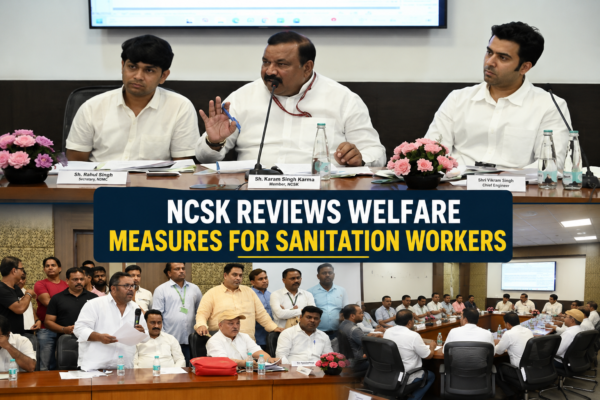
Pushes for Zero Manual Scavenging and Mechanised Cleaning
New Delhi: In a major step towards improving the safety, dignity, and working conditions of sanitation workers, the National Commission for Safai Karamcharis (NCSK) conducted a high-level review meeting at the New Delhi Municipal Council (NDMC) headquarters. The meeting focused on strengthening labour welfare measures, eliminating manual scavenging, and accelerating the adoption of mechanised sanitation systems across the capital.
The meeting was chaired by NCSK Member Shri Karam Singh Karma and attended by NDMC Secretary Rahul Singh, senior engineers, directors, health officials, sanitary inspectors, departmental heads, representatives of sanitation workers’ unions, outsourced service providers, and sanitation workers from different municipal circles.
During the review, the Commission assessed the functioning of the Public Health and Engineering Departments, with special emphasis on achieving the goal of Zero Manual Scavenging and ensuring the complete mechanisation of sewer and drain cleaning operations. The initiative aims to create a safer and healthier work environment for sanitation workers while reducing occupational hazards.
Addressing the gathering, Shri Karam Singh Karma praised sanitation workers for their indispensable role in maintaining urban cleanliness.
“Safai Karamcharis are the true custodians of our cities. They begin their work long before dawn to ensure our streets, public spaces, and neighbourhoods remain clean and healthy. Their dedication deserves the highest respect, and it is our collective responsibility to protect their dignity, welfare, and working conditions,” he said.

The meeting also served as an open platform where sanitation workers and union representatives raised long-standing grievances related to employment, safety, and service conditions. Officials discussed practical solutions and outlined a roadmap for timely implementation.
Among the key decisions taken during the meeting, the Commission directed the immediate initiation of the Temporary Muster Roll (TMR) recruitment process for sanitation workers under the NDMC Public Health Department. It also ordered the regularisation of services for 28 pending employees of the malaria department within one month.
To ensure transparency and labour welfare, contractors and outsourced agencies were instructed to submit complete records of employment agreements, Employees’ State Insurance (ESI), and Employees’ Provident Fund (EPF) compliance. Authorities were also directed to closely monitor outsourced operations so that every worker receives statutory social security benefits without delay.

The Commission reiterated its commitment to replacing hazardous manual cleaning practices with fully mechanised sewer and deep-drain cleaning technologies, thereby protecting sanitation workers from life-threatening occupational risks.
NDMC Secretary Rahul Singh assured the Commission that the civic body would continue adopting advanced monitoring systems and modern technology to improve sanitation services while ensuring better safety standards and quality of life for the city’s frontline sanitation workforce.
The review concluded with a strong commitment from both the NCSK and NDMC to strengthen labour rights, improve workplace safety, and uphold the dignity of sanitation workers through modern technology, better governance, and strict enforcement of welfare measures.
 war-times.com
Send an email
19 July 2026
war-times.com
Send an email
19 July 2026