


Trump-Xi Summit Set to Shape Global Trade
Taiwan Security, and Iran War Dynamics
 Samir Singh 'Bharat'-Editor-in-Chief
Send an email
10 May 2026
Samir Singh 'Bharat'-Editor-in-Chief
Send an email
10 May 2026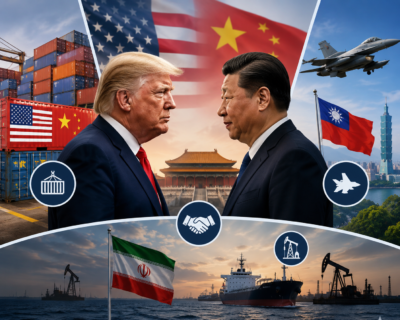
World-War: As preparations intensify for the upcoming meeting between United States President Donald Trump and Chinese Communist Party General Secretary Xi Jinping in Beijing on May 14 and 15, global attention is increasingly focused on the strategic issues expected to dominate the high-stakes summit. Early diplomatic readouts from preparatory phone calls between senior officials from both countries suggest that trade disputes, US arms sales to Taiwan, and the escalating conflict involving Iran are likely to become the central themes of discussion.
Trump-Xi Beijing Summit Set to Shape Global Power Balance
The summit comes at a particularly sensitive moment in US-China relations. Although Washington and Beijing agreed to a one-year trade war “truce” in October 2025, tensions between the world’s two largest economies have continued to deepen. Both sides have introduced fresh economic restrictions, expanded strategic competition, and sharpened rhetoric over regional security issues. The Trump-Xi meeting is therefore being viewed not only as a diplomatic engagement between two major powers but also as a crucial test of whether the fragile stability in bilateral relations can survive mounting geopolitical pressures.
Preparatory Talks Reveal Strategic Priorities
Ahead of the summit, senior officials from both governments have held multiple discussions aimed at narrowing differences and identifying possible areas of cooperation. On April 30, Chinese Foreign Minister Wang Yi held talks with US Secretary of State Marco Rubio, while Chinese Vice Premier He Lifeng separately spoke with US Treasury Secretary Scott Bessent and US Trade Representative Jamieson Greer.
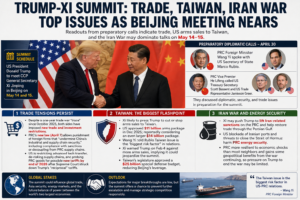
The discussions reportedly covered trade policy, sanctions, security concerns in the Indo-Pacific region, technology restrictions, and energy-related disruptions tied to the Iran conflict. Diplomats on both sides are believed to be working to prevent the summit from becoming confrontational while also protecting their national strategic interests.

Analysts say the preparatory calls indicate that neither Washington nor Beijing expects dramatic breakthroughs. Instead, the focus appears to be on crisis management, economic stabilization, and preventing further deterioration in bilateral relations.
Trade Tensions Continue Despite Truce
Trade remains one of the most contentious issues between the United States and China. Although the two countries suspended portions of their tariff war last year, economic competition has intensified in several sectors, particularly technology, manufacturing, and strategic supply chains.
Beijing has become increasingly concerned about Washington’s “de-risking” strategy, which aims to reduce US dependence on Chinese manufacturing and restrict China’s access to advanced technologies. American export controls targeting semiconductors, artificial intelligence technologies, and critical infrastructure sectors have significantly affected Chinese firms.

In response, China has strengthened its own legal and regulatory mechanisms to counter foreign economic pressure. On April 7, the Chinese government implemented a new law designed to punish foreign companies that “undermine China’s industrial and supply chain security.” The legislation grants Beijing broad authority to retaliate against firms that comply with US sanctions or attempt to shift supply chains away from China.
Chinese officials argue that the law is necessary to defend national economic sovereignty and prevent external interference in domestic industrial policy. However, Western governments and multinational corporations have expressed concern that the law could expose foreign firms operating in China to political retaliation and legal uncertainty.
At the same time, the United States continues to expand trade investigations into Chinese imports. The Trump administration is pursuing inquiries into several categories of Chinese goods that could eventually lead to additional tariffs by late 2026. These efforts gained momentum after the US Supreme Court invalidated Trump’s earlier “reciprocal” tariffs under the International Emergency Economic Powers Act (IEEPA) in February.
American officials maintain that the restrictions are not intended to sever economic ties completely but rather to reduce strategic vulnerabilities in critical industries such as electronics, telecommunications, defense manufacturing, and clean energy technologies.
The upcoming summit is therefore expected to feature intense negotiations over tariffs, technology restrictions, market access, and investment rules. While both sides are likely to seek mechanisms to stabilize trade relations, major structural disagreements appear unlikely to disappear anytime soon.
Taiwan Emerging as the Biggest Flashpoint
Beyond economic disputes, Taiwan is expected to become the most politically sensitive topic during the Trump-Xi meeting. Beijing has repeatedly condemned US military support for Taiwan, which China considers part of its sovereign territory under the “One China” principle.
The Trump administration approved an arms package worth 11 billion US dollars to Taiwan in December 2025. Reports also suggest that Washington is considering an even larger 14 billion dollar package that has not yet been officially announced. The proposed sale could include advanced missile systems, air defense platforms, naval assets, and intelligence support capabilities designed to strengthen Taiwan’s ability to deter a potential military confrontation.
Chinese leaders view such arms sales as a direct challenge to China’s territorial claims and regional influence. During recent diplomatic exchanges, Wang Yi reportedly warned Marco Rubio that the Taiwan issue represents the “biggest risk factor” in US-China relations.
Xi Jinping has personally raised the issue with Donald Trump before. During a February 4 phone call, Xi reportedly warned Trump against increasing military assistance to Taiwan, suggesting that further arms transfers could damage bilateral relations and complicate future diplomatic engagement.
However, Beijing’s leverage on the Taiwan issue may now be weaker than before. Taiwan’s legislature recently approved a massive 25 billion US dollar special defense budget aimed at funding existing and future military purchases from the United States. The budget demonstrates growing political consensus within Taiwan regarding the need to strengthen defense preparedness amid rising cross-strait tensions.
Supporters of the defense package argue that Taiwan must modernize its military to counter growing pressure from the People’s Liberation Army. Chinese military exercises near Taiwan have increased significantly in recent years, including air incursions, naval patrols, and simulated blockade operations.
For Washington, arms sales to Taiwan remain part of a broader strategy to maintain stability in the Indo-Pacific region and deter unilateral attempts to alter the status quo by force. US officials insist that support for Taiwan contributes to regional peace and does not represent support for formal Taiwanese independence.
Still, the issue remains deeply emotional and politically charged for Beijing. Observers expect Xi to strongly pressure Trump to reduce future arms sales or at least slow the pace of military cooperation with Taipei. Whether Trump shows willingness to compromise could significantly influence the broader tone of US-China relations in the months ahead.
Iran Conflict Adds New Layer of Complexity
Another major issue expected to surface during the summit is the ongoing conflict involving Iran and its impact on global energy markets. The war has disrupted shipping routes, destabilized the Persian Gulf region, and increased concerns over energy security for major importing nations, including China.
The United States has intensified pressure on Iran through sanctions and maritime restrictions targeting Iranian ports and shipping networks. In addition, intermittent closures or threats to close the Strait of Hormuz by Iranian forces have disrupted commercial shipping traffic through one of the world’s most strategically important waterways.
China, which imports substantial amounts of energy from the Middle East, has been directly affected by the disruptions. Beijing is reportedly concerned about long-term instability in Gulf trade routes and the broader economic consequences of rising oil prices.
Xi Jinping is expected to urge Trump to reconsider certain Iran-related sanctions affecting Chinese economic interests and to support measures that would stabilize maritime trade in the region. Chinese officials may also advocate for diplomatic engagement aimed at reducing military tensions and restoring secure shipping operations.
However, analysts believe Beijing is unlikely to aggressively pressure Washington to end the conflict immediately. Compared to many neighboring countries, China remains relatively resilient to the economic fallout from the Iran war. Beijing has diversified energy supplies, maintains substantial strategic reserves, and possesses strong state capacity to absorb temporary economic shocks.
Moreover, some geopolitical analysts argue that prolonged instability in the Middle East indirectly benefits China in certain ways. Continued US military engagement in the region could divert American strategic attention and resources away from East Asia, potentially giving Beijing greater room to expand influence in the Indo-Pacific.
As a result, China’s position on the Iran conflict may remain carefully balanced. Beijing is likely to advocate stability and uninterrupted trade while avoiding actions that would directly align it too closely with either Washington or Tehran.
Strategic Competition Overshadowing Cooperation
The Trump-Xi summit highlights the increasingly complex nature of modern US-China relations. The two powers remain deeply economically interconnected, yet they are simultaneously engaged in an expanding strategic rivalry spanning trade, technology, military influence, and global governance.
Under Trump’s renewed presidency, Washington has adopted a more openly competitive posture toward China while still attempting to preserve channels for dialogue. Trump has emphasized economic nationalism, domestic manufacturing, and strategic decoupling in sensitive sectors, all while presenting himself as capable of negotiating “strong but stable” relations with Beijing.
China, meanwhile, continues pursuing long-term ambitions to strengthen technological self-sufficiency, expand military capabilities, and increase global political influence. Xi Jinping has repeatedly framed China’s rise as inevitable and warned against foreign attempts to contain Chinese development.
Despite these tensions, neither side appears eager for a complete breakdown in relations. The economic costs of large-scale confrontation would be enormous for both countries and could destabilize the broader global economy. Financial markets, multinational corporations, and allied governments around the world are therefore closely watching the Beijing summit for signs of either escalation or stabilization.
Global Stakes of the Beijing Summit
The significance of the Trump-Xi meeting extends far beyond bilateral diplomacy. Decisions made during the summit could influence international trade flows, financial markets, military balances in Asia, and energy security across multiple regions.
Asian allies of the United States are particularly focused on the Taiwan issue, fearing that worsening US-China tensions could increase the risk of military confrontation in the Indo-Pacific. European governments are monitoring trade negotiations closely due to their own economic ties with both Washington and Beijing.
Meanwhile, developing economies remain concerned about the broader impact of geopolitical fragmentation on supply chains, commodity prices, and investment flows. Continued rivalry between the United States and China could accelerate the division of the global economy into competing technological and strategic blocs.
The summit may therefore serve as an important indicator of whether the world’s two largest powers can establish guardrails to manage competition responsibly or whether relations will continue drifting toward deeper confrontation.
Outlook Remains Uncertain
While expectations for major breakthroughs remain low, the Trump-Xi summit still represents a critical diplomatic opportunity. Even limited agreements on trade coordination, military communication channels, or regional stability could help reduce immediate tensions.
However, the underlying disputes driving US-China rivalry are deeply structural and unlikely to disappear through a single meeting. Conflicting visions of global leadership, security architecture, technological dominance, and political influence continue to shape relations between Washington and Beijing.
Trade restrictions, Taiwan’s defense posture, and the evolving Iran conflict are all symptoms of a broader geopolitical transition in which both countries are competing to define the future balance of global power.
As Trump arrives in Beijing next week, the world will be watching closely to see whether diplomacy can slow the momentum of confrontation—or whether the summit merely marks another chapter in the intensifying strategic rivalry between the United States and China.