


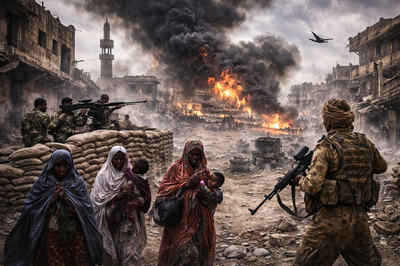
WAR-REPORT : Sudan stands today as a nation fractured by war, its political authority split, its social fabric torn apart, and its people enduring one of the gravest humanitarian crises in the world. Once a country struggling toward fragile democratic transition, Sudan has now become a battleground between rival military forces whose conflict has devastated cities, displaced millions, and drawn in powerful regional actors. Despite moments of diplomatic progress in 2025, efforts to resolve the crisis have stalled, leaving the future of Sudan uncertain and increasingly dangerous.
A Nation Divided by Force
Control over Sudan is no longer unified. The national army holds the capital, Khartoum, along with much of the eastern regions, while the powerful paramilitary group known as the Rapid Support Forces dominates large areas of western Sudan, particularly in the Darfur region. This division has effectively split the country into rival zones of influence, each governed by competing military authorities with little incentive to compromise.
The fragmentation of power has resulted in the near-total collapse of state institutions. Government services have largely ceased to function, law enforcement is minimal or absent, and infrastructure has been severely damaged. Khartoum, once the political and economic center of Sudan, has been reduced to a shadow of itself. Much of the city is now uninhabitable, with widespread destruction, lack of electricity, and shortages of basic necessities such as water and food.
This division is not merely geographic but deeply political and social. The conflict has intensified long-standing grievances and created new fault lines within Sudanese society. Communities have been uprooted, trust has eroded, and the prospect of national unity appears increasingly distant.
The Humanitarian Catastrophe
The human cost of Sudan’s conflict is staggering. Millions of Sudanese civilians are facing extreme food insecurity, with many at risk of starvation or famine. The collapse of agricultural systems, combined with disrupted supply chains and ongoing violence, has left large portions of the population without reliable access to food.

Displacement has reached unprecedented levels. Millions have fled their homes, seeking refuge either within Sudan or in neighboring countries. These displaced populations often live in overcrowded and under-resourced camps, where access to healthcare, sanitation, and education is severely limited.
Healthcare systems have also been devastated. Hospitals have been destroyed or forced to close, medical supplies are scarce, and healthcare workers face significant risks in carrying out their duties. Preventable diseases are spreading, and vulnerable populations, including children and the elderly, are particularly at risk.
The scale of suffering in Sudan has led many observers to describe it as the world’s worst humanitarian crisis. Yet despite its severity, the crisis has struggled to maintain sustained international attention, particularly as other global conflicts dominate headlines.

Diplomatic Progress and Setbacks
In 2025, there were cautious signs of diplomatic progress. International and regional actors engaged in negotiations aimed at securing a ceasefire and initiating a political process to resolve the conflict. These efforts raised hopes that a pathway to peace might be emerging.
However, this momentum has since faltered. Disagreements among key external stakeholders have undermined the coherence and effectiveness of diplomatic initiatives. In particular, tensions between Saudi Arabia and the United Arab Emirates have complicated efforts to present a unified approach to the conflict.
These two influential Gulf states have been associated with different sides of the Sudanese conflict, either directly or indirectly. Their rivalry has contributed to a fragmented diplomatic landscape, making it more difficult to coordinate pressure on the warring parties or to advance meaningful negotiations.
The broader geopolitical environment has also played a role. The escalation of conflict in the Middle East has diverted attention and resources away from Sudan, reducing the urgency with which international actors are addressing the crisis.
Regional Dynamics and Risks of Escalation
Sudan’s conflict does not exist in isolation. It is deeply intertwined with regional dynamics that increase the risk of further escalation. Neighboring countries and regional powers have strategic interests in Sudan, ranging from security concerns to economic investments.
One country that could be significantly affected is Ethiopia, a major power in the Horn of Africa. Ethiopia has its own internal challenges and regional ambitions, and instability in Sudan could have spillover effects that complicate its security environment.
The involvement of external actors raises the possibility that Sudan could become a proxy battleground, where regional and international powers pursue their interests through local allies. Such a scenario would not only prolong the conflict but also make it more difficult to achieve a sustainable resolution.
Collapse of Governance and Social Order
The ongoing war has led to a near-total breakdown of governance in Sudan. Public institutions that once provided basic services have ceased to function in many areas. Schools are closed, courts are inactive, and administrative systems have collapsed.
This vacuum has allowed armed groups to exert control over local populations, often through coercion. In some areas, informal systems of governance have emerged, but these are typically limited in scope and lack legitimacy.
The breakdown of social order has also led to increased crime and insecurity. Civilians face risks not only from the main conflict but also from looting, banditry, and localized violence. Women and children are particularly vulnerable, with reports of exploitation and abuse increasing as law enforcement structures disappear.
Economic Devastation
Sudan’s economy has been severely damaged by the conflict. Key industries have been disrupted, trade routes have been blocked, and investment has collapsed. Inflation has soared, and the national currency has lost much of its value.
For ordinary Sudanese citizens, the economic crisis has translated into rising prices for basic goods, loss of income, and deepening poverty. Even those who have not been directly displaced by the conflict are struggling to survive.
The destruction of infrastructure, including roads, bridges, and communication networks, has further hindered economic activity. Rebuilding these systems will require significant resources and time, even if peace is eventually achieved.
The Challenge of Peacebuilding
Achieving peace in Sudan will require more than a simple ceasefire. The conflict is rooted in complex political, economic, and social factors that must be addressed through a comprehensive and inclusive process.
One of the key challenges is the lack of trust between the warring parties. Years of conflict and broken agreements have created deep suspicion, making it difficult to negotiate in good faith. Any peace process will need to include mechanisms for building confidence and ensuring accountability.
Another challenge is the need to involve a wide range of stakeholders, including civil society, political groups, and regional actors. A durable peace cannot be imposed from above; it must reflect the needs and aspirations of the Sudanese people.
The Role of International Actors
Despite competing priorities, international and regional actors remain essential to any effort to resolve Sudan’s conflict. Countries with influence over the warring parties have a responsibility to use that leverage to promote peace.
Even as other crises demand attention, Sudan cannot be allowed to fall off the global agenda. Continued diplomatic engagement, humanitarian assistance, and coordinated pressure on the parties to the conflict are all necessary to prevent further deterioration.
The challenge is not only to restart negotiations but to sustain them over time. This will require patience, resources, and a willingness to address the underlying causes of the conflict.
A Narrow Window of Opportunity
Although the current situation appears bleak, there remains a narrow window of opportunity to prevent further escalation. The longer the conflict continues, the more entrenched divisions will become, and the harder it will be to achieve a political settlement.
Early action is critical. Renewed diplomatic efforts, combined with increased humanitarian support, could help stabilize the situation and create conditions for meaningful negotiations.
Conclusion
Sudan’s conflict represents a profound tragedy for its people and a significant challenge for the international community. The division of the country between rival military forces, the scale of the humanitarian crisis, and the involvement of external actors have created a complex and volatile situation.
While progress toward peace has stalled, it has not become impossible. With sustained effort and coordinated action, there remains a chance to halt the violence and begin the long process of rebuilding Sudan.
The cost of inaction, however, will be immense. Without renewed focus and commitment, Sudan risks descending further into chaos, with consequences that will be felt far beyond its borders.