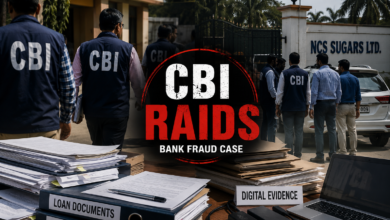


ED Raids Chennai-Based Steel Firms in ₹311 Crore SBI Fraud Case
Uncovers Benami Assets Worth Over ₹100 Crore
 Samir Singh 'Bharat'-Editor-in-Chief
Send an email
23 May 2026
Samir Singh 'Bharat'-Editor-in-Chief
Send an email
23 May 2026
New Delhi-Anantapur : The Directorate of Enforcement (ED), Chennai Zonal Office, has intensified its crackdown on large-scale banking fraud and money laundering by conducting extensive search operations at seven premises linked to M/s Thangam Steel Ltd. (TSL), M/s PS Krishnamurthy Steels Private Ltd. (PSK), and their directors and key accused persons in Chennai on May 19, 2026.
The searches were carried out in connection with an alleged bank fraud case involving cheating of the State Bank of India (SBI) consortium to the tune of nearly ₹311 crore. According to ED officials, the operation has led to the identification of several benami assets, seizure of incriminating documents, and recovery of digital evidence linked to the suspected money laundering network.
ED Action Based on CBI FIRs
The Enforcement Directorate initiated the investigation on the basis of two FIRs registered earlier by the Central Bureau of Investigation (CBI), Economic Offences Branch (EOB), Chennai. The FIRs accused M/s Thangam Steel Ltd. and M/s PS Krishnamurthy Steels Pvt. Ltd. of cheating and defrauding SBI through forged financial records and fraudulent business transactions.
The CBI had already filed charge sheets in the matter after completing its preliminary investigation into the alleged banking fraud.
According to officials, the companies and their directors allegedly manipulated financial documents over several years to obtain higher credit facilities and banking limits from the SBI-led consortium.


Fraudulent Enhancement of Bank Limits
Investigators revealed that the accused companies were engaged in steel manufacturing and trading activities and had systematically carried out financial manipulation between 2007 and 2013.
ED officials stated that the accused secured enhanced Cash Credit (CC) and Letter of Credit (LC) facilities from banks by submitting fabricated financial statements, inflated stock declarations, fake receivable statements, and forged trade-related documents.

Authorities suspect that the companies deliberately created a false impression of financial strength and business growth to obtain larger loans and banking exposure.
According to the investigation, the accused entities allegedly showed fictitious godowns, fabricated transport records, and manipulated inventory figures in order to convince banks that the companies were handling significantly larger volumes of steel products than they actually were.
Different Balance Sheets Submitted to Hide Financial Reality
One of the most serious allegations emerging from the probe is that the accused firms reportedly submitted different balance sheets to the State Bank of India and the Registrar of Companies (ROC).
Officials say this was done intentionally to conceal the true financial position of the companies while continuing to secure higher credit facilities from the banking system.
Investigators believe the discrepancies in financial disclosures were part of a carefully planned conspiracy to mislead banks and financial institutions.
The ED stated that these forged and manipulated records allowed the accused to continue availing loans and credit facilities despite mounting financial irregularities.

Circular Trading Used to Inflate Turnover
According to investigators, the companies also engaged in circular trading practices to artificially inflate turnover and profitability figures.
Circular trading involves fake or repetitive transactions among interconnected firms to create the illusion of genuine business activity. Officials suspect that several shell entities and fake companies were used to generate false invoices and business records.
By showing inflated turnover and profits, the accused allegedly projected a financially stable image before banks and lenders, enabling them to obtain larger loans and credit support.
The ED stated that these practices resulted in wrongful losses to SBI and corresponding unlawful gains to the accused persons.
Diversion and Layering of Funds
Investigators further discovered that a significant portion of the bank funds obtained fraudulently was diverted for personal use and acquisition of assets unrelated to the declared business activities.
The ED stated that the accused allegedly diverted the funds through multiple layers of financial transactions using fake and shell entities in an attempt to conceal the origin and movement of the money.
Authorities believe the money laundering process involved complex layering techniques to disguise the proceeds of crime and prevent detection by financial institutions and regulatory agencies.
The diverted funds were reportedly utilized for the acquisition of a steel division, personal properties, and other high-value assets.
Benami Properties Worth Over ₹100 Crore Identified
During the searches conducted across Chennai-linked premises, ED officials identified 43 immovable properties allegedly held in the names of benamidars, family members, and distant relatives of the accused.
According to the agency, these properties are estimated to be worth more than ₹100 crore.
Investigators suspect that the properties were deliberately purchased and registered under proxy names to prevent banks and recovery agencies from tracing and attaching them during loan recovery proceedings.
Officials said the use of benami arrangements was intended to shield illegally acquired wealth from regulatory scrutiny and legal action.
The ED is now examining ownership patterns, property records, and financial trails connected to these assets.
Documents and Digital Evidence Seized
The search operations also resulted in the seizure of several incriminating documents and electronic records that could provide crucial evidence regarding the alleged financial conspiracy.
Officials recovered business records, transaction details, property-related documents, digital storage devices, and other materials suspected to be linked to the laundering of funds.
The agency is currently conducting forensic analysis of the electronic evidence to identify the full extent of the money trail and the role played by various accused persons and associated entities.
Investigators are also examining whether additional shell companies and third-party operators were involved in routing and concealing the funds.
Banking Sector Continues to Face Fraud Challenges
The case once again highlights the persistent threat posed by sophisticated financial frauds targeting public sector banks and lending institutions.
Financial experts note that large corporate frauds often involve manipulation of accounting records, inflated asset valuations, fake trade documentation, and diversion of sanctioned funds through layered transactions.
Banking frauds not only cause heavy financial losses to institutions but also affect public confidence in the financial system.
Over the past few years, agencies such as the ED, CBI, Serious Fraud Investigation Office (SFIO), and financial regulators have increased scrutiny over cases involving wilful default, diversion of funds, and fraudulent loan practices.
ED Tightening Crackdown on Economic Offences
The Enforcement Directorate has significantly expanded its action against economic offences and money laundering cases involving corporate fraud, bank scams, and benami transactions across India.
Officials stated that the present case demonstrates how economic offenders allegedly misuse financial systems and business structures to secure loans fraudulently while concealing illegally acquired assets.
The agency has reiterated its commitment to tracing proceeds of crime, attaching illegally acquired properties, and ensuring accountability in major financial fraud cases.
Investigation Still Under Progress
The ED confirmed that further investigation in the case is ongoing. Officials are continuing to analyze the seized records and financial transactions to determine the complete extent of the alleged fraud network.
Investigators are also expected to examine the involvement of additional individuals, shell entities, and facilitators connected to the money laundering operation.
The agency may initiate further attachment proceedings against identified properties and assets as the probe advances.
With the recovery of critical evidence and identification of large benami holdings, the case is expected to become one of the significant banking fraud investigations currently underway in the country.