


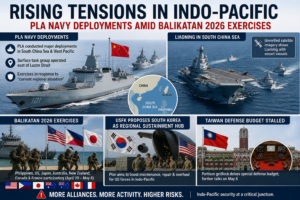
WAR-REPORT: The Indo-Pacific region is witnessing a sharp escalation in military signaling and strategic maneuvering, as the People’s Liberation Army Navy (PLAN) undertakes major deployments across the South China Sea and the western Pacific. These movements are widely interpreted as a calculated response by China to expanding multilateral military cooperation led by the United States and its regional allies.
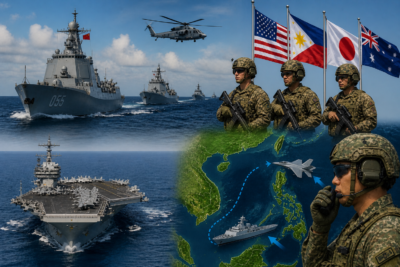
At the center of these developments are the ongoing Balikatan 2026 exercises in the Philippines, which have drawn participation from a growing coalition of countries including Japan, Australia, New Zealand, Canada, and France. Analysts suggest that China’s naval activity is intended not only as a direct response but also as a broader warning that increased alliance coordination in the Indo-Pacific will be met with heightened Chinese military presence.
Dual Naval Deployments: A Strategic Signal
The People’s Liberation Army Navy launched two significant deployments—one in the South China Sea and another in the western Pacific—demonstrating operational reach and readiness.
According to the PLA’s Southern Theater Command, a surface task group conducted exercises east of the Luzon Strait beginning April 24. The task group reportedly included:
- A Type 055 guided missile destroyer
- A Type 052D guided missile destroyer
- A Type 054A guided missile frigate
- A Type 903A replenishment vessel
This combination of high-end combatants and logistical support assets underscores China’s ability to sustain extended naval operations far from its mainland bases.

The PLA described the exercises as a response to the “current regional situation,” a phrase widely interpreted as referring to Balikatan 2026.
Balikatan 2026: Expanding Allied Cooperation
The Balikatan 2026 exercises, held from April 20 to May 8, represent one of the largest and most comprehensive military drills in the region.
Led by the United States and the Philippines, the exercises include participation from:

- Japan
- Australia
- New Zealand
- Canada
- France
Notably, Japan’s active participation marks a significant evolution in its defense posture, reflecting Tokyo’s increasing willingness to engage in collective security operations.
The exercises focus on joint operations, amphibious assaults, air defense, and maritime security, all of which are highly relevant to potential conflict scenarios in the region.
Aircraft Carrier Movements and Strategic Ambiguity
Adding to the complexity of the situation, the PLAN aircraft carrier Liaoning transited the Taiwan Strait on April 20, heading south.
Unverified satellite imagery circulating on Chinese social media suggests that the carrier may have been operating in the South China Sea alongside multiple escort vessels, including guided missile destroyers and frigates. However, official Chinese sources have not confirmed these reports.
The lack of transparency regarding the carrier’s exact location reflects a broader strategy of strategic ambiguity, allowing China to project power while maintaining uncertainty among its adversaries.
South China Sea Drills and Regional Messaging
On April 28, the PLA’s Southern Theater Command announced additional exercises in the South China Sea, accusing the Philippines of attempting to “stir trouble” in the region.
While details about the participating forces were not disclosed, the timing and rhetoric indicate that the drills were intended as both a military demonstration and a political message.
The South China Sea remains one of the world’s most contested maritime regions, with overlapping territorial claims involving multiple countries. China’s continued military activity in the area reinforces its claims and challenges the presence of foreign forces.
Emerging Capabilities: Type 076 Amphibious Assault Ship
Chinese state media also reported that a new amphibious platform, the Type 076 landing helicopter dock, recently departed Shanghai for sea trials in the South China Sea.
This vessel represents a significant enhancement of China’s amphibious warfare capabilities, potentially enabling:
- Rapid troop deployment
- Helicopter-based operations
- Support for expeditionary missions
Its deployment during a period of heightened tensions suggests that China is actively integrating new capabilities into its operational planning.
US Strategy: Strengthening Allied Defense Infrastructure
In parallel with China’s military activities, the United States is advancing efforts to strengthen its network of alliances and defense infrastructure in the Indo-Pacific.
A key component of this strategy involves US Forces Korea (USFK), which may play a central role in mobilizing allied defense industrial bases.
USFK Commander Xavier Brunson has proposed establishing South Korea as a Regional Sustainment Hub (RSH). This concept builds on the Pentagon’s Regional Sustainment Framework, aiming to conduct maintenance, repair, and overhaul operations in allied countries rather than the United States.
South Korea’s Expanding Role
The proposed RSH would significantly expand South Korea’s role in regional defense operations. Currently, South Korea already supports maintenance for certain US aircraft. Under the new framework, this could extend to:
- Naval vessels
- Missile systems
- Unmanned platforms
The initiative aligns with broader US strategic goals outlined in the 2026 National Defense Strategy, which emphasizes enabling allies to take greater responsibility for their own defense.
Policy Shifts in Seoul
The administration of Lee Jae Myung has signaled its willingness to assume a more proactive defense posture.
Key proposals include:
- Transferring wartime operational control (OPCON) from the US to South Korea
- Increasing defense spending to 3.5 percent of GDP
- Developing a nuclear-powered attack submarine
These measures reflect a growing recognition of the need to address evolving security challenges in the region, particularly those posed by China and North Korea.
Taiwan’s Defense Budget Deadlock
While military activity intensifies across the region, Taiwan faces internal political challenges that could affect its defense readiness.
The Legislative Yuan remains deadlocked over a proposed special defense budget aimed at strengthening asymmetric capabilities. Negotiations between major political parties—including the Democratic Progressive Party, Kuomintang, and Taiwan People’s Party—have failed to produce a consensus.
Although there has been some agreement on extending the funding timeline to 2033, disagreements persist over the scope and scale of procurement.
Strategic Implications for the Indo-Pacific
The convergence of these developments highlights several key trends shaping the Indo-Pacific security environment:
1. Intensifying Great Power Competition
The rivalry between United States and China is driving increased military activity and alliance formation.
2. Expanding Multilateral Cooperation
Exercises like Balikatan 2026 demonstrate the growing willingness of regional and extra-regional actors to collaborate on security issues.
3. Military Modernization and Innovation
Both China and the United States are investing in advanced capabilities, from amphibious platforms to logistics networks.
4. Political and Institutional Constraints
Internal challenges, such as Taiwan’s budget deadlock, highlight the complexities of aligning political processes with strategic priorities.
Our Media Opinion: A Region in Transition
The recent naval deployments by the People’s Liberation Army Navy, combined with expanding US-led military cooperation, underscore the rapidly evolving dynamics of the Indo-Pacific.
As regional actors adapt to shifting power balances, the risk of miscalculation and escalation remains a persistent concern. At the same time, efforts to strengthen alliances and enhance operational capabilities suggest a long-term strategic competition that will shape the future of the region.
The coming months will be critical in determining whether these developments lead to greater stability through deterrence—or increased tensions driven by rivalry and mistrust.