



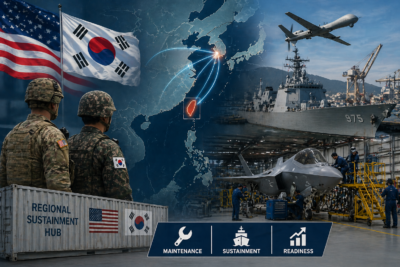
Special Report: The evolving geopolitical dynamics of the Indo-Pacific are reshaping long-standing military alliances and strategic doctrines. At the heart of this transformation lies the increasing importance of United States Forces Korea (USFK), which is now being positioned as a critical pillar in the United States’ broader effort to strengthen allied defense industrial bases and enhance operational readiness in the region.
Recent proposals and policy shifts suggest that South Korea is poised to assume a far more significant role—not only in defending the Korean Peninsula but also in supporting potential contingencies involving Taiwan and deterring the growing influence of the People’s Republic of China.

A Strategic Shift: From Peninsula Defense to Regional Power Projection
For decades, USFK has primarily focused on deterring threats from North Korea. However, the strategic landscape has shifted dramatically in recent years. Rising tensions in the Taiwan Strait, coupled with China’s expanding military capabilities, have compelled Washington to rethink its force posture in Asia.
General Xavier Brunson, commander of USFK, has proposed a transformative concept: establishing South Korea as a Regional Sustainment Hub (RSH). This initiative aligns with the US Department of Defense’s 2024 Regional Sustainment Framework, which emphasizes forward-deployed logistics and maintenance capabilities.

The idea is straightforward yet strategically powerful—rather than sending damaged or worn military equipment back to the United States for repairs, allied nations like South Korea would handle maintenance, repair, and overhaul (MRO) operations locally. This would significantly reduce response times, lower operational costs, and improve battlefield readiness.
South Korea as a Regional Sustainment Hub
South Korea already possesses advanced industrial and technological capabilities, making it a natural candidate for this role. The country has experience maintaining US military aircraft and has a robust defense manufacturing sector.
Under the proposed RSH model, South Korea’s responsibilities would expand to include:

- Maintenance of naval assets, including warships
- Repair and servicing of missile systems
- Support for unmanned systems such as drones
- Logistics coordination for forward-deployed US forces
This transformation would effectively turn South Korea into a logistical backbone for US operations across the Indo-Pacific.
Such a shift is particularly significant in the context of a potential Taiwan contingency. In the event of conflict, rapid repair and redeployment of military assets could prove decisive. Having a forward-based sustainment hub would allow US forces to maintain operational tempo without the delays associated with trans-Pacific logistics.
Alignment with the 2026 National Defense Strategy
The proposal to elevate South Korea’s role is closely tied to the United States’ 2026 National Defense Strategy (NDS). The document outlines a clear objective: enabling allies to take primary responsibility for their own defense while the US focuses on strategic deterrence—particularly against China.
Former US Under Secretary of Defense for Policy Elbridge Colby has been a vocal advocate of this approach. He has argued that USFK must be reoriented to address broader regional threats beyond North Korea, including the strategic challenge posed by China.
This vision represents a shift from a US-centric security model to a more distributed and collaborative framework, where allies play a central role in maintaining regional stability.
South Korea’s Policy Response Under Lee Jae Myung
The administration of Lee Jae Myung has responded proactively to these strategic developments. Recognizing the changing security environment, the government has proposed a series of ambitious defense initiatives aimed at strengthening South Korea’s military capabilities and autonomy.
Key proposals include:
- Increasing defense spending to 3.5% of GDP
- Accelerating the transfer of wartime operational control (OPCON)
- Developing an indigenous nuclear-powered attack submarine (SSN) program
- Expanding domestic defense manufacturing capabilities
These measures signal South Korea’s willingness to take on a larger role within the US-led alliance framework.
The OPCON Transition: A Milestone in Military Sovereignty
One of the most significant aspects of this evolving partnership is the planned transfer of wartime operational control (OPCON) from the United States to South Korea.
Currently, in the event of war, operational command of South Korean forces would be led by US commanders. However, both countries are now working toward transferring this authority to South Korea by the late 2020s.
General Xavier Brunson confirmed that USFK has submitted a detailed roadmap to the Pentagon outlining the requirements for completing the OPCON transfer by the second quarter of the 2029 fiscal year. He noted that the timeline is “in a good position,” although additional investments in defense capabilities will be necessary.
The Ministry of National Defense has indicated that the final timeline will be formalized during the annual Security Consultative Meeting (SCM) scheduled for October 2026.
Once completed, the OPCON transfer will mark a historic shift, positioning South Korea as the lead authority in combined defense operations on the Korean Peninsula.
Implications for a Taiwan Contingency
While the OPCON transition primarily concerns the Korean Peninsula, its implications extend far beyond. A more autonomous and capable South Korean military could play a critical role in supporting US operations in a Taiwan contingency.
However, this possibility introduces significant political and strategic complexities.
South Korea has traditionally maintained a position of “strategic ambiguity” regarding cross-Strait relations. This cautious stance reflects the country’s deep economic ties with China, which remains one of its largest trading partners.
Any overt involvement in a Taiwan-related conflict could risk severe economic repercussions.
China’s Economic Leverage and Strategic Pressure
The People’s Republic of China has previously demonstrated its willingness to use economic tools to influence South Korean policy decisions. A notable example occurred in 2017, when China imposed informal economic sanctions on South Korea following the deployment of the US-provided Terminal High Altitude Area Defense system.
These measures included restrictions on tourism, limitations on Korean businesses operating in China, and broader trade disruptions.
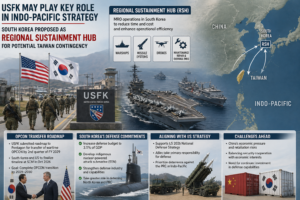
Given this precedent, analysts believe that China could again apply economic pressure if South Korea were to actively support US operations related to Taiwan.
Naval Capabilities and the Push for Nuclear Submarines
Another critical dimension of South Korea’s defense strategy is its naval modernization program. President Lee Jae Myung has emphasized the limitations of the country’s existing diesel-electric submarine fleet, particularly in terms of endurance and operational range.
To address these challenges, the administration has proposed developing nuclear-powered attack submarines (SSNs). These vessels would offer significantly greater endurance, allowing South Korea to monitor and counter submarine activities by both North Korea and China more effectively.
Such capabilities would not only enhance national defense but also contribute to broader regional security objectives aligned with US strategy.
Industrial and Economic Dimensions of Defense Cooperation
The establishment of South Korea as a Regional Sustainment Hub is not just a military initiative—it also carries substantial economic implications.
By expanding its role in MRO operations, South Korea could:
- Boost its defense industry
- Create high-skilled jobs
- Strengthen technological capabilities
- Increase exports of defense equipment and services
This aligns with the broader goal of building resilient and interconnected defense industrial bases among US allies.
Challenges and Strategic Trade-offs
Despite the clear benefits, the proposed transformation is not without challenges.
South Korea faces a delicate balancing act:
- Security vs. Economy: Strengthening military ties with the US may strain relations with China.
- Autonomy vs. Alliance Dependence: Greater independence in defense operations must be balanced with maintaining strong alliance coordination.
- Domestic Politics: Public opinion and political debates may influence the pace and scope of defense reforms.
These factors will play a crucial role in shaping the future trajectory of US-South Korea cooperation.

A New Era of Alliance Dynamics
The deepening integration of US and South Korean defense strategies reflects a broader trend in global security architecture. As threats become more complex and interconnected, traditional alliance models are evolving toward more flexible and distributed frameworks.
The concept of a Regional Sustainment Hub exemplifies this shift—leveraging the strengths of allied nations to create a more agile and resilient military network.
Our Media Opinion: Strategic Transformation in Motion
The repositioning of United States Forces Korea as a central node in Indo-Pacific defense strategy marks a pivotal moment in regional geopolitics. Through initiatives such as the Regional Sustainment Hub and the OPCON transfer, South Korea is stepping into a more prominent role as both a military and industrial partner.
As the United States seeks to deter the rising influence of the People’s Republic of China, the success of this partnership will depend on careful coordination, mutual trust, and strategic foresight.
The coming years will determine whether this evolving alliance can effectively balance deterrence, stability, and economic interests in one of the world’s most strategically vital regions